
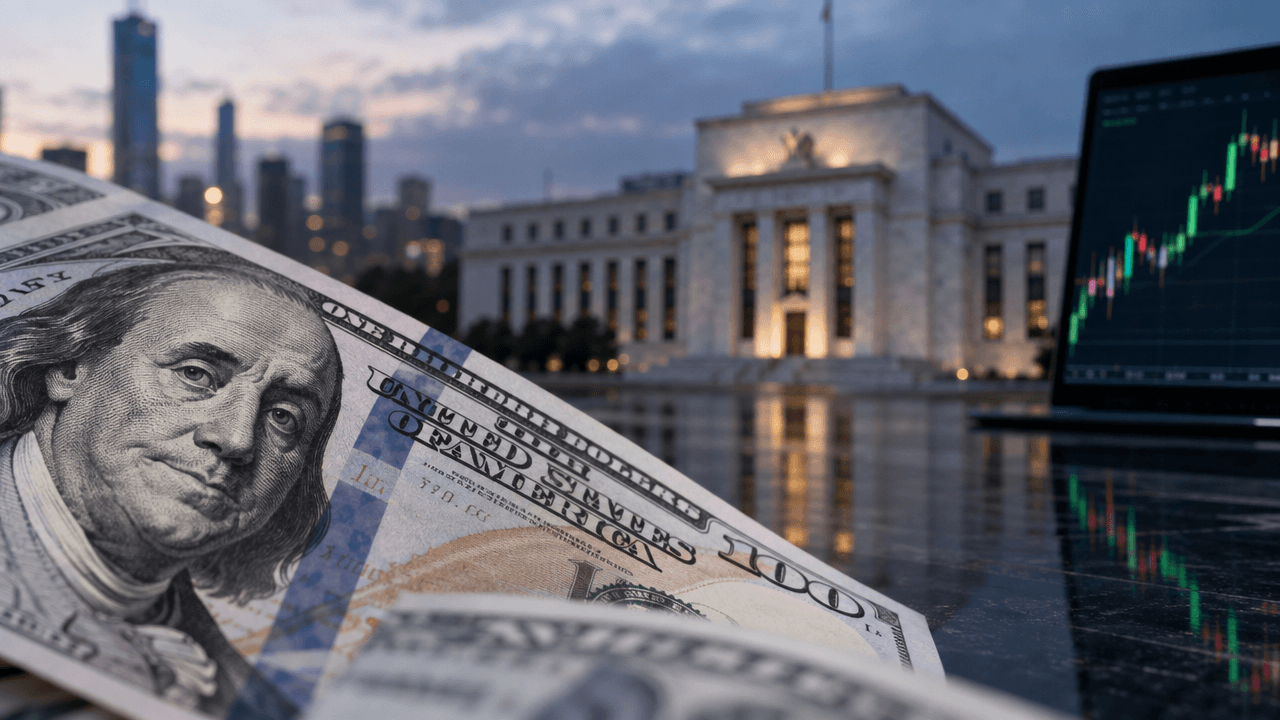
The dollar’s latest firming trend is a reminder that foreign exchange markets are as much about expectations as they are about current data.[2][14] As traders wait for the Federal Reserve’s minutes, higher U.S. Treasury yields are tightening financial conditions and nudging investors toward the relative safety of the greenback.[2][5] For both real-money and simulated traders, this is a textbook moment to study how shifts in rate expectations translate into currency moves and risk sentiment.[4][15]
Markets Poised For Fed Clarity
In the run-up to the release of Federal Open Market Committee (FOMC) minutes, markets typically reduce risk and increase hedges, especially when the policy outlook feels uncertain.[2][14] The current environment reflects that pattern: U.S. yields have drifted higher as investors price in the possibility that rates may stay restrictive for longer, and the dollar has edged up against a broad basket of currencies.[2][4][5] This combination often signals a “wait-and-see” stance rather than outright risk-off panic.
The minutes themselves rarely deliver a shock; instead, they refine the market’s understanding of the Fed’s reaction function.[4][8] Recent minutes have highlighted how expected policy rates and Treasury yields move in tandem as participants reassess inflation, growth, and financial stability risks.[4][5] Even modest changes in language around “higher for longer” or concerns about financial conditions can generate outsized moves in FX, particularly when positioning is stretched.
For context, the dollar’s path over the last two years has been choppy but ultimately resilient.[15] After a 9.4% decline in the U.S. Dollar Index in 2025, it rebounded about 1.7% through mid-August 2026 as markets reassessed the relative strength of the U.S. economy and interest-rate differentials.[15] The current firming ahead of the minutes fits that narrative of a dollar that tends to regain traction whenever rate uncertainty resurfaces.
Why Higher Yields Support The Dollar
The mechanics linking Treasury yields and the dollar are straightforward but powerful. When U.S. yields rise, dollar-denominated assets offer better compensation for risk, attracting global capital and lifting the currency.[5][15] Fed minutes often reinforce this dynamic by signaling whether policymakers see more work ahead in containing inflation or whether they are edging closer to a pause.[4][5] A more hawkish tilt tends to push yields and the dollar higher; a more dovish read does the opposite.[2][12]
Interest-rate differentials are key. If U.S. short-term rates look set to remain above those of other advanced economies, the dollar gains a structural tailwind.[5][8] Previous FOMC minutes have documented periods when the broad dollar index rose specifically because U.S. short-term rates widened relative to those in other major markets.[5][8] That same logic is in play now as traders reassess the odds of future hikes or a later-than-expected easing cycle.
For E8 Markets users operating in a simulated environment, this is an ideal time to model how different yield scenarios affect FX pairs. Building playbooks that map “higher yields, stronger dollar” and “lower yields, softer dollar” regimes forces traders to think in terms of cause and effect rather than simple price patterns. That discipline tends to translate well into real-world decision-making.
Impact On Risk-sensitive Currencies And Assets
Risk-sensitive currencies—such as the New Zealand dollar, Australian dollar, and many emerging-market currencies—often feel the pressure when the dollar firms and U.S. yields rise.[14][2] Recent moves in the New Zealand dollar ahead of the FOMC minutes show that investors are quick to rotate away from higher-beta FX when global financial conditions tighten.[14] This behavior reflects a classic “risk premium” adjustment: when funding costs rise, investors demand more compensation to hold volatile assets.
Equities and credit markets are part of the same story. Fed minutes that emphasize persistent inflation or the need for restrictive policy can weigh on stocks and corporate bonds, reinforcing a bid for the dollar and other safe-haven assets.[4][5] Conversely, if the minutes hint at growing concern over financial stability or slowing growth, markets may start to price a gentler path for rates, easing the pressure on risk assets and high-beta currencies.[4][12]
For simulated traders, watching how cross-asset correlations evolve around the release is as valuable as trading the FX moves themselves. When bonds sell off, the dollar rallies, and equities wobble, it becomes easier to see how macro narratives connect. Capturing these relationships in a simulated portfolio helps traders refine strategies that are robust across multiple asset classes.
How Traders Can Navigate Fed Minutes Events
Events like FOMC minutes releases are ideal training grounds for process-driven trading. In both live and simulated markets, disciplined traders tend to follow a three-step framework: prepare, observe, and adapt. Preparation means mapping scenarios—hawkish, balanced, or dovish—and defining how you expect dollar, yields, and risk assets to react under each path.[2][4] This lays the groundwork for objective decision-making once the text hits the tape.
Observation is about tracking the initial reaction without over-committing. Professional traders often watch the first 15–30 minutes of price action in the dollar index, key FX pairs, and Treasury yields before adjusting positions.[2][5] Spikes that fade quickly may indicate an overreaction, while sustained moves often reflect a genuine shift in consensus. In a SimFi environment, this is an ideal moment to compare your scenario map with actual market behavior and identify where your expectations diverged.
Adaptation comes next. If the minutes lean more hawkish than expected and the dollar breaks higher alongside yields, trend-following or carry-oriented strategies may gain appeal.[4][5] If the tone is more cautious, suggesting increased sensitivity to growth risks, mean-reversion or risk-on strategies in high-beta currencies and equities might offer better opportunities.[4][12] The key is to treat the minutes not as a one-off event, but as an update to the macro backdrop that should feed into your ongoing risk management and portfolio design.
Key Takeaways For Simulated Finance Traders
First, understand that a firming dollar ahead of Fed minutes reflects the market’s desire for clarity on the future path of rates and financial conditions.[2][4] This is less about a single data point and more about the cumulative impact of inflation, growth, and policy signals. Second, recognize that rising U.S. yields are a primary driver of dollar strength, particularly when rate differentials move in the dollar’s favor.[5][8]
Third, appreciate the knock-on effects on risk-sensitive currencies and assets, which often underperform when financial conditions tighten and the dollar is in demand.[2][14] Finally, use a simulated environment to practice building scenarios, stress-testing strategies, and refining your reaction function around scheduled macro events. Doing this consistently can turn a complex news flow into structured, repeatable decision-making.