
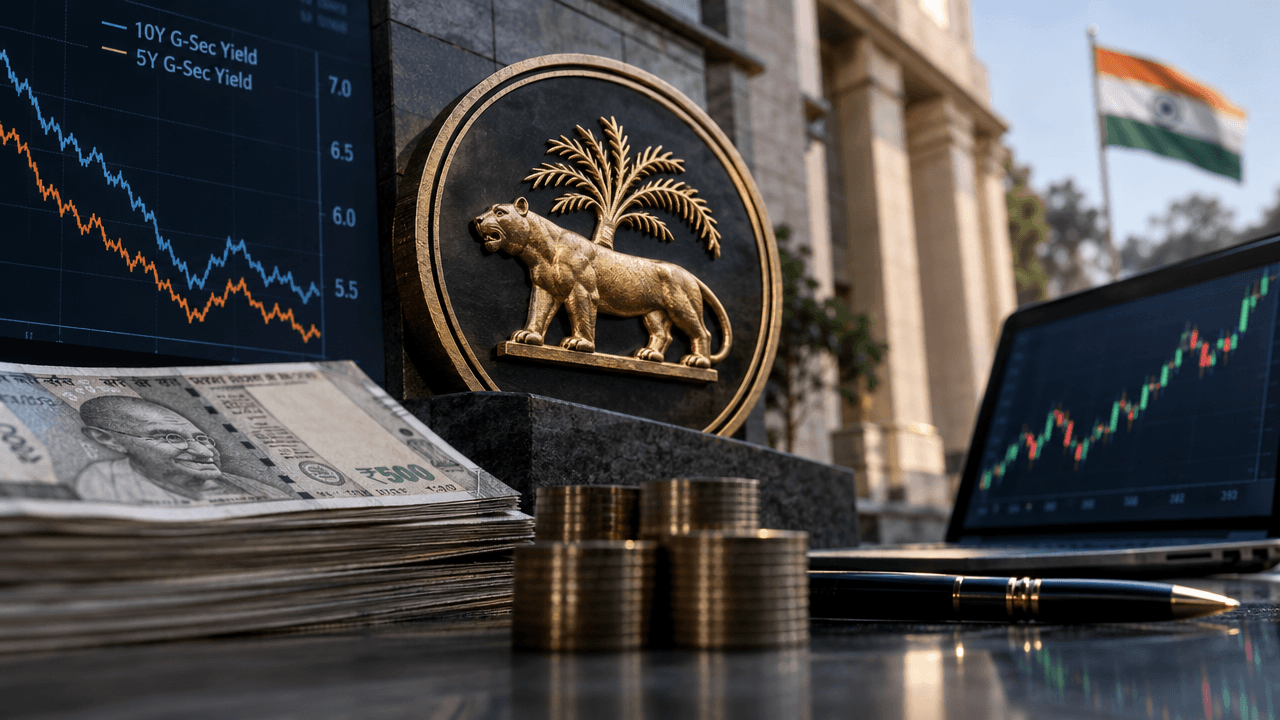
The Reserve Bank of India’s upcoming monetary policy decision is shaping up as one of the most closely watched events in emerging markets, with economists split on whether the central bank will deliver India’s first rate hike since 2023 or hold steady. A 25 basis point increase in the repo rate to 5.50% would signal a clear pivot back toward tightening, driven by rising inflation risks, higher oil prices and pressure on the rupee and Indian bond markets. For traders, this is not just a macro headline—it is a regime-change moment that can redefine trends across currencies, rates and equities.
Macro Backdrop: Why The Rbi Is Under Pressure
Since cutting the repo rate from 5.50% to 5.25% in December 2025, the RBI has opted for continuity, keeping the benchmark rate unchanged through its February, April, June and August 2026 policy reviews.[9][10][11][12] This period of stability has been accompanied by a broadly neutral stance, with policymakers signaling a data-dependent approach as they monitor evolving inflation and growth dynamics.[9][10][11]
That macro backdrop is now shifting. Rising global oil prices are a double blow for India: they push up import costs and widen the current account deficit, while feeding directly into domestic inflation via fuel and transportation costs. At the same time, geopolitical uncertainty and tighter global financial conditions are contributing to volatility in capital flows, putting additional pressure on the rupee and local bond yields.[9][14] In this context, a rate hike becomes one of the RBI’s most direct tools to anchor inflation expectations and support the currency.
What A 25 Bps Hike Could Mean For Markets
If the RBI raises the repo rate by 25 basis points to 5.50%, the immediate impact will be felt in the short end of the yield curve. Money market rates and short-dated government bond yields are likely to adjust higher, reflecting the new policy rate and the potential for further tightening if inflation remains elevated. Bond prices, particularly for shorter maturities, would tend to move lower as yields rise.
For the rupee, a hike could provide near-term support by improving interest rate differentials and signaling a stronger commitment to price stability. Higher rates can make rupee assets more attractive to foreign investors, helping to counteract outflows triggered by global risk-off episodes or rising U.S. yields. However, the currency reaction will depend heavily on the RBI’s guidance: a one-off hike accompanied by cautious language may have a more modest impact than a move framed as the first step in a new tightening cycle.
Equity markets tend to react in a more nuanced way. Banks and financials may benefit from wider net interest margins over time, but higher funding costs can weigh on credit growth, especially in interest-sensitive segments like consumer loans and real estate. Rate-sensitive sectors—such as autos, housing and discretionary consumption—could see increased volatility as investors reassess earnings trajectories and valuations. For active traders, the key is to understand not just the immediate knee-jerk reaction, but the path markets may follow over the next few weeks as positioning and expectations adjust.
Scenario Analysis: Hike Vs Hold
Effectively trading a central bank event requires a clear view of the main scenarios. In this case, three are particularly relevant:
1) 25 BPS HIKE, HAWKISH TONE The RBI raises the repo rate to 5.50% and emphasizes inflation risks, oil-led pressures, and the need to stay vigilant. This scenario could see the rupee strengthen, short-end yields rise sharply, and rate-sensitive equities under pressure. Volatility might spike, but the narrative would be one of policy credibility and inflation control.
2) 25 BPS HIKE, CAUTIOUS OR NEUTRAL TONE Here, the RBI moves but stresses that future action will be data-dependent, avoiding any explicit commitment to a tightening cycle. Markets might view this as a “fine-tuning” move rather than a major shift. Reaction could be more muted: modest rupee support, a controlled rise in yields, and equity markets oscillating as they digest mixed signals.
3) NO HIKE, DATA-DEPENDENT HOLD If the RBI keeps the repo rate at 5.25%, reiterating its neutral stance and focusing on growth risks, markets could initially interpret this as dovish relative to expectations. The rupee might face renewed pressure, and bond yields could adjust higher if investors worry that the central bank is “behind the curve” on inflation. Conversely, equities may welcome the absence of immediate tightening, especially in domestically focused sectors.[9][10]
Using Simulated Finance To Prepare For The Decision
For traders on a SimFi platform like E8 Markets, this RBI event is a textbook opportunity to practice structured scenario planning and risk management without real-world capital on the line. Rather than trying to predict the outcome with certainty, the focus should be on building robust trading plans for each of the key scenarios.
Start by mapping the likely reaction across asset classes—USD/INR, Indian government bond futures, bank stocks, and broader indices. Define entry and exit levels, position sizes and stop-loss rules for a hike versus a hold. Then, run these strategies in the simulated environment to test how they perform under different volatility profiles and news flows.
Equally important is tracking how expectations evolve before the decision. Changes in implied volatility, yield curve positioning, and FX risk reversals can all provide clues about market sentiment. Simulated trading allows you to experiment with trades that express these views—such as relative-value plays between short and long-dated bonds, or options strategies that benefit from volatility spikes—while building a disciplined framework you can later apply to live markets.
Practical Takeaways For Traders
As the RBI decision approaches, traders and SimFi participants can focus on a clear checklist:
- Know the baseline: understand the current repo rate, recent policy history and the RBI’s stated stance.[9][10][11][12]
- Clarify your scenarios: define what “hawkish” and “dovish” outcomes look like in terms of both the rate move and the language.
- Identify key instruments: map which markets are most sensitive—rupee pairs, short-term bonds, bank stocks, rate-sensitive sectors.
- Plan risk, not just direction: size positions conservatively around event risk, and use stops and profit targets informed by historical volatility.
- Use SimFi to rehearse: treat the simulated environment as a laboratory for testing strategies, refining execution, and reducing emotional bias before trading real capital.
Conclusion
Whether the RBI delivers India’s first rate hike since 2023 or opts for another hold, this decision will help define the next phase of India’s monetary and market cycle. A move to 5.50% would mark a clear response to mounting inflation and external pressures, with implications that ripple through the rupee, bonds and equities. Even a status-quo decision would carry significant information about how the central bank balances growth and price stability. For traders—especially those leveraging simulated finance tools—the real edge lies not in guessing the outcome, but in preparing systematically for all plausible scenarios and turning a major policy event into a structured learning and trading opportunity.