
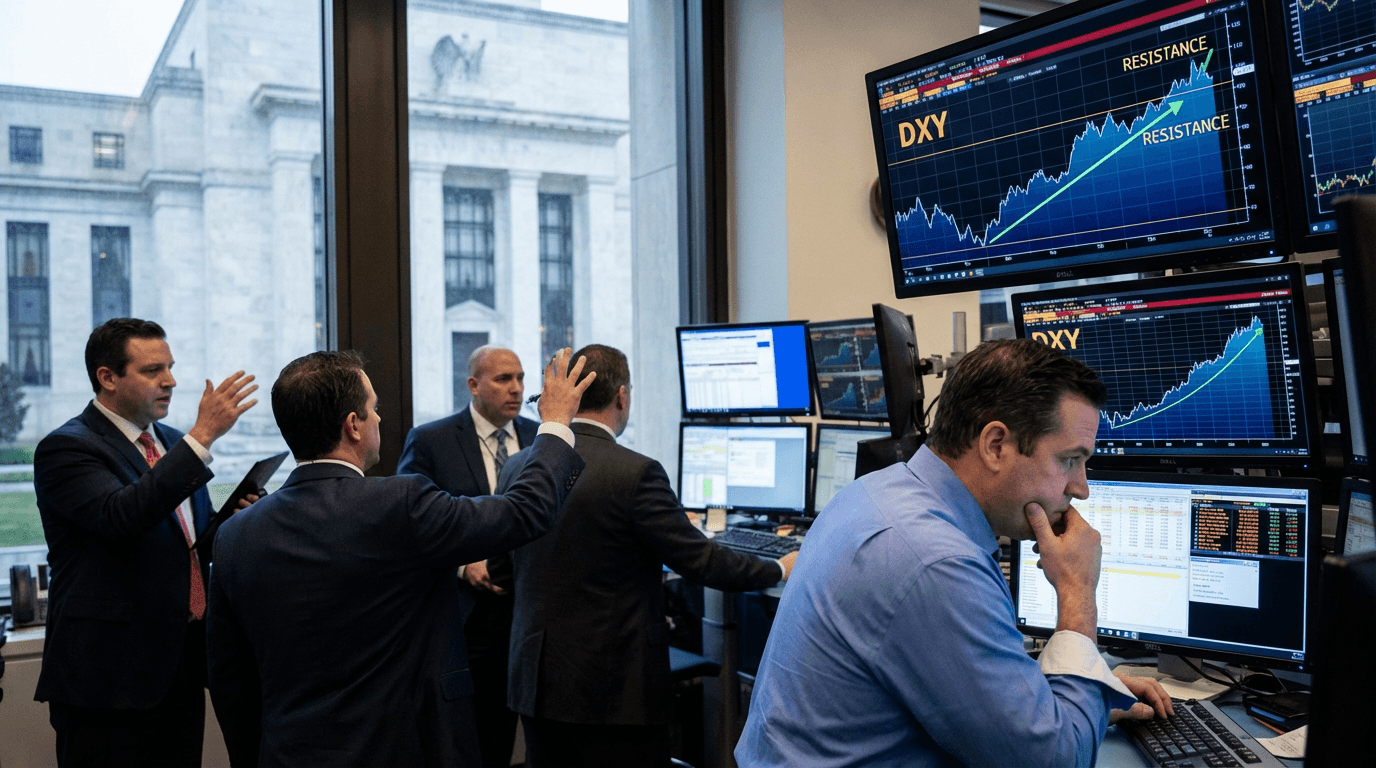
The U.S. dollar has regained modest momentum in recent trading sessions, with the Dollar Index (DXY) advancing 0.19% to reach 97.88 as of February 26, 2026. This uptick reflects renewed strength in the greenback, driven primarily by shifting expectations around Federal Reserve policy and the market's reassessment of near-term monetary conditions. While the advance may appear modest on the surface, it represents a meaningful shift in sentiment after weeks of consolidation and marks a critical inflection point for traders monitoring currency markets and their cross-asset implications.
What's Driving The Dollar's Recovery
The current strength in the U.S. dollar stems largely from hawkish sentiment surrounding the Federal Reserve's policy trajectory. Recent commentary from Fed officials has shifted toward a more cautious stance on rate cuts, with policymakers signaling that interest rates may remain elevated for an extended period. Fed officials Susan Collins and Thomas Barkin have both emphasized that holding rates steady is appropriate given an improving labor market alongside persistent inflation risks. This hawkish tilt has repositioned the dollar as an attractive asset for yield-seeking investors and has reinforced expectations that the Fed may not aggressively ease monetary policy in the near term.
The reversal also reflects broader dynamics in real yields. Rising expectations around sticky inflation and stable policy rates have supported U.S. Treasury yields, which in turn have strengthened the dollar's appeal relative to other major currencies. The DXY's advance to 97.88 demonstrates that despite a significant weakening cycle throughout 2025—when the dollar fell 8.21% over the 12-month period—renewed opportunities are emerging for dollar bulls.
Technical Picture: Breaking Out Of Consolidation
From a technical perspective, the DXY has spent the better part of the past several months trapped in a well-defined consolidation range between 96.00 and 102.00. The index repeatedly tested the upper boundary near 102.00 without sustaining a breakout, only to bounce defensively at the 96.00 support level multiple times. This range-bound behavior created confusion for traders seeking directional clarity, but the current advance suggests momentum may be shifting.
At 97.88, the DXY is now testing the intermediate resistance zone near 99.50 to 100.00. A sustained move above this level would open the door toward the major structural resistance at 101.90 to 102.00. According to technical analysis, a clean daily close above 102.00 would signal a genuine breakout and potentially initiate a larger trend reversal to the upside. The current rally has an estimated probability of success around 40% according to market technicians, with sideways consolidation between 96 and 100 carrying a 35% probability and a bearish breakdown below 96 estimated at 25%.
The short-term momentum indicators support the bullish scenario. The Relative Strength Index (RSI) has rebounded from oversold levels and now sits comfortably above 50, indicating that buying pressure has returned. This technical alignment between price action and momentum creates a constructive backdrop for further strength, provided key support levels continue to hold.
Implications For Currency Pairs And Traders
The strength in the broad dollar index has manifested across specific currency pairs, most notably USD/JPY, which rallied to two-week highs near 156.28. However, this advance encountered resistance from intervention concerns, a persistent theme whenever yen pairs rise sharply. Japanese authorities have historically intervened to weaken the yen during aggressive rallies, and market participants remain vigilant for such moves. This dynamic creates a ceiling for near-term JPY weakness, even as dollar strength persists.
For traders, the current environment presents both opportunities and risks. The dollar's strength typically benefits U.S. exporters, pressures commodity prices, and can create headwinds for emerging market assets. Conversely, a weakening dollar scenario would reverse these dynamics, providing relief to commodity-dependent economies and supporting emerging market currencies. Understanding which scenario materializes hinges on whether the DXY can sustain momentum above 99.50 or rolls back toward support.
Key Factors To Monitor
Several catalysts will determine the dollar's path forward. Federal Reserve communications remain paramount—any dovish surprise or signals of faster rate cuts would immediately weaken the dollar, while hawkish rhetoric would reinforce strength. Inflation data, particularly CPI and PCE readings, will also influence rate expectations and therefore currency valuations. Additionally, U.S. Treasury yields warrant close attention, as rising real yields tend to support the dollar while falling yields pressure it.
Risk sentiment represents another critical variable. In risk-off environments, the dollar typically strengthens as a safe-haven asset, while risk-on appetite can weaken it. Finally, any shifts in monetary policy from other central banks, particularly the European Central Bank or Bank of Japan, could influence relative dollar strength through comparative yield dynamics.
Looking Ahead
The current advance in the DXY to 97.88 represents a potential inflection point after months of range-bound consolidation. Whether this develops into a sustained breakout or merely a tactical bounce depends on the interplay between Fed policy expectations, inflation dynamics, and broader risk sentiment. For traders, the key levels to watch remain 99.50 to 100.00 for intermediate resistance and 96.00 to 96.50 for critical support. As the quarter progresses, clarity on these technical barriers will likely emerge, setting the stage for the next major directional move in the world's most important currency.