
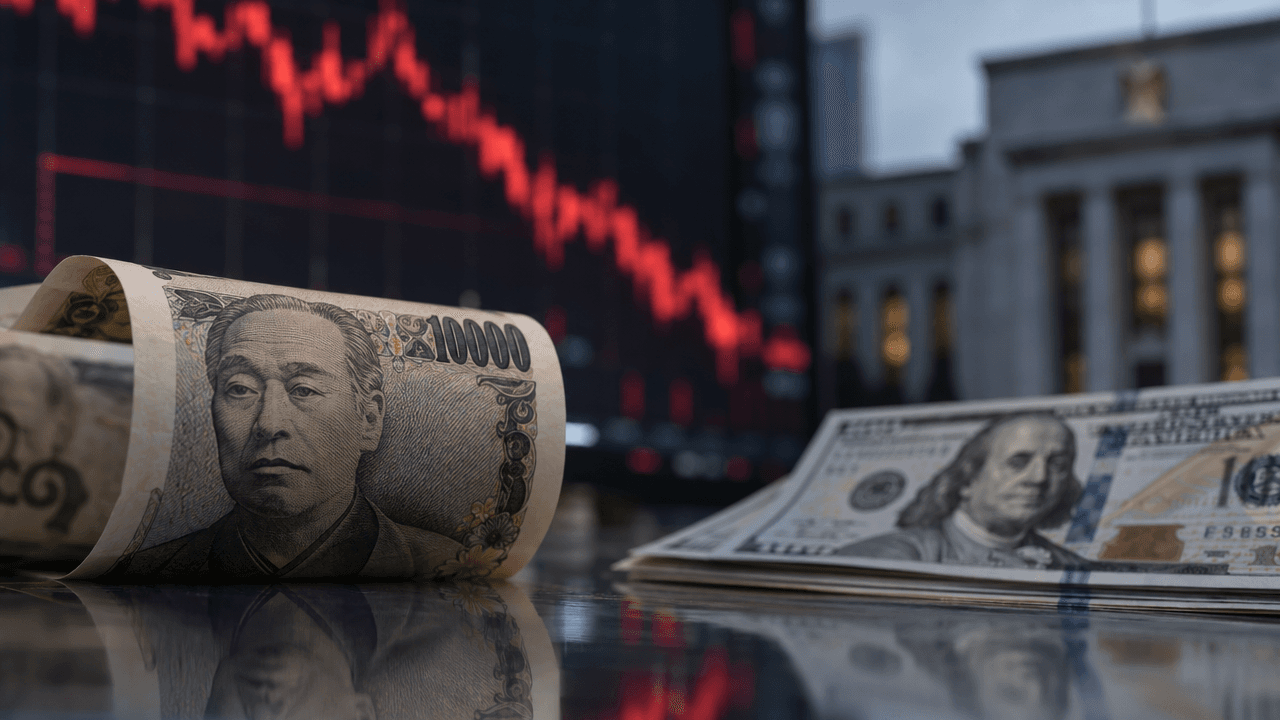
The dollar is holding broadly steady while the Japanese yen strengthens, revealing an important shift in how investors are responding to renewed market stress. A sharp equity selloff, led by technology and artificial-intelligence shares, has encouraged traders to reduce exposure to riskier assets and seek traditional havens. The yen rose to a one-week high near 157.40 per dollar before giving back part of its advance, while the dollar remained supported against several major currencies. [1]
The move is not a straightforward dollar rally or a broad-based yen recovery. Instead, it reflects competing forces: the dollar benefits from its reserve-currency status and deep Treasury market, while falling U.S. yields are reducing the interest-rate advantage that normally supports the greenback. At the same time, the yen is attracting demand because it has historically performed well when investors unwind risky positions.
Why Risk Aversion Is Supporting The Yen
Currency markets often react to changes in risk appetite before economic data confirms a trend. When stocks fall sharply, investors commonly reduce positions in equities, emerging-market currencies, commodity-linked currencies, and other assets that perform well during periods of optimism. Capital then moves toward assets perceived as safer, including government bonds, the U.S. dollar, the Swiss franc, and the Japanese yen.
The yen has an additional feature that makes it especially sensitive to market turbulence. For years, Japan’s relatively low interest rates encouraged investors to borrow yen and purchase higher-yielding assets elsewhere. This strategy, often called the carry trade, can generate returns while markets are calm. However, when volatility rises, traders may close those positions. Buying back yen to repay loans can accelerate the currency’s gains.
Recent market commentary has also pointed to expectations that the Bank of Japan may continue normalizing policy. Minutes from the central bank reinforced expectations of further normalization, providing the yen with support beyond its traditional haven role. [7]
Why The Dollar Is Not Rallying More Strongly
The U.S. dollar generally benefits from risk aversion because international investors often seek the liquidity of U.S. markets. Yet this episode demonstrates why the dollar’s safe-haven performance is not automatic.
The key issue is the bond market. Investors seeking safety have been buying Treasuries, pushing their prices higher and yields lower. The two-year Treasury yield, which is particularly sensitive to expectations for Federal Reserve policy, fell by roughly 10 basis points during the market turmoil. The 10-year yield also declined as investors repositioned for slower growth or softer interest-rate expectations. [11]
Lower yields can weaken the dollar’s appeal because they reduce the return available to investors holding dollar-denominated assets. If traders believe the Federal Reserve will have less need to maintain restrictive policy, expectations for future U.S. rates may fall as well. That can offset the greenback’s normal haven advantage.
This explains the current divergence: the dollar is stable because it remains highly liquid and widely demanded, but the yen is gaining more visibly because it is benefiting from both defensive positioning and the unwinding of leveraged trades.
The Technology Sell-off And Market Confidence
Technology shares have been central to the latest risk-off move. Investors have become more cautious about valuations across the artificial-intelligence sector, particularly after a period of strong gains and heavy spending on chips, data centers, and related infrastructure.
The concern is not necessarily that artificial intelligence lacks long-term potential. Rather, markets are questioning whether projected earnings growth will justify the scale of current valuations and capital expenditure. Earlier selloffs were intensified by disappointing results and doubts about whether massive AI investment would generate adequate returns. More recently, concerns about political scrutiny of AI and data-center expansion have added another source of uncertainty. [9]
When highly valued technology shares decline, the effect can spread beyond the stock market. Equity losses may reduce investor confidence, raise volatility, and trigger portfolio rebalancing. Fund managers may sell positions that performed well and increase allocations to cash, government bonds, or defensive currencies. The resulting currency moves can therefore become larger than the original stock-market event might suggest.
What Traders Should Watch Next
The next phase of the dollar-yen move will depend on whether the equity selloff stabilizes or becomes a broader deterioration in risk sentiment. A rebound in technology stocks could reduce demand for the yen and encourage investors to rebuild carry-trade positions. Conversely, another sharp decline in equities could push USD/JPY lower as traders seek protection and unwind leverage.
U.S. economic data will remain important, particularly employment figures and indicators that influence Federal Reserve expectations. Strong payroll growth could lift Treasury yields and restore some of the dollar’s interest-rate support. Weak data could reinforce expectations of easier policy, keeping yields lower and allowing the yen to remain the stronger haven.
Traders should also monitor the yield spread between U.S. and Japanese government bonds, Bank of Japan communication, and movements in equity volatility. Currency strength based only on temporary panic can fade quickly, while a move supported by changing interest-rate expectations may prove more durable.
Practical Takeaways For Simfi Traders
First, do not treat every risk-off session as a simple dollar-buying opportunity. The dollar and yen can both benefit from fear, but falling U.S. yields may favor the yen in a U.S.-centric equity shock.
Second, watch price relationships rather than one headline. A falling USD/JPY rate combined with lower Treasury yields and weaker technology shares would confirm that defensive flows are influencing the market.
Third, manage position size carefully around major data releases. Payrolls and central-bank signals can reverse currency moves rapidly, especially when traders are already positioned for a particular outcome.
Finally, separate market direction from market volatility. A compelling fundamental narrative does not eliminate the risk of sudden countertrend moves. In a simulated trading environment, using predefined stops, modest leverage, and scenario-based planning can help test a strategy without allowing one unexpected headline to dominate the entire account.
Conclusion
The dollar’s stability and the yen’s advance illustrate how interconnected markets respond when confidence weakens. Falling technology shares are encouraging investors to reduce risk, while Treasury buying is lowering yields and limiting the dollar’s safe-haven gains. The yen, meanwhile, is benefiting from defensive demand, carry-trade unwinding, and expectations of further Bank of Japan normalization.
For traders, the central lesson is that currencies are shaped by several forces at once. Equity momentum, bond yields, central-bank expectations, and positioning can all pull in different directions. Understanding those relationships is more valuable than reacting to a single headline—and it can provide a clearer framework for navigating the next major market move.