
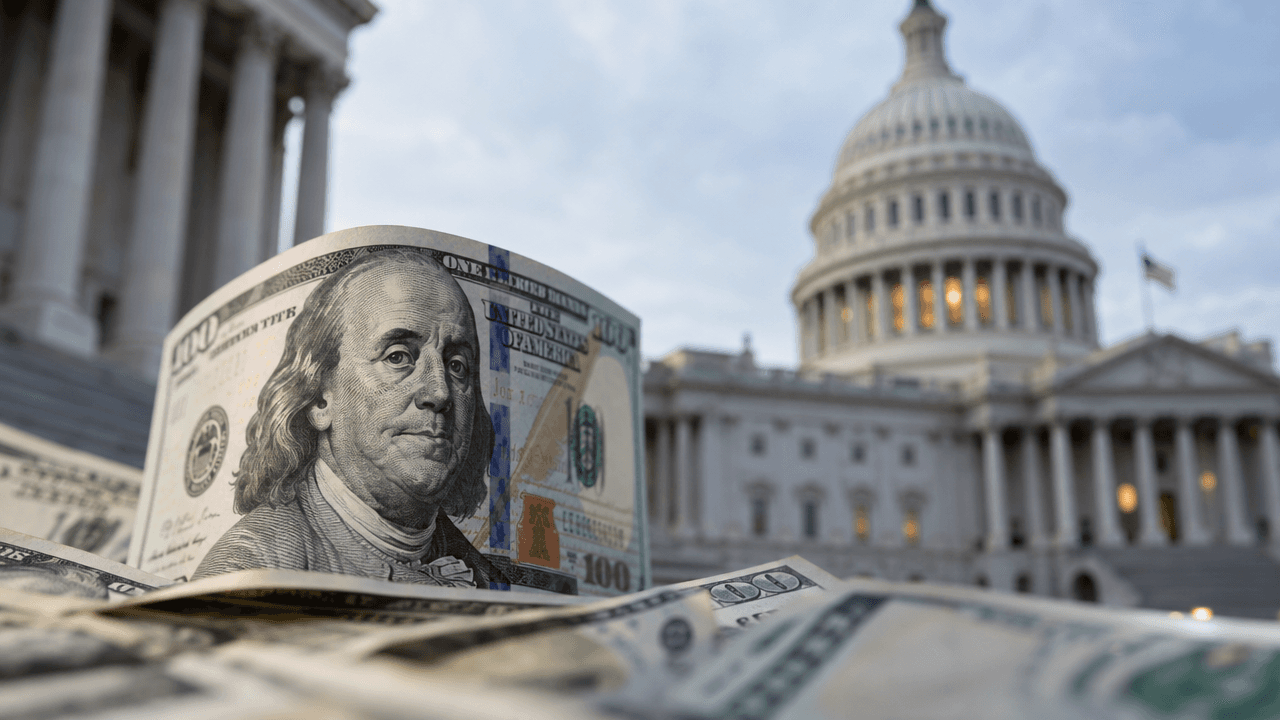
The U.S. dollar is holding in a narrow range as traders await the outcome of the U.S. midterm elections and assess what a potential shift in congressional power could mean for fiscal policy. The dollar index was steady near 101.94, reflecting a market that is cautious rather than strongly committed to a directional bet. [1]
The election has become the central short-term catalyst for foreign exchange markets. Control of Congress could influence government spending, tax policy, debt-ceiling negotiations, regulation, and the risk of a government shutdown. Yet investors are not pricing in a dramatic move before the result is known. Instead, many are reducing exposure and waiting for greater clarity.
For SimFi traders, this is an important reminder that markets can remain quiet before a major event and become highly volatile immediately afterward. A narrow trading range does not necessarily signal low risk. It can represent compressed uncertainty, with potential for a sharp breakout once the political outcome is confirmed.
THE DOLLAR’S WAIT-AND-SEE MARKET
The dollar’s stability reflects several competing forces. On one side, the U.S. currency continues to benefit from its role as a major reserve currency and from relatively high U.S. interest rates. On the other, traders are concerned that an unexpected election result could change expectations for government borrowing, economic growth, and Federal Reserve policy.
A Republican hold could be interpreted as supportive for the dollar if investors expect continuity in fiscal policy and fewer obstacles to government spending decisions. A Democratic sweep, by contrast, could raise concerns about political gridlock, debt-ceiling negotiations, or a possible government shutdown, depending on how markets interpret the likely policy direction. Some analysts also see the possibility of a Democratic sweep as negative for the dollar because it could weigh on risk sentiment and technology-related investment. [7][11]
A divided government would create its own interpretation. Historically, gridlock can sometimes reassure investors by reducing the likelihood of major policy changes. However, it can also make routine fiscal decisions more difficult. The immediate market reaction will depend less on the political label and more on whether the result is viewed as predictable, credible, and manageable.
Euro Remains Under Pressure
The euro remained near a 17-month low around 1.1159 U.S. dollars. The common currency has faced additional pressure after Fitch revised its outlook for France from stable to negative, increasing investor attention on fiscal conditions within the euro area. [1][8]
A weaker euro can reinforce the appearance of broad dollar strength, even when the dollar itself is not making a major move against every currency. The EUR/USD pair is particularly important because it is the most actively traded currency pair and has significant influence on the dollar index.
For traders, the area around 1.1159 represents a closely watched reference point rather than a guaranteed support level. If the euro breaks lower after the election, traders may interpret that as confirmation of continued dollar demand. A rebound could indicate that investors had already priced in much of the negative news and are taking profits on existing dollar positions.
Technical levels should not be considered in isolation. A move through a prior low has greater significance when accompanied by higher trading volume, stronger momentum, or a clear change in interest-rate expectations.
Yen Weakness Signals Rate And Policy Tensions
The yen weakened approximately 0.15% to 157.78 per dollar, leaving USD/JPY close to levels that have attracted considerable market attention. [1] The pair reflects more than election risk. It also captures the interest-rate gap between the United States and Japan, expectations for Japanese policy, and concern about possible official action if yen weakness becomes disorderly.
When U.S. yields remain attractive relative to Japanese yields, investors may continue to favor the dollar over the yen. However, elevated USD/JPY levels can also increase the risk of abrupt reversals. Traders who assume that a trend will continue indefinitely may be vulnerable to a sudden policy signal, intervention concern, or broad market shift toward safe-haven positioning.
In SimFi environments, USD/JPY is therefore a useful example of why position size matters. A relatively small percentage move in a highly leveraged position can have a large effect on account equity. Waiting for confirmation may be less exciting than trading the first price spike, but it can help reduce exposure to false breakouts.
How Simfi Traders Can Prepare
The most practical approach is to create a scenario plan before the election result. Define what would happen to the dollar under a Republican hold, a Democratic sweep, or a divided Congress. Then identify which currency pairs are most likely to respond and establish invalidation levels before entering a trade.
Traders should also monitor the broader calendar. U.S. employment data and interest-rate decisions from other central banks are arriving during the same period, creating the possibility that currency markets will respond to economic data rather than politics alone. A dollar move that appears election-driven may actually reflect changing expectations for Federal Reserve policy.
Risk controls are especially important during event-driven markets. Consider reducing position size, avoiding excessive leverage, and using stop-loss orders that account for normal volatility without placing them so tightly that routine fluctuations trigger an exit. It is also wise to avoid opening several highly correlated dollar trades, since a single headline can affect EUR/USD, USD/JPY, GBP/USD, and other pairs at the same time.
Conclusion
The dollar’s steady performance ahead of the U.S. midterm elections reflects caution, not complacency. With the dollar index near 101.94, the euro close to 1.1159, and the yen around 157.78 per dollar, traders are watching political outcomes, fiscal expectations, interest rates, and risk sentiment simultaneously. [1]
For SimFi traders, the key lesson is to prepare for multiple outcomes rather than predict one with certainty. Build a plan, control leverage, and wait for price action to confirm whether the election creates a genuine trend or only a temporary burst of volatility. In an uncertain market, disciplined execution is often more valuable than a confident forecast.