
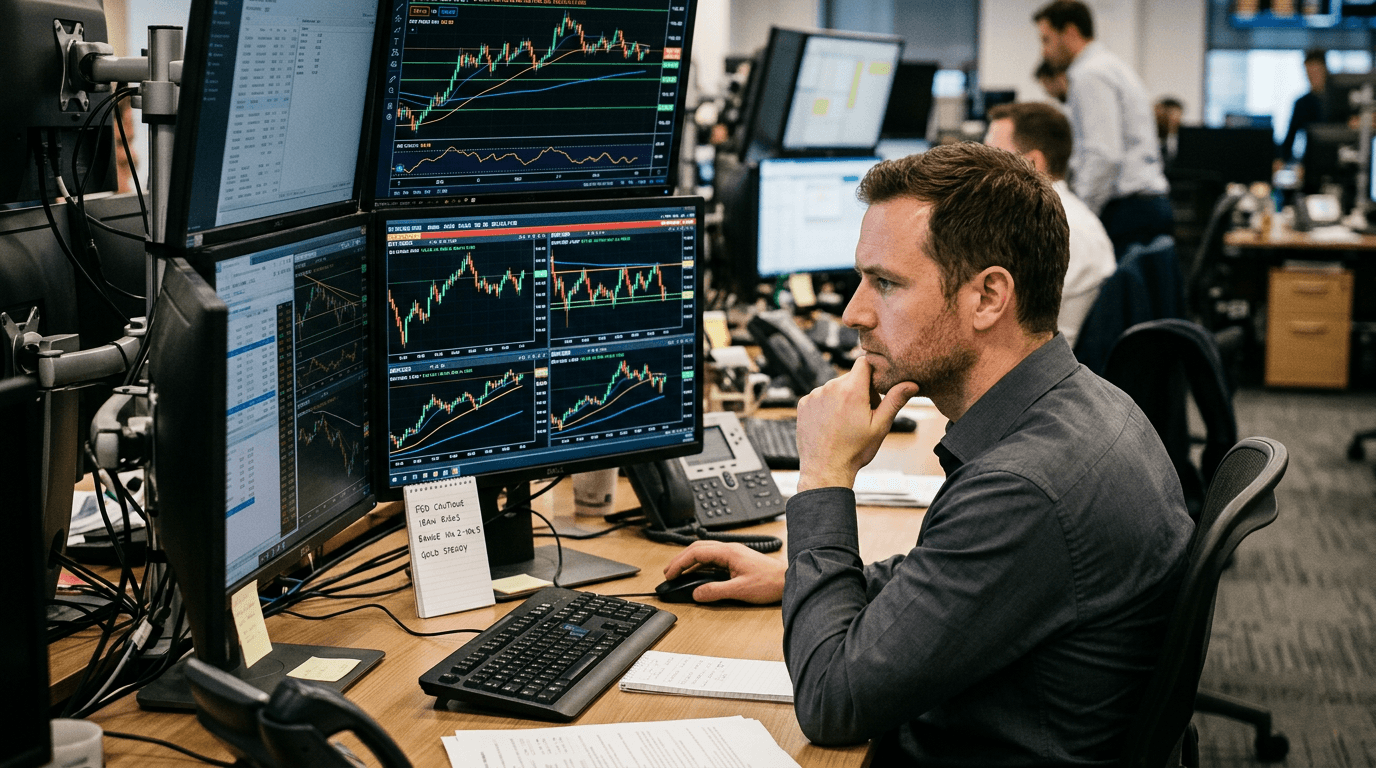
The U.S. dollar index is doing something that often frustrates traders: very little. After a burst of volatility around earlier Middle East headlines, the greenback has traded broadly steady as markets balance unresolved Iran risks with a Federal Reserve that still looks reluctant to deliver aggressive rate cuts.[5] That combination has kept major pairs like EUR/USD and GBP/USD locked in relatively tight ranges and has also helped cap upside in gold as investors avoid big directional bets ahead of the next round of geopolitical and policy news.[5]
What A Steady Dollar Index Really Signals
A flat or narrowly ranging U.S. Dollar Index (DXY) is rarely a sign that “nothing is happening.” Instead, it often reflects a temporary equilibrium: markets have priced in a meaningful amount of risk but lack a clear catalyst to justify the next big move.[3][5]
In this case, traders are weighing two powerful, but opposing, forces. On one side, geopolitical uncertainty around Iran tends to support safe-haven demand for the dollar, especially when there is concern about energy supply disruptions and broader Middle East spillovers.[1][4][5] On the other, the longer-term outlook for U.S. monetary policy is shifting toward fewer and later rate cuts, which can cap both the upside and downside in the dollar as expectations oscillate within a relatively narrow range.[5]
For active FX traders, a steady DXY usually translates into:
- Tight trading ranges in major pairs such as EUR/USD, GBP/USD, and USD/CHF
- Lower realized volatility compared to recent spikes
- More mean-reverting price action, where breakouts are less likely to follow through
In short, the current backdrop is more conducive to tactical, range-based strategies than to big “trend-following” bets, at least until the next macro or geopolitical shock decisively breaks the stalemate.
Iran Risk, Oil, And The Safe-haven Dollar
Geopolitical shocks like those involving Iran affect markets through several clear channels: security risk, energy and supply chains, and broader macrofinancial conditions.[4] Iran is a key oil producer, and any threat to supply routes through the region can quickly translate into higher oil prices, higher inflation expectations, and tighter financial conditions.[2][4]
Historically, elevated Iran tensions have tended to support the dollar as global investors seek perceived safety in U.S. assets and price in the risk of higher energy-driven inflation.[1][3] When the threat level rises, the dollar often trades firm alongside other classic havens such as the yen and, at times, gold.[1][4][6]
However, the relationship is not one-way. When markets start to believe in de-escalation or a ceasefire, the “risk premium” embedded in the dollar can unwind. Earlier episodes of renewed diplomatic signals around Iran have triggered sharp reversals lower in the DXY as traders priced out worst‑case scenarios and rotated back into riskier currencies.[2] That pattern helps explain why the dollar can look resilient but not explosive during periods of “waiting” – enough risk to keep it supported, but enough hope of de-escalation to prevent a runaway rally.[2][5]
The current environment of ceasefire uncertainty fits that pattern. Markets are alert to headline risk but not yet convinced that an extreme scenario is imminent, resulting in firm but rangebound dollar trading.[5] For traders, that means monitoring oil, energy equities, and Middle East news flow as leading indicators of potential FX regime shifts.
The Fed Path: Why Rate-cut Expectations Matter
Overlaying the geopolitical story is the Fed’s policy trajectory. Markets have steadily pared back expectations for rapid or deep rate cuts as U.S. data has remained relatively resilient and Fed officials have stressed their preference for more evidence that inflation is durably returning toward target before easing.[1][5]
When traders believe the Fed will keep rates higher for longer, U.S. yields tend to remain attractive vs. other developed markets, supporting the dollar through carry trades and portfolio flows. However, if those expectations are already well priced, incremental shifts in Fed rhetoric may only nudge the dollar rather than drive large directional moves.[1][5]
That is roughly where the market sits today
- Iran-related risk keeps a floor under demand for safe assets.
- Higher-for-longer Fed expectations prevent aggressive selling of the dollar.
- But the absence of a decisive change in either inflation data or Fed guidance limits new buying.
For FX, that combination leaves EUR/USD and GBP/USD trading in relatively tight bands, with intraday moves often tied to second‑tier data or positioning adjustments rather than major macro surprises.[5] For gold, firm but stable yields and a steady dollar help cap large breakouts, with investors reluctant to chase price moves without clearer policy or geopolitical direction.[2][5]
Trading A Rangebound Dollar: Practical Playbook
In a SimFi or prop-style trading environment, a steady dollar index can be a great backdrop for honing discipline and execution, even if it feels less exciting than a trend day. The focus shifts from calling the next big macro move to exploiting shorter-term price behavior.
A few practical approaches
1) Lean into well-defined ranges When the DXY and major pairs show repeated respect for clear support and resistance levels, range trading – buying near support, selling near resistance with tight, pre-defined stops – can be effective. In pairs like EUR/USD and GBP/USD, look for areas where price has repeatedly turned, and align trade size with the narrower volatility environment.[5]
2) Adjust volatility expectations Options pricing tends to reflect expectations of future volatility. In quieter periods, implied volatility often compresses. More advanced traders may explore short-volatility strategies, but in a news-driven environment, these should be approached with caution and robust risk limits, as a surprise headline on Iran or the Fed can instantly reprice risk.[2][4][5]
3) Use SimFi to stress-test event responses Simulated environments are ideal for practicing playbooks around sudden spikes in geopolitical risk or surprise Fed commentary. Traders can rehearse scenarios such as an abrupt escalation in Iran tensions (testing safe-haven flows, spreads, and slippage) or a shockingly dovish/hawkish Fed pivot, and refine entries, exits, and risk controls without real capital at risk.[4][6]
Scenarios That Could Break The Stalemate
Even when markets appear calm, traders should think in terms of scenarios and triggers that could push the dollar out of its current range.
Key ones to watch
- Geopolitical escalation: A deterioration in Iran-related headlines, renewed attacks, or clear threats to critical energy infrastructure and shipping routes could lift oil prices and reignite safe‑haven demand, potentially driving a stronger dollar and supporting other havens like the yen.[1][4][6]
- Durable de-escalation: Credible progress toward a ceasefire or diplomatic breakthrough could unwind the risk premium embedded in the dollar, particularly if accompanied by softer U.S. data that nudges the Fed closer to easing. Earlier periods of Iran de-escalation have shown that such shifts can trigger swift dollar sell-offs.[2][5]
- Fed surprise: A major shift in Fed communication or a key data release that materially changes the rate outlook – for example, an upside inflation surprise or a sharp slowdown in labor markets – could quickly reprice yields and break the current FX ranges.[1][5]
For traders, the message is clear: while the dollar index may look calm on the surface, it is resting on a delicate balance of geopolitical and policy expectations. Using this quieter period to map scenarios, define levels, and refine risk management puts you in a stronger position for when the next big move finally arrives.