
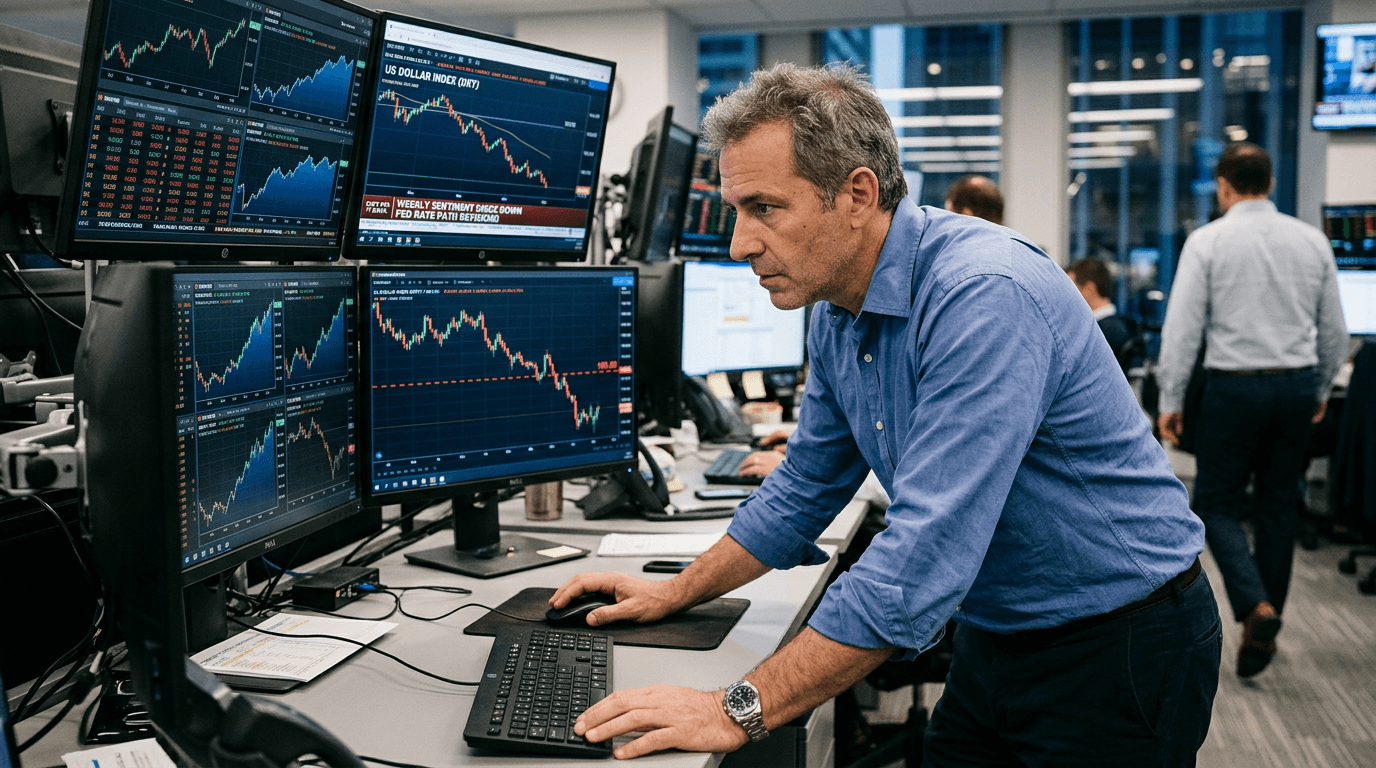
The US Dollar Index has just done something it rarely does: it slipped below the psychologically important 100 level after a soft US Producer Price Index (PPI) print and a sharp drop in consumer sentiment. For traders, this is more than a chart milestone; it is a signal that markets are rapidly repricing the path of Federal Reserve policy, with implications across currencies, commodities, indices, and rates.
What The Dollar Index Breaking 100 Really Means
The US Dollar Index (often called DXY) measures the value of the dollar against a basket of major currencies, heavily weighted toward the euro, followed by the yen and the pound.[4] When the index falls, it indicates broad-based dollar weakness versus this basket.[4][5]
The 100 level is not just a round number – it has historically acted as a key support and resistance zone, a sort of psychological anchor for investors, corporations, and central banks.[1] A sustained move below 100 for the first time since mid‑2023 signals that the prior strong-dollar regime is being challenged.[1]
This latest break comes after a slide from levels near 110, meaning the dollar has already given back around 10% from its cyclical highs.[1] When such a long-running trend reverses and a major level gives way, it tends to trigger shifts in asset allocation, algorithmic flows, and institutional hedging strategies, not just short-term speculative trading.[1]
In practice, a weaker DXY usually means: - Major pairs like EUR/USD and GBP/USD tend to trade higher as the dollar side weakens.[1][5] - Safe-haven dynamics in USD/JPY can shift, especially if US yields are falling alongside the dollar. - Dollar-bloc currencies (AUD, NZD, CAD) and many emerging market FX often find support as the global cost of dollars eases.
SOFT PPI, WEAK SENTIMENT, AND WHY MARKETS SEE DEEPER FED CUTS
The catalyst for this break was a combination of weaker-than-expected inflation and deteriorating sentiment.
US PPI, a key measure of pipeline inflation pressures, surprised with a 0.4% monthly decline. That is a meaningful move lower for a data series that typically changes in smaller increments. At the same time, the University of Michigan consumer sentiment index slumped, underlining concerns that high rates and a softening labor market are weighing on household confidence.
Taken together, these releases send a clear message to rates traders: 1. Inflation pressures in the production pipeline are easing, reducing the urgency for the Fed to keep policy tight. 2. Weak sentiment increases the risk of slower consumption and softer growth ahead. 3. The combination supports the case for not just earlier, but potentially deeper, rate cuts.
Fed funds futures quickly adjusted, with markets pricing a more aggressive easing path over the coming quarters. When rate expectations shift lower, short-term US yields tend to fall, compressing the interest-rate advantage that supported the dollar during the hiking cycle. Lower relative yields make dollar-denominated assets less attractive, feeding into broad dollar selling.
For traders, the key is not only what the Fed has said, but what markets now assume the Fed will be forced to do if data continues in this direction.
Market Ripple Effects: Fx, Commodities, And Risk Assets
A decisive move in the Dollar Index rarely stays contained to FX. It ripples across asset classes:
Currencies: A weaker dollar typically supports higher EUR/USD, GBP/USD, AUD/USD, and NZD/USD, while USD/JPY becomes more sensitive to US–Japan yield spreads and risk sentiment.[1][5] Emerging market currencies often benefit as funding in dollars becomes “cheaper” and fears of dollar-driven stress ease.[3]
Commodities: Because most commodities are priced in dollars, a falling DXY tends to be supportive for gold, oil, and industrial metals as non‑US buyers effectively see lower local-currency prices.[1] This dynamic can combine with the “Fed cut” narrative to boost gold, which likes both lower real yields and a weaker dollar.
Equities and risk assets: US equities can react in a mixed way. On one hand, lower yields and an easier Fed are positive for growth and tech names. On the other, the data that pushed the Fed in that direction (weaker sentiment, concerns about demand) can weigh on cyclical sectors. Outside the US, a weaker dollar is often supportive for risk assets in Europe, Asia, and emerging markets as it eases financial conditions globally.[3]
Rates and credit: Falling rate expectations boost government bond prices and can tighten credit spreads as markets anticipate looser policy. However, if sentiment data point to a deeper growth scare, credit markets can become more selective even in a lower‑yield environment.
TRADING PLAYBOOK: HOW TO NAVIGATE A WEAKER DOLLAR THE SMART WAY
When a major level like 100 breaks, it is tempting to chase the move. A more professional approach is to combine macro context, technical levels, and risk management.
Key ideas for traders to consider
1. Respect the technicals around 100 Treat 100 as a pivot rather than a line. If price consolidates below, it validates the breakdown and opens up deeper support zones highlighted by prior lows.[1] If it quickly snaps back above 100, the move may have been a stop‑driven flush rather than the start of a sustained downtrend.
2. Anchor trades in the Fed narrative Ask: are softer PPI and weak sentiment one‑off surprises, or part of a trend? If upcoming CPI, jobs, and spending data confirm disinflation and a cooling economy, the case for a structurally weaker dollar strengthens. If the next data run hot, the market may have over‑priced cuts, setting the stage for a dollar rebound.
3. Think in relative, not absolute, terms FX is always about relative stories. A weaker US outlook only pushes EUR/USD significantly higher if the euro area is not simultaneously facing similar or worse problems. The same goes for GBP, JPY, and EM FX. Always compare central bank paths, growth momentum, and inflation profiles across economies.
4. Use correlation, not just direction A weaker DXY often correlates with stronger gold, firmer oil, and better performance in EM indices. Traders can express views through these related assets rather than via FX alone, especially if they have more edge in commodities or indices.
5. Size and risk controls first Breaks of key levels can produce whipsaws. Use predefined stop levels, moderate leverage, and scenario planning (“what if the Fed sounds more hawkish next meeting?”) to avoid being caught on the wrong side of a violent squeeze.
Practical Value Of Simulated Trading In This Environment
For many traders, trading around macro turning points is where the most opportunity – and the most risk – lies. Simulated finance environments, like those on professional SimFi platforms, offer a powerful way to test strategies in real market conditions without putting live capital at risk.
In a simulated setting, you can: - Practice trading the DXY break via major FX pairs and dollar‑bloc futures. - Backtest how your strategy would have performed during previous dollar regime shifts. - Experiment with cross‑asset trades, like long gold vs. short dollar, or EM equity exposure hedged with FX. - Stress test your risk management rules under high‑volatility conditions driven by data surprises and rapid shifts in Fed pricing.
By the time you move from simulated to live trading, you want your playbook for “dollar breaks 100 on dovish repricing” to be rehearsed, not improvised.