
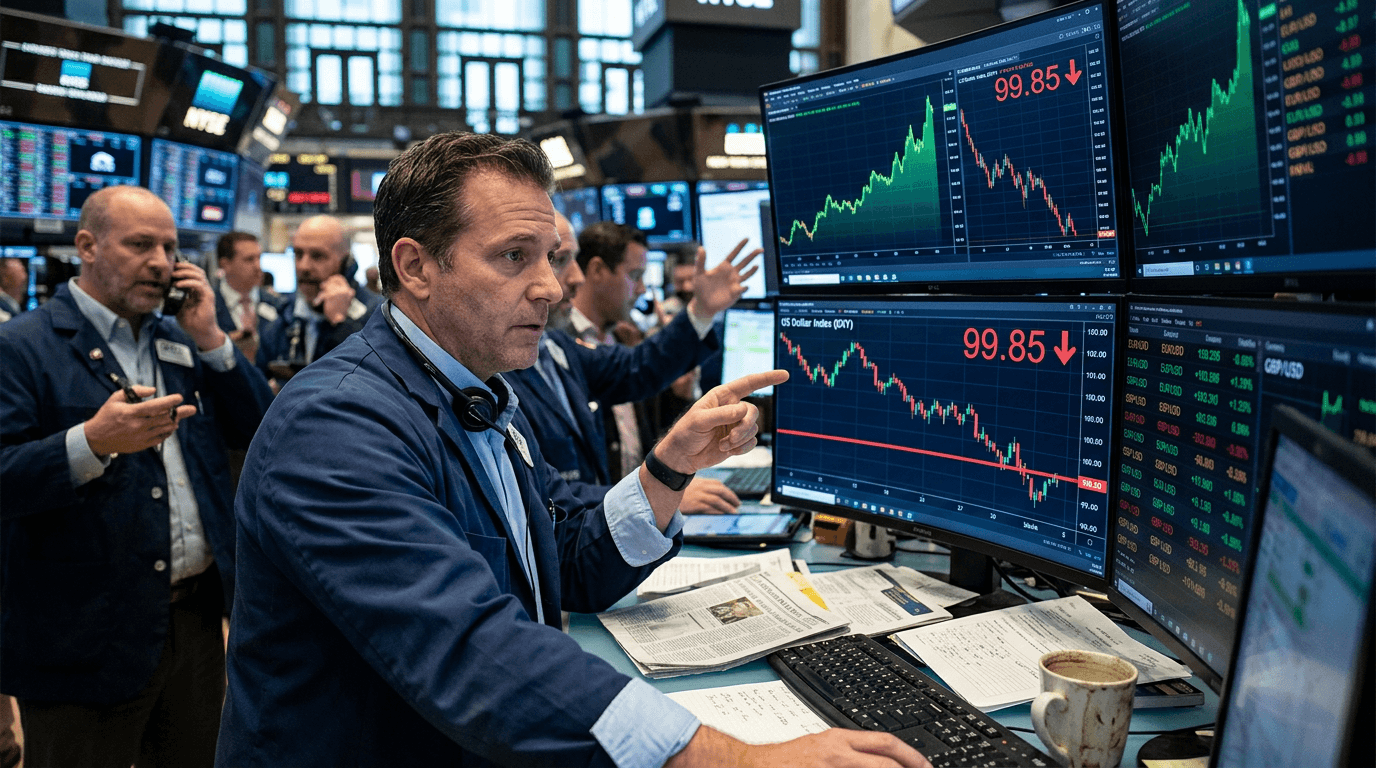
The US Dollar Index has fallen below the critical 100 level, a significant technical breakdown reflecting shifting geopolitical risk dynamics and investor sentiment in foreign exchange markets. Trading near 99.40 after peaking at 100.54 just weeks ago, the DXY now consolidates within a narrow range where key support and resistance levels will determine the greenback's next significant move.
Understanding The Us Dollar Index
The US Dollar Index (DXY) measures the value of the American dollar against a basket of six major global currencies: the Euro, British Pound, Japanese Yen, Swiss Franc, Swedish Krona, and Canadian Dollar. By tracking these weighted currency pairs simultaneously, the DXY provides traders and investors with a comprehensive snapshot of dollar strength in international trade and financial markets.
The index operates on a base value of 100, making it remarkably intuitive for traders to interpret. When the DXY trades above 100, the dollar is strengthening relative to this basket of major currencies, reflecting strong global demand for dollars and investor confidence in US financial assets. Conversely, readings below 100 signal a weakening dollar, suggesting reduced demand or declining confidence in the greenback compared to alternatives.
The recent breakdown below 100 carries psychological significance beyond mere technical levels. It represents a shift from a risk-off environment where investors sought dollar safety to a more balanced risk appetite where capital flows toward alternative opportunities. This transition matters tremendously for traders positioning portfolios and allocating capital.
Geopolitical Tensions And The Recent Surge
The spike to 100.54 in early April 2026 was driven almost entirely by geopolitical turmoil rather than traditional economic factors. Escalating tensions in the Middle East created acute fear among investors, spurring demand for safe-haven assets. The US dollar, as the world's primary reserve currency, benefits most from this flight to quality during periods of uncertainty.
During this phase, crude oil prices reached four-year highs, fueling the Petrodollar trade where stronger oil prices traditionally correlate with dollar strength. This created a reinforcing cycle: geopolitical fears drove oil higher, which drove the dollar higher, which further elevated risk premiums across financial markets. For traders, this period demonstrated how specific external events can overwhelm traditional economic analysis.
The fundamental drivers of currency value—interest rate differentials, inflation expectations, trade flows, and relative economic growth—temporarily took a backseat to pure risk aversion. This is a critical lesson: markets don't always behave according to textbook economic theory.
The Reversal And Breakdown
The dollar's recent descent below 100 reflects a rapid unwinding of the geopolitical risk premium that had supported it. As ceasefire announcements emerged and signs of de-escalation appeared in headlines, investors reconsidered their defensive positioning. The fear that had seemed so urgent weeks earlier began evaporating, triggering profit-taking among traders who had accumulated long dollar positions during the spike.
This reversal highlights an essential principle for traders: premiums built on specific, temporary events are inherently unstable. Once the triggering event loses urgency or resolves positively, the premium that accumulated around it can disappear with remarkable speed. Traders who fail to recognize when narratives shift risk being trapped on the wrong side of sharp reversals.
Technical Levels Traders Need To Watch
The current consolidation range presents several critical technical levels. The 98.00 zone represents solid 2025 support that has been tested multiple times. A decisive break below this level could accelerate weakness toward 97.40 to 97.60, with even stronger support around the 2025 lows near 96.40 to 96.80.
Resistance clusters between 99.40 and 99.50 form the immediate ceiling, with the major resistance zone extending from 100.00 to 100.50. The four-hour 50-period moving average near 98.335 serves as a tactical level with significance for intraday traders. Daily indicators have shown buy signals, yet the overall structure remains trapped within consolidation, indicating a lack of conviction from either buyers or sellers.
Market Implications For Traders
A weaker dollar creates opportunities and challenges for different market participants. US exporters benefit from improved price competitiveness globally, but companies reliant on imports face higher procurement costs. For traders, the weakness creates dynamic opportunities in currency pairs, particularly in EUR/USD and other major crosses, though volatility may remain elevated until consolidation resolves decisively.
Understanding what moves the DXY has become essential for modern traders. This episode demonstrated how geopolitical events can overwhelm traditional economic factors, while also showing how quickly sentiment can shift when catalysts diminish. Trading the DXY requires flexibility and the ability to recognize when market narratives change.
Looking Forward
The dollar's trajectory from here depends on several competing factors. Any meaningful re-escalation of geopolitical tensions would likely reverse the recent weakness rapidly, pushing the DXY back above 100. Economic data releases affecting interest rate expectations will also influence direction, as will clarifications on trade policy implementation and tariff schedules.
For traders, the current consolidation phase offers an opportunity to wait for the next directional catalyst rather than fighting within a confined range.