
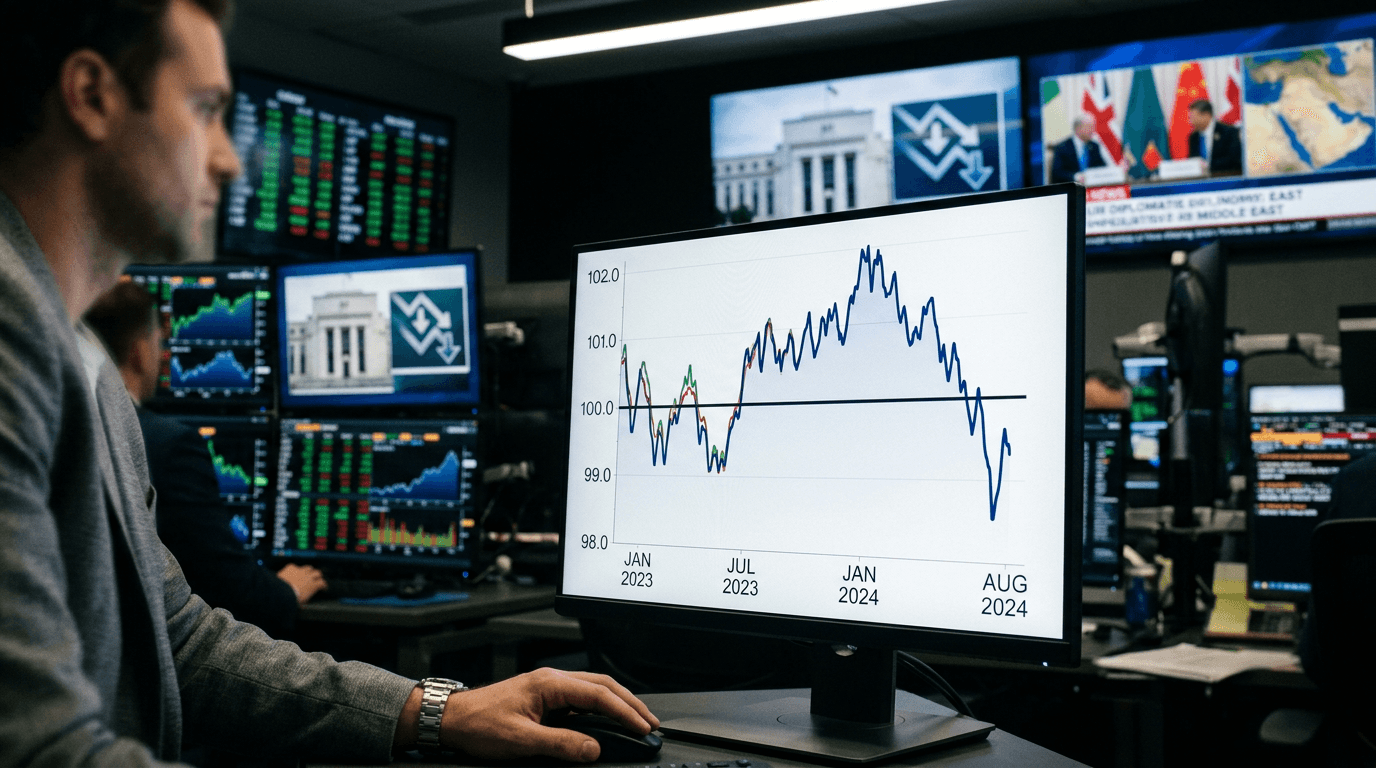
The U.S. Dollar Index has recently crossed a pivotal psychological barrier, slipping below the 100 mark, a threshold closely monitored by traders for months. This move signals a profound shift in the currency markets, extending beyond typical technical adjustments. With easing geopolitical tensions, marked by U.S.-Iran ceasefire discussions, and the Federal Reserve indicating a pause in its monetary tightening cycle, global investors are reassessing their stance on dollar-denominated assets. This shift holds significant implications for forex traders, commodity investors, and participants in international markets.
The 100 mark on the Dollar Index is more than just a technical threshold; it represents the point where the dollar trades weaker than its historical average since the index's inception in 1973. A sustained breach below this level suggests a shift toward dollar weakness, prompting investors and traders to reevaluate their exposure to the U.S. currency. This current decline is particularly noteworthy, reflecting a nearly 10 percent reversal from earlier this year when the dollar approached 110 due to expectations of continued Federal Reserve tightening.
Factors Behind the Dollar's Recent Decline
Several factors have converged to weaken the dollar's traditional dominance. The Federal Reserve's recent policy announcements, indicating a pause in monetary tightening, have profound implications for the currency markets. For years, higher U.S. interest rates attracted foreign capital seeking better returns, providing structural support for the dollar. With this advantage now eroding, one of the dollar's key pillars of strength has been removed.
Simultaneously, central banks in other regions have adopted more aggressive stances. The European Central Bank and the Bank of England have both taken firmer positions on interest rates, narrowing the interest rate differential that previously favored dollar assets. Improved economic data from the Eurozone has further diminished the dollar's safe-haven appeal as investors feel more comfortable shifting toward riskier assets.
Geopolitical developments have also played a crucial role. Reports of potential ceasefire negotiations between Iran, the U.S., and regional mediators have eased market tensions considerably. President Trump's delay of threatened strikes on Iranian infrastructure and discussions of a "double-sided ceasefire" contingent on Iran reopening the Strait of Hormuz have shifted trader sentiment from risk-off to risk-on. This reduction in geopolitical premium has allowed investors to trim dollar positions as part of broader risk management strategies.
Technical Signals and Key Levels
From a technical perspective, the breach below 100 carries unmistakably bearish implications. Charts reveal a pattern of lower highs and lower lows, indicating institutional selling pressure rather than mere profit-taking. Notably, the 50-day moving average has formed a death cross by crossing below the 200-day moving average, a classic bearish signal associated with sustained downward momentum in currency markets.
Trading volumes spiked dramatically during the breakdown, confirming the move's strength and institutional conviction. This wasn't a weak decline driven by thin liquidity; institutional investors actively unwound substantial dollar positions. As of April 8, 2026, the DXY has declined to 98.84, hitting a four-week low. Over the past four weeks, the Dollar Index has lost 0.29 percent, while the 12-month decline stands at 3.96 percent.
For active traders monitoring the DXY, several key support and resistance levels demand attention. On the downside, immediate support is near 99.70 and 98.50. A break below 98.50, a level untested since early 2023, could indicate deeper weakness and further losses. A fall below 97.50 would signal a clearer long-term trend reversal with potentially significant effects on capital flows across various asset classes.
On the upside, the 100.20 to 100.50 range represents a potential recovery zone. If the dollar manages to reclaim this area, resistance extends toward 101.60 and ultimately 103. The 200-day moving average remains a critical focal point, as traders assess whether current weakness indicates a temporary correction or a sustained trend change.
Implications for Traders and Investors
The DXY's decline below 100 carries substantial consequences for various market participants. Currency traders must reassess their directional bias on dollar pairs, while commodity traders should note that a weaker dollar typically supports commodity prices denominated in U.S. currency. Investors in international markets may experience reduced currency headwinds when converting foreign gains back to dollars. Companies with significant international revenue exposure face improved translation advantages.
This technical breakdown suggests that traders are losing faith in the traditional dollar strength narrative. For those monitoring broader market trends, the combination of Fed policy shifts, geopolitical easing, and technical deterioration creates a compelling case for sustained dollar weakness in the near to medium term. However, traders should remain vigilant regarding key support levels and monitor whether the dollar stabilizes above its 200-day moving average or continues its downward momentum. The current environment rewards active risk management and disciplined position sizing.
News Impact Score: 7