
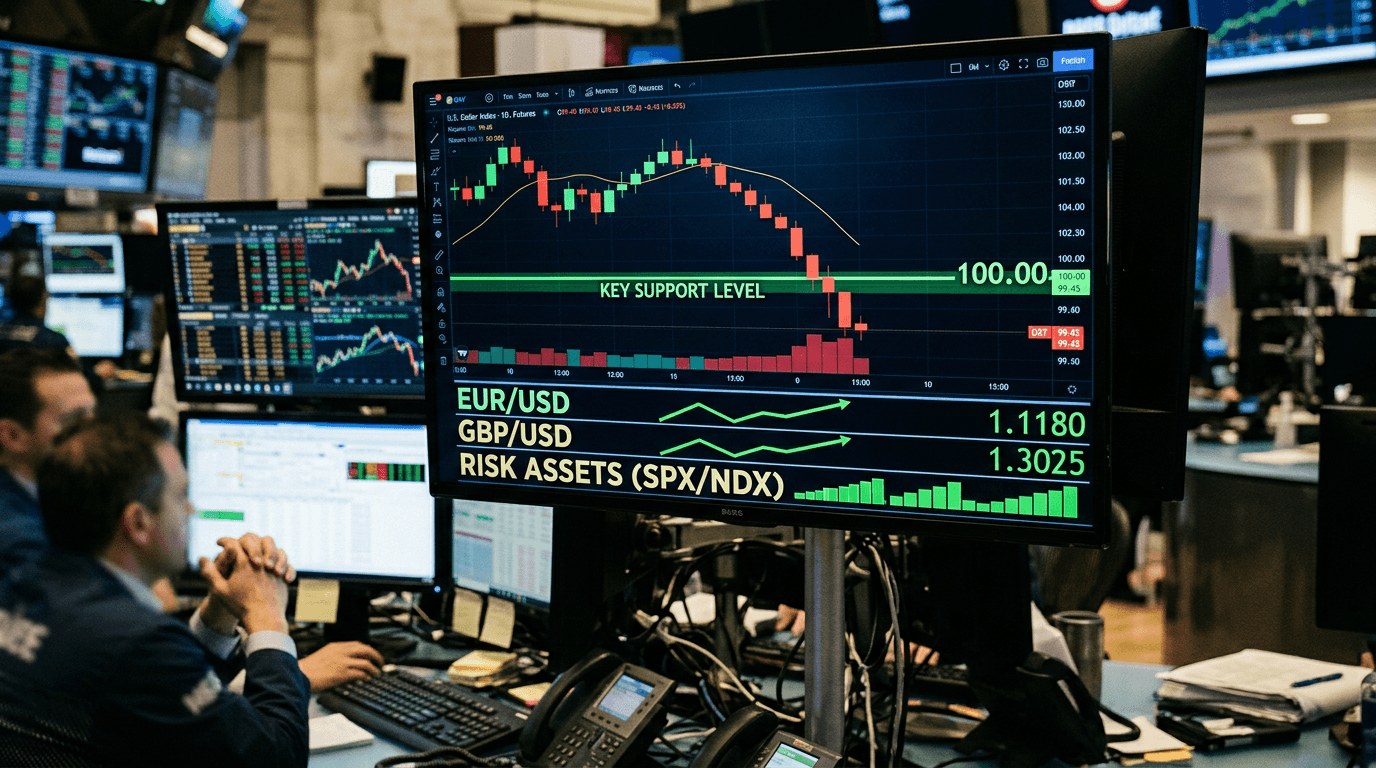
A sharp break below the 100 level in U.S. dollar index futures is more than just a line on a chart – it is a signal that the global FX landscape may be entering a new phase. With dollar futures gapping lower and sliding to levels last seen in mid-2023, traders across currencies, equities, commodities, and crypto now need to reassess positioning, risk, and opportunity as the world’s reserve currency loses some of its recent shine[1].
WHAT THE DOLLAR INDEX IS – AND WHY 100 MATTERS
The U.S. Dollar Index (often quoted as DXY or through futures tied to it) measures the value of the dollar against a basket of major currencies, heavily weighted toward the euro, along with the yen, pound, Canadian dollar, Swedish krona, and Swiss franc[3]. It rises when the dollar strengthens relative to this basket and falls when the dollar weakens[3].
The 100 level has long been viewed as a key psychological and technical threshold. Trading above 100 often coincides with periods of relative dollar strength, tighter global financial conditions, and headwinds for risk assets and emerging markets. Drops below 100, especially following extended periods of dollar strength, are frequently associated with shifts toward easier financial conditions, stronger performance in non‑U.S. assets, and trend reversals in major FX pairs[1][3].
Recent moves have been especially notable: the index sliding toward the high‑90s marked its weakest levels in years and echoed historical episodes that preceded major rotations in global markets[1]. In futures markets, that break below 100 underscores growing conviction that the dollar cycle may be turning, at least in the short to medium term[5].
WHAT IS DRIVING DOLLAR WEAKNESS?
Several forces typically converge when the dollar index breaks lower:
First, interest rate expectations are crucial. The dollar’s strength in recent years has been closely linked to relatively high U.S. yields and aggressive Federal Reserve tightening. As markets begin to price in slower growth, potential rate cuts, or a shallower rate path, the interest rate advantage that supported the dollar narrows, pressuring the index lower.
Second, global growth differentials matter. When investors expect stronger recoveries or more resilient growth outside the U.S., capital tends to rotate into non‑U.S. assets, supporting foreign currencies at the dollar’s expense. In those environments, dollar index futures often soften as traders anticipate improved performance in Europe, the U.K., or key emerging markets.
Third, risk sentiment plays a role. Counterintuitively, extreme risk aversion boosts the dollar as a safe haven, while improving risk appetite can weigh on it as investors seek higher‑beta opportunities in equities, credit, commodities, and crypto. The recent drop below 100 has coincided with renewed interest in risk assets, including Bitcoin reclaiming major milestones, suggesting that some capital is rotating away from cash and the dollar into higher‑risk exposures[1].
Finally, technical positioning can amplify the move. A cluster of stop orders around a well‑watched level like 100 can trigger accelerated selling once that threshold breaks, turning a controlled retracement into a swift slide.
IMPACT ON EUR/USD, GBP/USD, AND MAJOR FX PAIRS
Because the dollar index is dominated by the euro, moves in DXY often mirror the trend in EUR/USD[3]. When the index breaks below 100, it generally points to a stronger euro, especially if eurozone data or policy expectations are improving relative to the U.S. For traders, that can translate into:
- A bias toward buying dips in EUR/USD rather than fading rallies
- A re‑evaluation of hedging strategies for euro‑denominated portfolios
- Greater sensitivity to European Central Bank communication, as policy divergence versus the Fed becomes a key driver
GBP/USD typically responds in a similar direction but with higher volatility. A softer dollar provides a tailwind to the pound, but domestic U.K. fundamentals and Bank of England policy can either amplify or dampen the move. When DXY is below 100, markets often test the topside in GBP/USD, especially if U.K. data surprises to the upside.
Other pairs also feel the impact
- USD/JPY can decline if falling U.S. yields reduce the appeal of carry trades that borrow in yen to buy dollars.
- Commodity currencies (AUD, NZD, CAD) often benefit from a weaker dollar, particularly if global growth and commodity demand are improving.
- Emerging market FX may outperform as dollar funding pressures ease, though idiosyncratic risks still matter.
What A Weaker Dollar Means For Risk Assets
A falling dollar has broad repercussions beyond FX.
For U.S. equities, a weaker dollar can be a tailwind, especially for multinational companies that generate a large share of revenue abroad. A softer dollar boosts the value of foreign earnings when translated back into dollars, supporting earnings per share and potentially valuations.
In commodities, many contracts are priced in dollars, so dollar weakness often supports higher prices in oil, metals, and agricultural products as non‑U.S. buyers effectively face a lower local‑currency cost. This dynamic can reinforce inflation in some regions but is typically positive for commodity producers.
Crypto markets have historically shown an inverse relationship with the dollar index at key turning points. Recent commentary has highlighted how the drop below 100 coincided with Bitcoin reclaiming major price levels, reinforcing the narrative of digital assets as alternative risk exposures when dollar liquidity conditions ease[1].
For global portfolios, a softer dollar can mark the start of a period where non‑U.S. equities, emerging markets, and alternative assets outperform U.S. benchmarks. That makes the current break below 100 an important signal for asset allocators, even if the immediate move in prices is modest.
HOW TRADERS CAN NAVIGATE A SUB‑100 DOLLAR INDEX
For both live and simulated traders, the dollar’s break below 100 is an opportunity to rethink strategy, not a prompt to chase moves blindly.
A few practical steps
1. Re‑map your correlations Review how your current portfolio or trading book behaves relative to the dollar. Identify which positions benefit from further dollar weakness (for example, long EUR/USD, long gold, long emerging market equities) and which are hurt by it (such as short crypto or dollar‑sensitive exporters).
2. Watch rate expectations and policy communication The sustainability of dollar weakness hinges on how markets reassess the Fed’s path versus other central banks. Follow changes in rate expectations and yield curves; sharp reversals there can quickly halt or reverse the dollar’s decline.
3. Respect technical levels on DXY futures Dollar index futures trade with clear technical structures[5]. Monitor support zones below 100 and resistance levels above. Failed breaks or quick reversals around those areas can offer tactical trading opportunities in both the index and related FX pairs.
4. Use simulated environments to test scenarios Simulated finance platforms allow traders to test how different strategies perform under various dollar regimes without risking real capital. For example, you can model portfolios that assume prolonged dollar weakness and compare them with scenarios where the break below 100 proves temporary. This helps refine risk management, position sizing, and diversification choices before deploying capital in live markets.
5. Avoid narrative overconfidence While history shows that sub‑100 readings have sometimes preceded major market shifts[1], every cycle is different. Combine macro narratives with data, price action, and your own tested rules rather than trading purely on headlines.
Conclusion
The drop in U.S. dollar index futures below the 100 level marks a meaningful inflection point in the FX landscape and a potential catalyst across global markets. As the world’s benchmark currency softens, major pairs like EUR/USD and GBP/USD gain room to run, while risk assets from equities and commodities to crypto can find fresh support. For traders, the key is not predicting the future path of the dollar with certainty, but building robust, well‑tested strategies that can adapt whether this move develops into a full‑fledged dollar downtrend or proves to be a brief pause in a longer‑term range.