
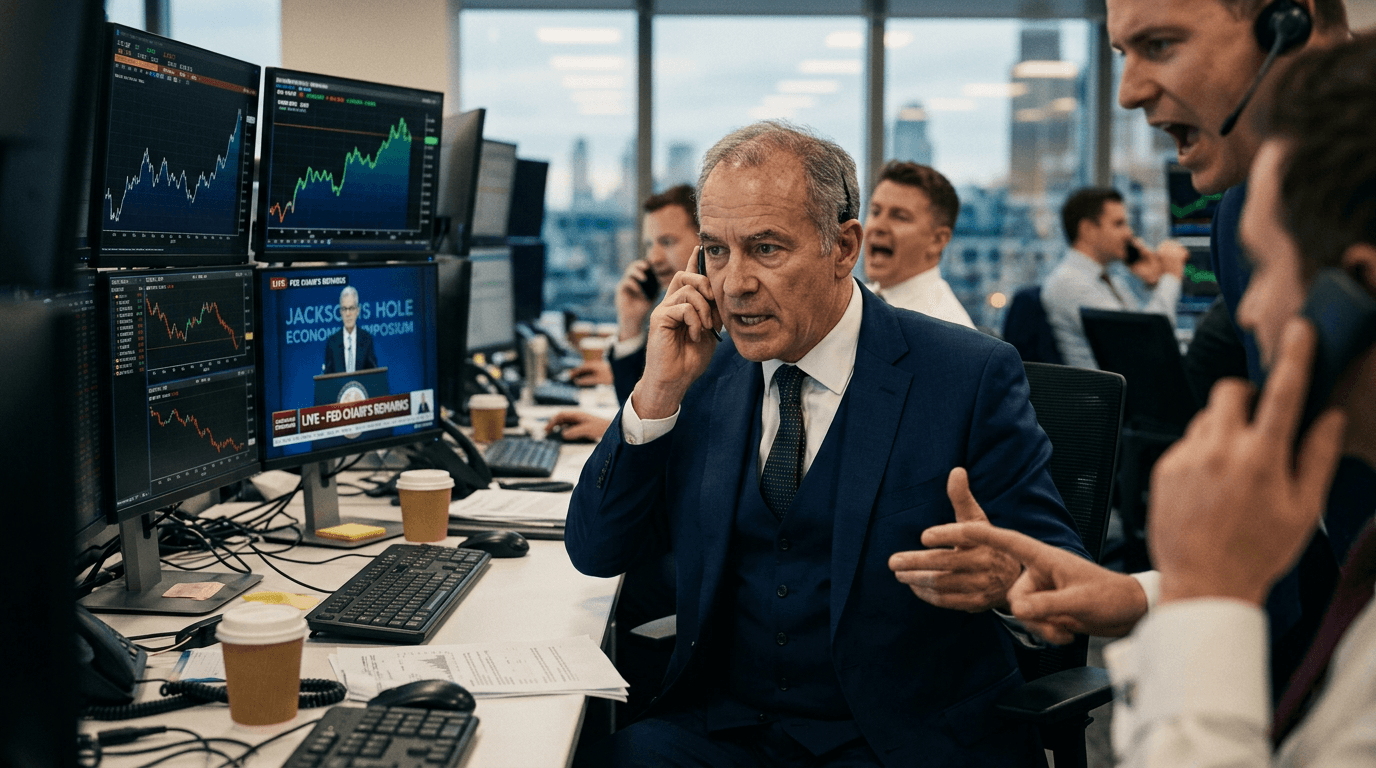
The US dollar’s latest advance is a textbook example of how central bank communication can quickly reshape global markets. After Federal Reserve Chair Kevin Warsh signaled that further rate hikes may be needed if inflation fails to cool, traders rapidly repriced the path of US interest rates, lifting the dollar against major peers and pressuring risk-sensitive currencies. Expectations for tighter policy flowed through forex markets, Treasury yields, and equity index futures in a matter of hours, underscoring why traders need to understand the mechanics of a “hawkish shift” and how to position around it.
FED SIGNALS: WHY WARSH’S COMMENTS MATTER
In his keynote appearance at the Jackson Hole symposium, Warsh reaffirmed the Fed’s commitment to a 2% inflation target, measured by the PCE price index, and warned that policymakers may “have work to do” if inflation does not convincingly return toward that goal[1][5]. These remarks stressed that current financial conditions are not especially restrictive, leaving room for rates to move higher if inflation proves sticky[5]. For markets that had begun to flirt with the idea of a prolonged pause or even cuts in 2027, this was a clear reminder that the tightening cycle may not be finished.
Importantly, Warsh’s tone builds on a series of Fed communications throughout the summer. The FOMC has kept its policy rate in a 3.50% to 3.75% range across recent meetings, but updated projections have gradually shifted from penciling in rate cuts to signaling at least one hike before year-end[2][3][11][13]. Several regional Fed presidents have also voiced support for tighter policy to contain inflation, reinforcing the perception that the committee is leaning hawkish rather than neutral[9][13]. Warsh’s Jackson Hole comments effectively tied these strands together and gave markets a focal point for revaluing the outlook.
For traders, the key takeaway is that the Fed’s reaction function remains firmly anchored on inflation. As long as price growth runs above target and inflation expectations stay elevated, policymakers will treat a strong labor market and resilient activity as justification to lean toward more tightening rather than premature easing[1][4][11]. Reading Fed speeches in this context—what is said about inflation, growth, and financial conditions—is essential for anticipating market reaction.
How The Dollar Reacted Across Markets
The immediate response was a broad-based rally in the US dollar. The dollar index, which measures the greenback against a basket of major currencies, rose around 0.5–0.6% on the day, marking its biggest daily gain in roughly two and a half months and pushing it to the highest level since mid-August[5][14]. That move is notable in a currency market where daily changes are often measured in tenths of a percent.
Rate expectations shifted sharply as well. Odds of at least a 25 basis point hike at the Fed’s September meeting jumped to roughly 57–60%, up from about 35–40% before Warsh’s speech, according to futures-based tools that track market pricing[5][12][14]. Higher expected policy rates fed directly into Treasury yields, with shorter maturities—which are more sensitive to Fed policy—seeing the largest moves[4][6][8]. Equity index futures softened, reflecting concerns that tighter financial conditions could weigh on valuations and earnings, particularly in rate-sensitive sectors[4][8].
Risk-sensitive currencies and emerging-market FX came under pressure as the stronger dollar and higher US yields reduced the appeal of carry trades and increased funding costs[13][14]. Asian currencies, in particular, were described as sliding against the dollar after investors digested the hawkish tilt in Fed expectations[13][14]. This cross-asset reaction highlights how a single speech can cascade across global portfolios: higher US rate expectations → stronger dollar → weaker risk assets.
Implications For Forex Traders
For discretionary and systematic FX traders alike, the episode underscores several practical lessons.
First, Fed communication is a tradable event. Even when policy rates are left unchanged, shifts in forward guidance—or, in Warsh’s case, a move away from explicit guidance but toward a clearly hawkish tone—can drive large moves in rate expectations and currencies[4][7][11]. Traders who had mapped scenarios ahead of Jackson Hole and understood where market pricing stood were better positioned to react quickly when the speech came out.
Second, the dollar’s behavior confirms its role as a “policy differential” trade. When the Fed is perceived as more hawkish than other major central banks, the dollar tends to outperform as investors rotate into US assets and away from currencies backed by more dovish policy stances[6][8][10]. Crosses such as EUR/USD, GBP/USD, and USD/JPY can move meaningfully as interest-rate differentials and yield spreads adjust to new expectations.
Third, risk management around such events is critical. Volatility can spike in the minutes and hours after high-profile speeches, and liquidity may be thinner than usual. Traders who use clear position sizing, predefined stop levels, and scenario planning—both for hawkish and dovish surprises—are better able to weather rapid repricing without being forced out of trades at the worst possible levels.
WHAT SIMULATED FINANCE (SIMFI) TRADERS CAN PRACTICE NOW
For SimFi traders on platforms like E8 Markets, episodes like Warsh’s Jackson Hole speech are ideal case studies to turn into structured learning and practice.
You can start by reconstructing the market backdrop just before the speech: where the dollar index was trading, how Fed funds futures priced the next meeting, and how major FX pairs were positioned. Then, simulate different outcomes—a more dovish Warsh, a more aggressively hawkish Warsh—and compare hypothetical P&L under each scenario. This builds intuition for how sensitive different instruments are to shifts in Fed tone.
Next, design trading plans around scheduled Fed events. Outline entry criteria (for example, a certain threshold change in implied hike probabilities), preferred instruments (spot FX, index CFDs, or US yield proxies), and risk rules. In a simulated environment, you can run these playbooks repeatedly across different macro regimes, refining them without the pressure of real capital.
Finally, use this episode to practice multi-asset thinking. In SimFi, you can explore how a stronger dollar and higher yields might affect equity indices, sectors like financials versus tech, and commodities priced in dollars. This cross-asset lens is increasingly important as macro themes such as inflation and policy tightening drive correlated moves across markets.
Conclusion: Navigating A More Hawkish Fed
The dollar’s rally after Kevin Warsh’s remarks is more than just a one-day move; it is a reminder that central bank communication remains one of the most powerful forces in modern markets[5][12][14]. A relatively small shift in perceived policy bias—from “patient” to “might need to hike”—was enough to push the dollar to multi-week highs, lift rate expectations, and weigh on risk assets.
For active traders, the path forward lies in treating Fed events as integral parts of a trading framework: doing the homework on policy context, defining scenarios in advance, and aligning positions with evolving probabilities rather than static forecasts. For SimFi participants, these moments are opportunities to turn theory into practice, testing strategies and risk management in a realistic but risk-free environment.
As long as inflation remains above target and growth holds up, the Fed will keep the option of further tightening on the table—and markets will respond accordingly[1][4][11]. Understanding that link between policy signals and price action is essential for anyone looking to trade the US dollar, build resilient portfolios, or simply interpret the next spike in volatility with greater confidence.