
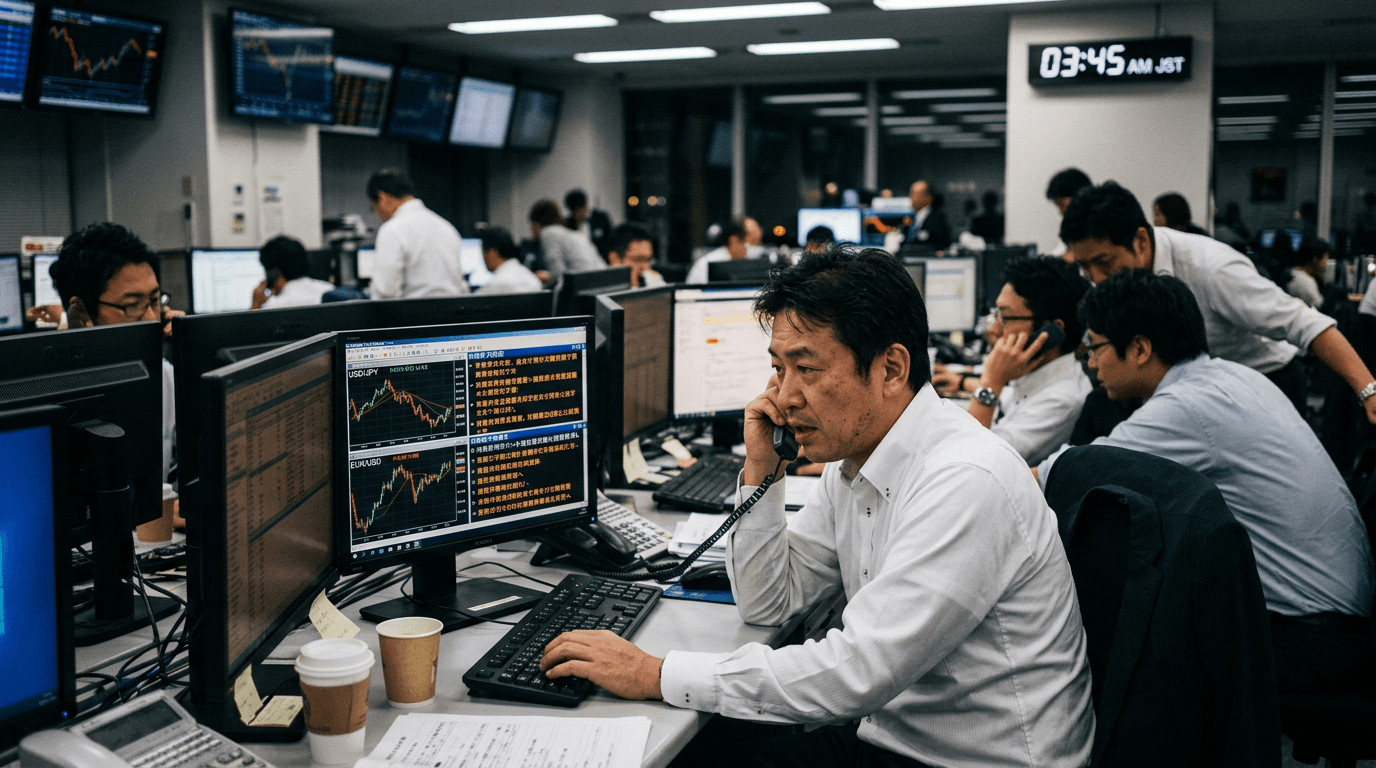
Dollar buyers were back in control in early Asian trading as renewed Middle East escalation and fresh Iran‑related headlines pushed investors toward safe‑haven assets, lifting the greenback against major peers while liquidity remained thin and price action volatile.[1][2][4][7] Indicative forex pricing showed EUR/USD and GBP/USD slipping as traders reacted to weekend news flow and U.S. political commentary, setting an uneasy tone for the rest of the global trading day as more Asian centers came online.[1][2][7]
WHAT IS DRIVING THE SAFE-HAVEN BID INTO THE DOLLAR?
When geopolitical risk spikes, markets often revert to a familiar playbook: sell risk‑sensitive assets and buy perceived safe havens such as the U.S. dollar, Treasuries, gold, and, at times, the Swiss franc and Japanese yen.[7][8][10] The latest flare‑up in Middle East tensions, including ongoing conflict dynamics involving Iran, Israel and the Gulf, has reinforced that pattern, as investors reassess the probability of supply disruptions and broader regional escalation.[1][2][7]
Several fundamental factors underpin the dollar’s appeal in this environment. First, the U.S. economy is viewed as relatively insulated from energy shocks compared with Europe and parts of Asia, thanks in part to its status as a significant net energy exporter.[2][3] That reduces perceived downside risk to U.S. growth from higher oil prices, making the dollar an attractive defensive asset when crude spikes. Second, safe‑haven demand often coincides with a preference for deep, liquid markets: U.S. dollar funding remains the backbone of global trade and finance, and U.S. Treasuries are still the world’s benchmark risk‑free asset.[3][7][10]
In parallel, investors are watching how higher oil prices from Gulf tensions and potential Strait of Hormuz disruption could feed back into global inflation expectations.[1][7] A worst‑case scenario involving significant shipping disruptions could push Brent oil toward the USD 100–130 range, a level that would meaningfully alter inflation and rate expectations.[7] While markets are not yet pricing that extreme outcome, the tail‑risk alone is enough to sustain a bid in the dollar and other havens as traders hedge against adverse surprises.[7][8]
Thin Asia Liquidity: Why The Timing Of Moves Matters
The current move is unfolding in what market participants describe as “thin Asia trade” – early‑week, early‑session conditions where full global liquidity has yet to return and order books can be patchy.[1][4] In these hours, a burst of geopolitical headlines can have an outsized impact because fewer counterparties are quoting large sizes, spreads are wider, and stops or algorithmic triggers can be hit more easily, amplifying directional moves.[1][4]
For traders, especially those using simulated finance platforms to practice strategy, this timing nuance is critical. Thin liquidity means:
Prices can gap more readily around headline releases, especially in major pairs like EUR/USD, GBP/USD and high‑beta FX such as AUD/USD.[1][4]
Short‑term volatility is often higher relative to the amount of new fundamental information, because the market is still “discovering” levels as London and New York desks remain largely sidelined.[1][4]
Execution quality can vary, with slippage more likely if orders are placed around illiquid moments or local fixes.
Understanding this microstructure context helps distinguish between moves driven primarily by liquidity conditions and those reflecting deeper, lasting shifts in positioning or fundamentals. Early‑Asia price swings often set the tone, but they can also be faded later in the day if headline risk eases or if larger players step in on the other side of the trade.
How Major Fx Pairs Are Reacting
Indicative pricing shows the dollar index grinding higher, extending recent gains as investors build defensive exposure.[2][4][9][10] In recent sessions tied to Middle East escalation, the dollar index has added around 0.3%, with moves today continuing that trend, albeit in a more measured fashion.[2][4][10]
Against the euro, the greenback has pushed EUR/USD lower, with the single currency recently down around 0.4% to the 1.1450 area as traders factor in growth and energy risks for Europe.[2][7] The British pound has seen similar pressure, slipping about 0.5% to near 1.32–1.32 handle levels, its weakest point in several weeks, as UK assets remain sensitive to global risk sentiment and oil’s inflation implications.[2]
Risk‑sensitive currencies are faring even worse. The Australian dollar, often seen as a barometer for global risk appetite, has led declines, at one point dropping by as much as 1% against the U.S. dollar in early Asian trade before stabilizing.[4] This pattern – stronger USD versus EUR, GBP and AUD – is consistent with a classic risk‑off, safe‑haven rotation.[1][2][4]
Interestingly, not all “havens” are moving in lockstep. The Swiss franc remains well supported, reflecting its traditional store‑of‑value role in periods of geopolitical tension.[7] Gold prices, already elevated, continue to serve as a hedge against extreme shocks, consolidating around high levels with potential upside if the conflict worsens.[7][8] The yen, meanwhile, is influenced by dual forces: safe‑haven demand and ongoing speculation about possible intervention by Japanese authorities as USD/JPY trades near levels Tokyo previously defended.[2][3] That mix can create choppy, headline‑sensitive moves in JPY pairs even when the broader dollar trend is clear.
Implications For Traders And Simulated Finance
For active traders and those using SimFi platforms to refine their skills, this type of environment is a live case study in managing geopolitical risk, liquidity, and macro narratives simultaneously. The key is to distinguish between structural signals and short‑term noise.
On the structural side, the conflict’s impact on oil and inflation expectations, the relative insulation of the U.S. economy to energy shocks, and central bank reaction functions (Federal Reserve, ECB, Bank of Japan, SNB) will drive medium‑term FX trends.[2][3][7] On the tactical side, headline timing, liquidity pockets, and positioning data will shape intraday swings and false breaks.
Simulated trading conditions allow participants to test:
How different pairs react to a risk‑off shock – for example, comparing EUR/USD and AUD/USD versus USD/CHF and USD/JPY.
What happens to correlation structures: equities versus FX, oil versus inflation‑sensitive currencies, gold versus the dollar.[7][8][10]
Execution and risk management strategies in thin liquidity – such as sizing adjustments, wider stops, and the pros and cons of trading around major news releases.
By replaying similar scenarios and stress‑testing strategies, traders can build playbooks for future geopolitical shocks, improving their ability to respond calmly when real capital is on the line.
Practical Takeaways For The Week Ahead
Several practical themes emerge from the dollar’s firm tone in thin Asia trade:
Safe‑haven demand remains in focus. As long as Middle East tensions stay elevated and the risk of supply disruption in key chokepoints like the Strait of Hormuz persists, defensive flows into the dollar and other havens are likely to remain a recurring feature of the FX landscape.[1][7][8]
Watch energy markets and inflation expectations. Significant moves in Brent and WTI will influence not just commodity currencies but also the policy calculus for central banks, including the Fed and ECB, and thus medium‑term FX pricing.[1][3][7]
Respect liquidity conditions. Early‑Asia and early‑week trading can exaggerate moves; traders should be mindful of the risk of whipsaws if the news cycle calms or if major institutions fade the initial reaction once broader liquidity returns.[1][4]
Stay diversified and manage tail risks. Multi‑asset portfolios that blend FX, rates, equities, commodities and gold have been highlighted as a robust way to contain tail risks in the current environment.[7] For discretionary and simulated traders alike, this is a reminder that concentration risk can be costly in volatile, headline‑driven markets.
Ultimately, the dollar’s firmness in thin Asia trade is less about a single headline and more about the market’s ongoing effort to price a complex mix of geopolitical tension, energy risk, and evolving monetary policy expectations. For traders who can connect those dots – and manage liquidity and leverage carefully – this environment offers both challenges and opportunities.