
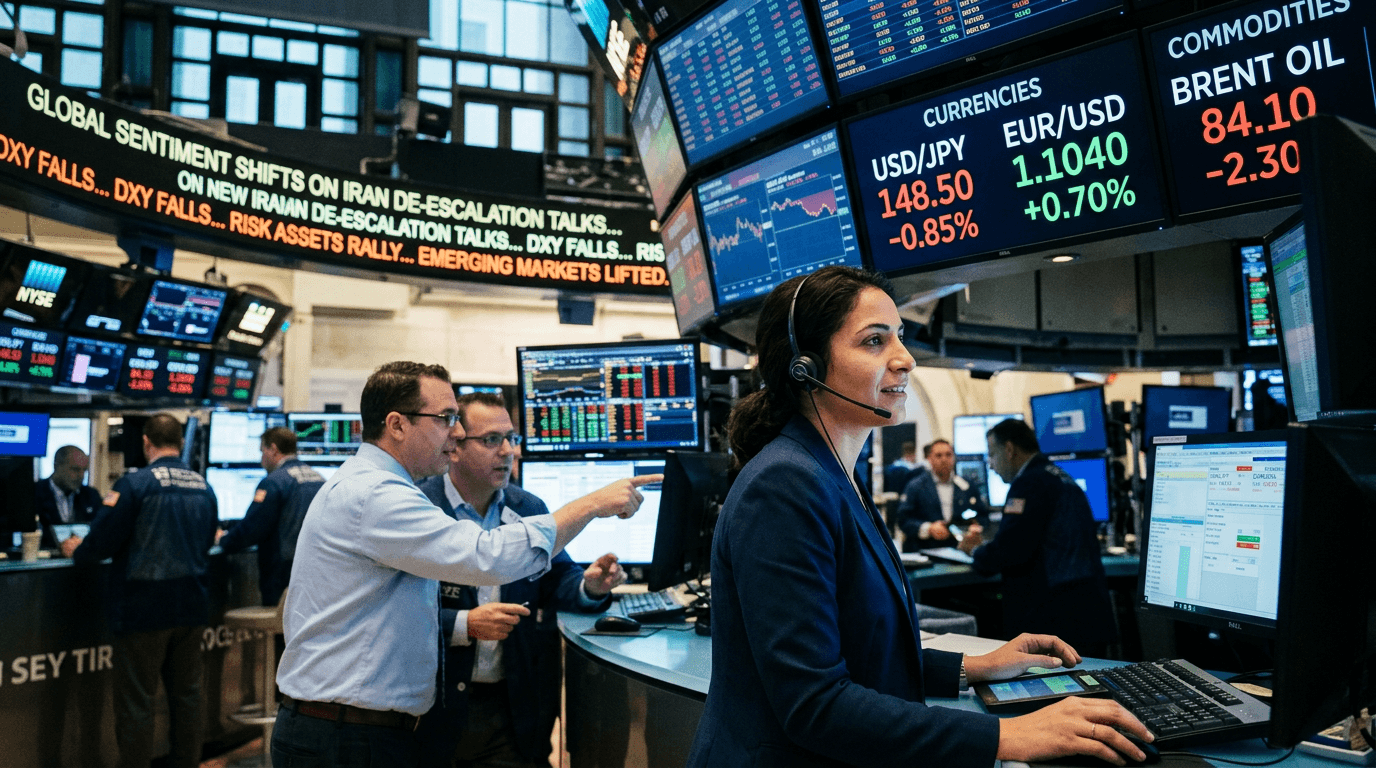
The U.S. dollar is softening as markets warm to the possibility of de‑escalation around Iran, nudging investors out of defensive positioning and back into risk assets.[4][5] While the move is not a full-blown trend reversal yet, it is a textbook example of how geopolitics, central-bank expectations, and macro data intersect to drive FX and broader markets.[3][4] For traders, both live and simulated, this is a timely case study in navigating shifts from “risk-off” to “risk-on” regimes.
WHAT IS DRIVING THE DOLLAR’S DROP?
The immediate catalyst is growing optimism that tensions involving Iran could ease through diplomatic channels, reducing the perceived probability of a deeper regional conflict.[4][6] As headlines point to progress or renewed engagement, markets quickly reprice the geopolitical risk premium that had previously supported the dollar as a safe haven.[4][7]
When geopolitical risks rise, the dollar often benefits from safe-haven flows, especially when energy supply is threatened and investors fear a spike in oil prices and inflation.[2] As that tail risk recedes, the logic reverses: demand for the dollar’s safety fades, and capital rotates into higher-beta currencies and assets.[4][5]
Recent trading has reflected this dynamic. Reports suggest investors are trimming long-dollar positions and reallocating into currencies linked to global growth, such as parts of Asian FX, as well as into equities and credit.[4][5] In thinner, holiday-affected markets, even modest order flow can amplify these moves, making price action appear more dramatic than the underlying fundamental shift.[5]
For traders, the lesson is that FX is not only about interest rate differentials; it is also about how markets perceive and price tail risks. That perception can change quickly when the news cycle turns.
How Iran Peace Hopes Shift Risk Sentiment
Sentiment is the bridge between geopolitics and asset prices. When investors believe a conflict may escalate, they typically move into cash, Treasuries, the dollar, and sometimes gold. When they sense de‑escalation, they are more willing to reach for yield and growth.
Improved hopes for a U.S.–Iran understanding are fostering a “risk-on” tone in global markets, encouraging investors to add exposure to equities, emerging-market currencies, and higher-yielding credit.[3][4] The same news flow has eased some anxiety in energy markets, with oil prices fluctuating rather than surging as traders reassess the likelihood of supply disruptions.[3][5]
This does not mean risks have disappeared. Geopolitical paths are rarely linear, and ceasefire or negotiation headlines can reverse quickly. But each day without fresh escalation reinforces the narrative that the worst-case scenarios may be less likely, which steadily undermines the case for defensive dollar positioning.[4][7]
For short‑term traders, these phases can produce strong intraday trends in risk assets and volatility around news headlines. For swing and position traders, the key question is whether the improvement in sentiment will last long enough to justify a sustained shift in portfolio allocation.
Winners And Losers Across Asset Classes
Dollar softness tied to easing geopolitical stress creates a fairly familiar pattern of winners and losers.
On the currency side, non‑USD pairs have generally found support as the dollar retreats.[1][4] Asian currencies have been among the beneficiaries, drawing flows from investors who see better risk-adjusted opportunities as geopolitical clouds thin.[5] High‑beta FX and some commodity-linked currencies tend to perform well in such environments, as long as global growth expectations remain intact.
Equities and risk assets have also responded positively. As optimism around peace prospects filters into sentiment, stock markets have seen renewed buying interest, with investors gravitating toward cyclical sectors and growth stories that benefit from a calmer macro backdrop.[3][4] Credit spreads often tighten in these conditions as demand for yield picks up.
Safe-haven assets can lose some shine. While the dollar has been the focus, other havens such as long-dated government bonds or defensive equity sectors may also lag as capital migrates elsewhere. At the same time, oil’s reaction is nuanced: prices have stabilized or eased from recent highs as concerns about Iranian-related supply shocks moderate, even as traders continue to monitor developments closely.[3][5]
For portfolio managers and active traders, the challenge is distinguishing between a tactical relief rally and a durable shift in the underlying risk landscape. The more evidence markets see of sustained diplomatic progress, the more confident they become in maintaining risk-on positioning.
What Traders Should Watch Next
Even as Iran-related risk fades from the foreground, the dollar’s path will still be heavily influenced by central-bank expectations and incoming economic data.
On the monetary policy side, traders are tracking how the Federal Reserve responds to a changing inflation and growth outlook. If easing geopolitical tensions contribute to more stable energy prices and less inflation pressure over time, that could give the Fed a bit more flexibility—though policymakers will remain data-dependent.[2][3] Conversely, any renewed spike in energy due to setbacks in negotiations could reignite inflation concerns and push expectations toward tighter policy.[2]
Upcoming U.S. data on inflation, employment, and growth will be crucial for confirming or challenging the current soft-dollar narrative. Strong data that revives talk of higher-for-longer U.S. rates could quickly support the dollar, even in a calmer geopolitical environment. Softer data that increases the odds of future Fed easing would likely reinforce dollar weakness and bolster risk assets.
Markets also care about relative stories. If other major central banks, such as the European Central Bank or Bank of England, sound more hawkish than the Fed, rate differentials could move against the dollar regardless of Iran headlines. Conversely, if U.S. yields remain meaningfully higher than those of key peers, the dollar may find a floor even as safe-haven demand fades.
Practical Takeaways For Simulated And Live Traders
For traders using simulated environments as well as live accounts, the current backdrop is an ideal training ground for integrating news, macro, and price action into a coherent strategy.
First, build a routine for tracking geopolitical risk. Map out key scenarios—further de‑escalation, stalemate, or re‑escalation—and note how each would likely affect the dollar, oil, equities, and higher-beta FX. Then monitor news flow against that framework and practice adjusting positions accordingly in a simulated setting, where you can test reactions without capital at risk.
Second, connect geopolitical developments to central-bank expectations. Keep an eye on how interest-rate futures and bond yields react to Iran headlines and energy-price moves. This helps you understand when the story is shifting from pure sentiment to something that can alter the policy path and the longer-term trajectory of currencies.
Third, respect liquidity and positioning. Moves in holiday-thinned markets can be exaggerated, which creates both opportunity and risk.[5] Use simulated trading to practice scaling in and out, setting wider stops in thin conditions, and avoiding over-leverage when headlines can flip the narrative in minutes.
Finally, treat this period as a live case study in risk management. When the dollar weakens on peace optimism, it is tempting to chase risk assets aggressively. A more professional approach is to define clear invalidation levels, diversify across instruments, and size positions so that a surprise headline does not knock you out of the game.
For both new and experienced traders, the softening dollar on Iran peace hopes is more than a headline—it is a practical lesson in how narrative, policy, and data intersect to drive markets, and how disciplined preparation can turn that complexity into opportunity.