
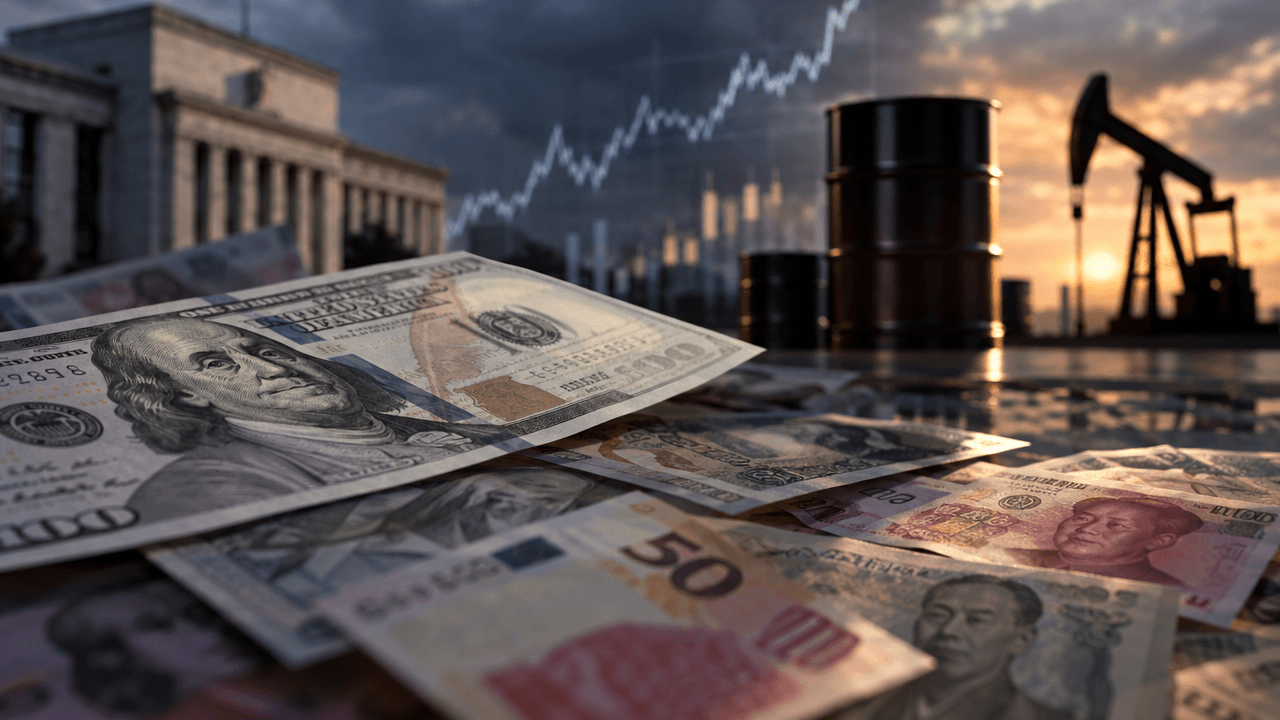
Global foreign exchange markets are entering a new stress phase as a stronger dollar, rising U.S. yields and elevated oil prices combine to pressure both emerging and developed-market currencies. Rupee and sterling weakness near recent lows underscores how quickly macro conditions have shifted from a benign carry-friendly environment to one where funding costs are rising and volatility is creeping higher.
Global Fx Under Pressure
Across emerging markets, currency indices have been sliding for several sessions as global bond yields push higher and investors rotate away from riskier assets. This downturn reflects a classic flight-to-quality dynamic, where the dollar and U.S. Treasuries reclaim their role as safe havens when funding conditions tighten and macro uncertainty rises.[10] For traders who grew comfortable with low-volatility FX ranges, this move is a reminder that cross-asset correlations can change rapidly when rates and commodities start to move together.
Developed-market currencies are hardly immune. Sterling’s grind lower and the rupee’s struggle to hold key support levels show how vulnerable high-deficit, energy-importing economies can be when the global cost of capital rises. Even where domestic fundamentals look stable, the combination of higher U.S. yields and pricier oil tilts the risk/reward against these currencies, encouraging investors to trim exposure and reassess leverage across FX books.[5][10]
Fed Hike Expectations And Dollar Strength
The immediate catalyst for this bout of FX stress is a sharp repricing of Federal Reserve policy expectations. Market-based measures now imply around a 90% probability of a rate hike at the upcoming Fed meeting, up from roughly 70% before the latest upside surprise in core inflation.[11][15] Surveys of economists and market participants similarly show a clear majority expecting not just one hike, but at least one additional increase over the coming year.[3][6] That shift has widened rate differentials in favor of the dollar and forced traders to rethink the timing of any future easing cycle.
Higher U.S. yields ripple through FX via several channels. First, they raise the “hurdle rate” for holding non-dollar currencies, especially when local yields do not rise in step. Second, they increase funding costs for leveraged strategies, including popular dollar-funded carry trades into higher-yielding emerging-market currencies.[5][10] As the cost of borrowing dollars climbs, carry trades that once looked attractive on paper can suddenly become uneconomical, triggering position reductions or forced unwinds that amplify currency moves.
For major currencies like sterling, which often rely on global investors to finance current-account deficits, a more aggressive Fed path can be particularly challenging. If investors can earn higher risk-free yields in dollars, they may demand a greater premium—via weaker exchange rates or higher local yields—to hold pound- or rupee-denominated assets. That repricing process tends to be fast, painful and asymmetric, with downside in the currency often arriving before any compensating upward move in domestic yields.[3][6][11]
Oil's Role In The Currency Sell-off
Oil prices are adding another layer of stress to FX markets, especially for energy-importing economies. Research on the oil–exchange rate nexus shows that higher real oil prices typically transfer income from importing countries to exporting ones, leading to depreciation pressures for importers’ currencies and, in many cases, appreciation for exporters.[2][12][14] Countries like India, Japan and much of Europe face rising energy bills when crude rallies, which can strain current accounts and weigh on local FX.
Elevated oil prices also feed into inflation expectations. When traders see crude breaking higher, they often anticipate stickier headline and core inflation, particularly in economies with limited ability to pass through costs or subsidize fuel.[1][5][8] That can push central banks into difficult trade-offs: tighten policy to defend the currency and anchor inflation, or tolerate some FX weakness in order to protect growth. Either outcome can be destabilizing for markets if communication is unclear or if policy moves diverge sharply from prior guidance.
For oil exporters, the picture is more nuanced. In theory, countries with large energy surpluses should see some FX support as export revenues rise.[1][13][14] In practice, however, the current environment of rising global yields and shifting risk appetite means even commodity-linked currencies can struggle. Investors may prioritize liquidity and policy credibility over terms-of-trade dynamics, which can blunt the usual “petro-currency” benefits and keep volatility elevated across the board.
Practical Implications For Fx Traders
For active FX traders, the combination of Fed tightening expectations and higher oil prices changes the playbook. Strategies that thrived in a low-rate, low-volatility regime—such as unhedged carry trades or range-bound mean reversion—face greater drawdown risk when the dollar is bid and funding costs rise. Steeper rate differentials in favor of the U.S. mean that short-dollar positions need strong, idiosyncratic catalysts to work, rather than relying on a gradual drift away from the greenback.[5][10]
Risk management needs to adjust accordingly. Position sizing that felt conservative in a calm environment may be too aggressive once intraday ranges widen and correlations across FX, rates and commodities tighten. Traders should consider stress-testing portfolios against scenarios such as: a surprise extra Fed hike, a further 10–20% move higher in oil, or a sharp widening in EM credit spreads. Historical studies of oil and exchange-rate volatility suggest that shocks in one market can propagate quickly to the other, making scenario analysis essential rather than optional.[2][9][12]
On the tactical side, there is still room for opportunity. Strong dollar phases often produce clear trends in specific crosses, particularly where macro fundamentals diverge sharply. Oil-exporting currencies with credible policy frameworks may outperform those of high-deficit importers, while economies that move swiftly to address inflation can regain some FX support even amid global tightening.[1][5][13] The key is distinguishing between structurally vulnerable currencies and those temporarily caught in the crossfire of global macro repricing.
Using Simulated Markets To Stress-test Strategies
In a complex environment like this, simulated finance platforms such as E8 Markets offer a valuable way to test ideas without real capital at risk. Traders can recreate current conditions—strong dollar, higher U.S. yields, firmer oil—and run through different strategy responses, from hedged carry to trend-following and volatility breakout approaches. By tracking how simulated portfolios behave during rate surprises or commodity spikes, participants build intuition about where their risk concentrations truly lie.
Simulated environments are particularly powerful for exploring funding and leverage dynamics. Because rising dollar funding costs are central to the current FX strain, traders can experiment with varying leverage, rolling schedules and funding currencies to see how P&L profiles change as rates move. This kind of hands-on practice makes it easier to translate abstract macro themes—like “Fed repricing” or “oil shock”—into concrete risk limits, stop-loss policies and position structures.
Finally, simulated trading helps traders refine their process around macro news events. With markets now highly sensitive to inflation releases, Fed communications and oil inventory data, having a clear pre- and post-event checklist can be a differentiator. Using SimFi tools to rehearse event-driven scenarios teaches traders how to avoid emotional overreactions, manage slippage and systematically incorporate new information into their views, all within a risk-free training ground.