
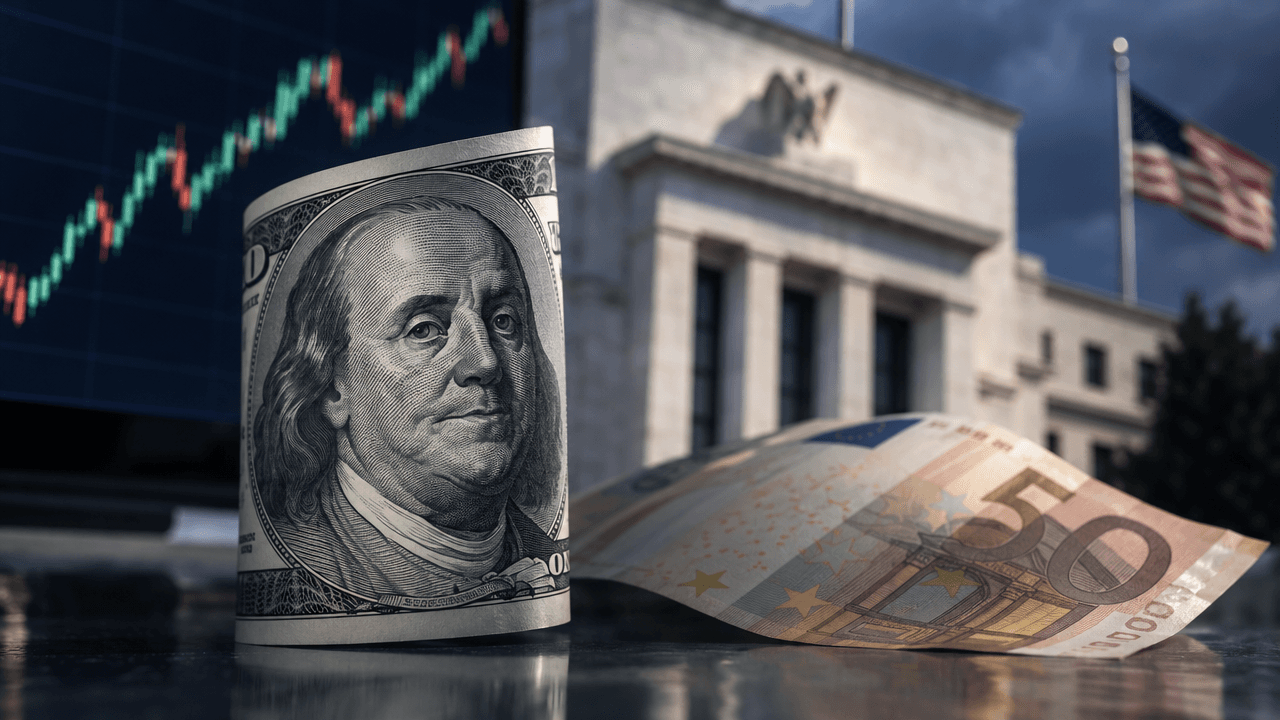
The US dollar is holding firm near a seven-week high as investors digest a clear message from Federal Reserve officials: the tightening cycle may not be over yet.[6][11][13] The Dollar Index is trading just above the 100 mark, supported by the Fed’s recent rate hike to 3.75%–4.00% and hawkish guidance that has pushed major currency pairs like EUR/USD onto the defensive.[1][6][10][11]
Market Snapshot
After the latest policy meeting, the Fed raised its benchmark rate by 25 basis points, lifting the federal funds target band to 3.75%–4.00%.[1][10] This move marked the first increase since 2023 and signaled a shift away from the previous pause toward renewed tightening.[3][10] The Dollar Index responded by climbing above 100, trading around 100.3–100.5 and notching its highest levels in several weeks.[6][11][13][15] The index has advanced over several sessions, underscoring persistent demand for the greenback as markets re-price the path of US interest rates.[6][11]
In the FX space, the euro has borne the brunt of this dollar strength. EUR/USD is trading in the mid‑1.14s to high‑1.14s, near a seven‑week low, with rallies struggling to sustain above short‑term moving averages.[1][3][6][7][14] Technical indicators such as a subdued RSI and resistance around the 20‑period EMA highlight a bearish bias, even as the pair consolidates rather than collapsing outright.[14] Other G10 currencies show similar patterns, with the dollar’s firmer tone broadly capping upside attempts.
Why Hawkish Fed Signals Prop Up The Dollar
The key driver behind the dollar’s resilience is the Fed’s communication strategy, which has turned unmistakably hawkish.[2][9][12] Policymakers have emphasized that inflation remains too high and has been elevated for too long, reinforcing their willingness to lift rates further if necessary.[2][12] Updated rate projections and post‑meeting commentary have been described as a “credibly hawkish” package, convincing markets that additional tightening is a realistic possibility rather than a remote risk.[9][12]
Understanding the distinction between “hawks” and “doves” helps explain the market reaction. Hawks prioritize combating inflation and are more comfortable with higher interest rates, while doves focus on employment and growth and typically favor easier policy.[4] Recent speeches and press conferences have clearly tilted toward the hawkish side of this spectrum, with officials stressing the need to keep financial conditions sufficiently restrictive to bring inflation back under control.[2][9][12] For currency markets, this matters because higher expected US yields improve the relative attractiveness of dollar‑denominated assets.
The unanimous vote for the recent rate hike added another layer of credibility to the Fed’s message.[10] Previously, some officials had dissented in favor of holding rates steady, leaving room for speculation that internal divisions might slow the tightening process.[10] A united front signals that the committee broadly agrees on the need for firm action, which in turn anchors expectations for a higher terminal rate and supports the dollar.
PRESSURE ON EUR/USD AND GLOBAL FX
EUR/USD has slid from levels above 1.15 to trade closer to 1.1460–1.1490, with the euro heading for weekly losses against the dollar.[1][3][6][7][11] The pair’s inability to reclaim key resistance near the 20‑period EMA around 1.1564 suggests that buying interest is fading on rallies, and the short‑term structure remains tilted to the downside.[14] The six‑week low near 1.1460 has emerged as a critical support zone that traders are watching for signs of either stabilization or further breakdown.[1][14]
The broader theme is that as US yields move higher, currencies with less aggressive central banks tend to underperform. The euro, for example, faces a less hawkish outlook from the European Central Bank compared with the Fed, creating a policy divergence that favors the dollar.[6][11] Similar dynamics play out across other G10 pairs, where markets weigh each central bank’s willingness to continue tightening against the economic cost.
For traders, this environment often translates into trend‑following opportunities but also heightened volatility around data releases and speeches. Any sign that inflation is moderating faster than expected or that growth is faltering could prompt a reassessment of the Fed’s trajectory, quickly feeding through to the Dollar Index and major pairs.[9][12] Conversely, upside surprises in inflation or labor market data would likely reinforce the current hawkish bias and keep the dollar supported.
Key Takeaways For Traders
First, the current dollar strength is not just about the latest rate hike; it is about the Fed’s commitment to keeping policy restrictive until inflation is convincingly on a downward path.[2][9][12] As long as Fed officials continue to signal the possibility of further tightening, the Dollar Index is likely to remain underpinned above the 100 level.[6][11][13]
Second, currency traders should monitor Fed communication as closely as traditional data releases. Press conferences, speeches, and minutes can shift expectations for future rate moves, often moving markets even in the absence of an actual decision.[9][12] A subtle change in language—for instance, dropping references to temporary “supply shocks” and simply describing inflation as “elevated”—can be enough to tilt sentiment.[12]
Third, EUR/USD and similar pairs are currently trading in zones where technical levels matter. Support near 1.1460 and resistance around 1.1564 offer clear reference points for risk management, allowing traders to define stops and profit targets more systematically.[1][14] Combining these levels with macro themes—such as the hawkish Fed narrative—can help refine directional bias and avoid chasing moves without a clear framework.
Using Simulated Finance To Prepare
For both new and experienced traders, simulated finance (SimFi) platforms like E8 Markets provide a valuable sandbox for testing strategies in this kind of policy‑driven environment. By recreating scenarios where the Dollar Index breaks above key thresholds or EUR/USD retests major support, traders can experiment with position sizing, risk limits, and reaction plans without putting real capital at risk.
Practicing around central bank events is particularly useful. SimFi environments allow traders to simulate Fed meeting days, press conferences, and surprise speeches, observing how spreads, volatility, and slippage might behave when liquidity thins and directional flows intensify. This helps traders develop rules—for example, reducing leverage ahead of major announcements or avoiding entry during the most volatile minutes—that can later be applied in live markets.
Conclusion
The firm dollar, underpinned by a hawkish Fed and expectations of further tightening, is shaping the current FX landscape and challenging major counterparts such as the euro.[1][6][9][11] With the Dollar Index hovering near seven‑week highs and EUR/USD stuck near key support, traders face a market where central bank communication is just as important as economic data.[6][11][14] Using a structured approach—combining macro analysis, technical levels, and simulated practice—can turn this evolving policy backdrop into a set of tradable opportunities rather than unpredictable risks.