
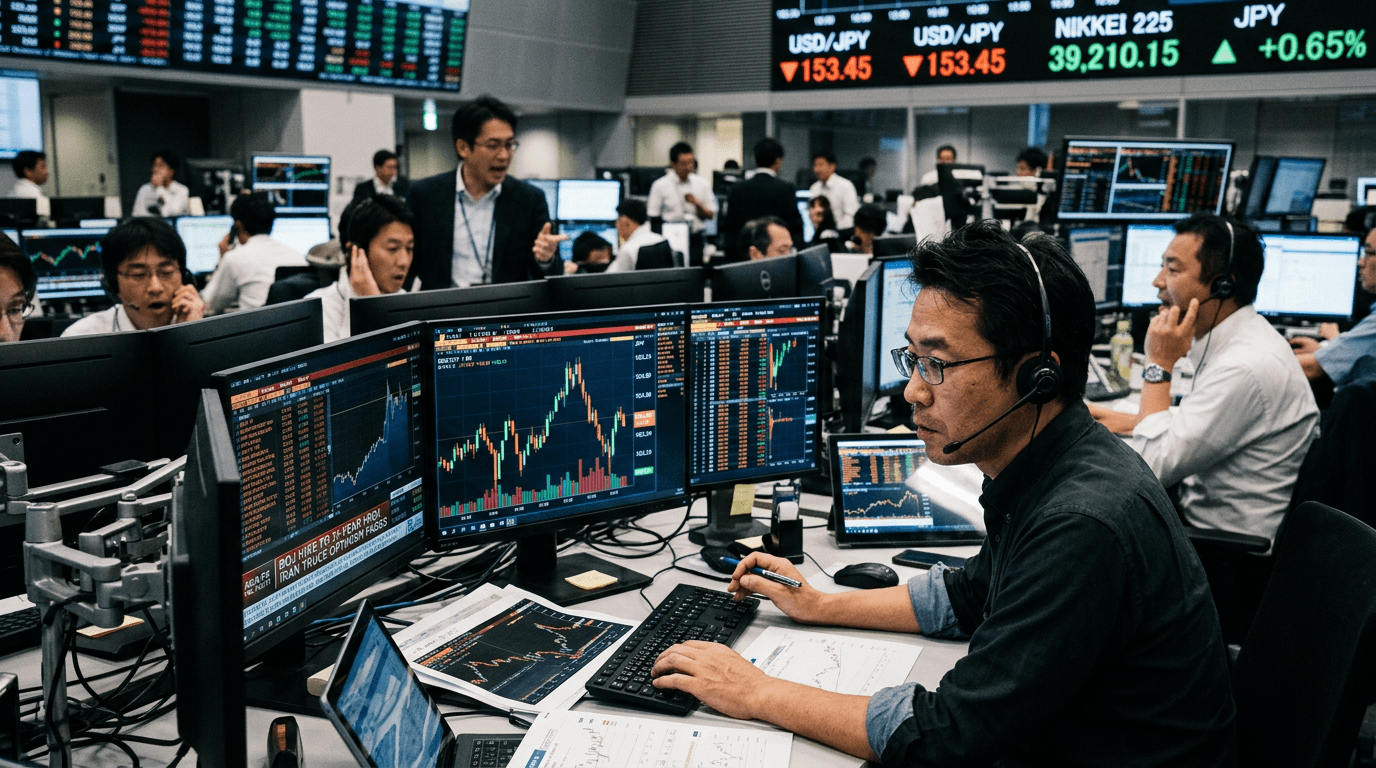
The U.S. dollar has found its footing again, stabilizing against major peers as early optimism over an Iran truce fades and attention swings to a historic move from the Bank of Japan, which has hiked rates to a 31-year high. At the same time, the BOJ’s shift away from ultra-easy policy is colliding with geopolitically driven safe-haven flows, keeping USD/JPY and broader Asia FX especially volatile. For traders, this is a classic example of how macro narratives can flip quickly – and why risk management and scenario planning matter as much as the trade idea itself.
Iran Truce Optimism Meets Safe-haven Reality
In recent sessions, headlines around a potential ceasefire or peace framework between the United States and Iran initially pushed the dollar lower as traders rotated into risk assets such as equities.[2][4][5] Historically, when tensions in the Iran conflict have eased, investors have stepped away from the safe-haven dollar and into higher-beta trades, mirroring earlier episodes where talk of reopening key shipping routes lifted market sentiment.[1][2][5]
But those relief rallies rarely come with guarantees. As traders scrutinize the fine print of draft agreements and note that key commitments still need political approval, the initial “risk-on” impulse has faded.[1][2][5] Markets have been reminded that ceasefire headlines can be fragile, and that a lingering “war premium” in energy and inflation expectations remains embedded in pricing.[5] That uncertainty has nudged portfolios back toward the dollar, reasserting its role as a defensive anchor in times of geopolitical doubt.[2][3]
Why The Dollar Is Holding Its Ground
The current phase is less about an aggressively strengthening dollar and more about a stabilization after a knee-jerk selloff on truce optimism.[2][3] The dollar index has tended to edge only modestly higher or remain broadly flat in recent trading, reflecting a push-and-pull between hopes for de-escalation and reminders that the situation can still deteriorate.[2][3] This kind of “sticky” dollar behavior is typical when markets are caught between competing macro forces.
Safe-haven demand remains a key driver. Episodes such as U.S. strikes on Iranian targets have previously seen the dollar firm as investors seek liquid, defensive assets.[3] When those risks appear to recede, the dollar softens; when doubts re-emerge, buyers return.[2][4][5] Oil dynamics add another layer: progress toward reopening strategic shipping lanes has contributed to lower crude prices at times, easing inflation fears and supporting risk sentiment, yet any sign that deals might falter can quickly flip that narrative.[1][5] For FX traders, the lesson is that geopolitically driven flows are rarely one-way and can reverse on single headlines.
Boj At A 31-year High: Why It Matters
Against this backdrop, the Bank of Japan has added a powerful new driver to FX markets by raising interest rates to their highest level in more than three decades. That move marks a significant acceleration in Japan’s exit from an era of near-zero and negative rates, and it directly challenges one of the core foundations of the global carry trade: cheap yen funding. For years, traders have borrowed in yen to buy higher-yielding assets elsewhere; a higher policy rate makes that strategy less straightforward and potentially more volatile.
The new 31-year high in Japanese rates does not suddenly turn Japan into a high-yield market, but it does narrow the gap versus other major central banks and sends a clear signal that the BOJ is more willing to prioritize inflation control and currency stability. That has important implications for USD/JPY. On one side, a firmer dollar, supported by safe-haven flows and relatively higher U.S. yields, still points toward upside pressure.[2][3] On the other, a more assertive BOJ and the risk of official intervention around key psychological levels – historically near the 160 area per dollar – act as a strong cap on runaway yen weakness.[2][3] The result is a pair primed for sharp swings as macro narratives evolve.
Implications For Fx And Simulated Traders
For discretionary traders – whether in live markets or on SimFi platforms – this environment demands respect for volatility, especially in yen and Asia FX crosses. When the dollar is being pulled by both geopolitics and central-bank divergence, technical levels can break quickly and then snap back just as fast. USD/JPY, EUR/JPY, and AUD/JPY are likely to remain sensitive to both BOJ communications and any fresh news on the Iran front, while regional currencies in Asia can feel the ripple effects through risk sentiment and trade links.
Practically, that argues for tighter risk protocols and more dynamic trade management. Position sizing should reflect the potential for intraday spikes around headlines, and traders may want to define clear invalidation levels rather than “averaging down” in choppy markets. Scenario testing is especially useful: in a simulated environment you can map out how your strategy performs under three broad regimes – (1) renewed escalation in Iran and stronger safe-haven flows into the dollar, (2) a durable truce that sustains risk-on appetite, and (3) a BOJ path that turns more or less hawkish than expected. Those exercises help refine reaction plans before the next surprise hits the tape.
Key Takeaways For Your Trading Playbook
Several themes stand out. First, the dollar’s stabilization reflects a classic safe-haven pattern: when ceasefire optimism wobbles, capital flows back toward the greenback.[2][3][4] Second, geopolitics and central banks are interacting, not acting in isolation; BOJ’s move to a 31-year high in rates is reshaping the yen narrative at the same time that headlines from the Middle East are jolting risk sentiment. Third, USD/JPY and Asia FX are likely to remain focal points for volatility as traders reassess both the end of ultra-cheap yen funding and the durability of any Iran truce. For traders, live or simulated, the edge will go to those who treat macro events not as one-off surprises but as evolving storylines – adjusting exposure, testing scenarios, and letting risk management dictate how aggressively to press each view.