
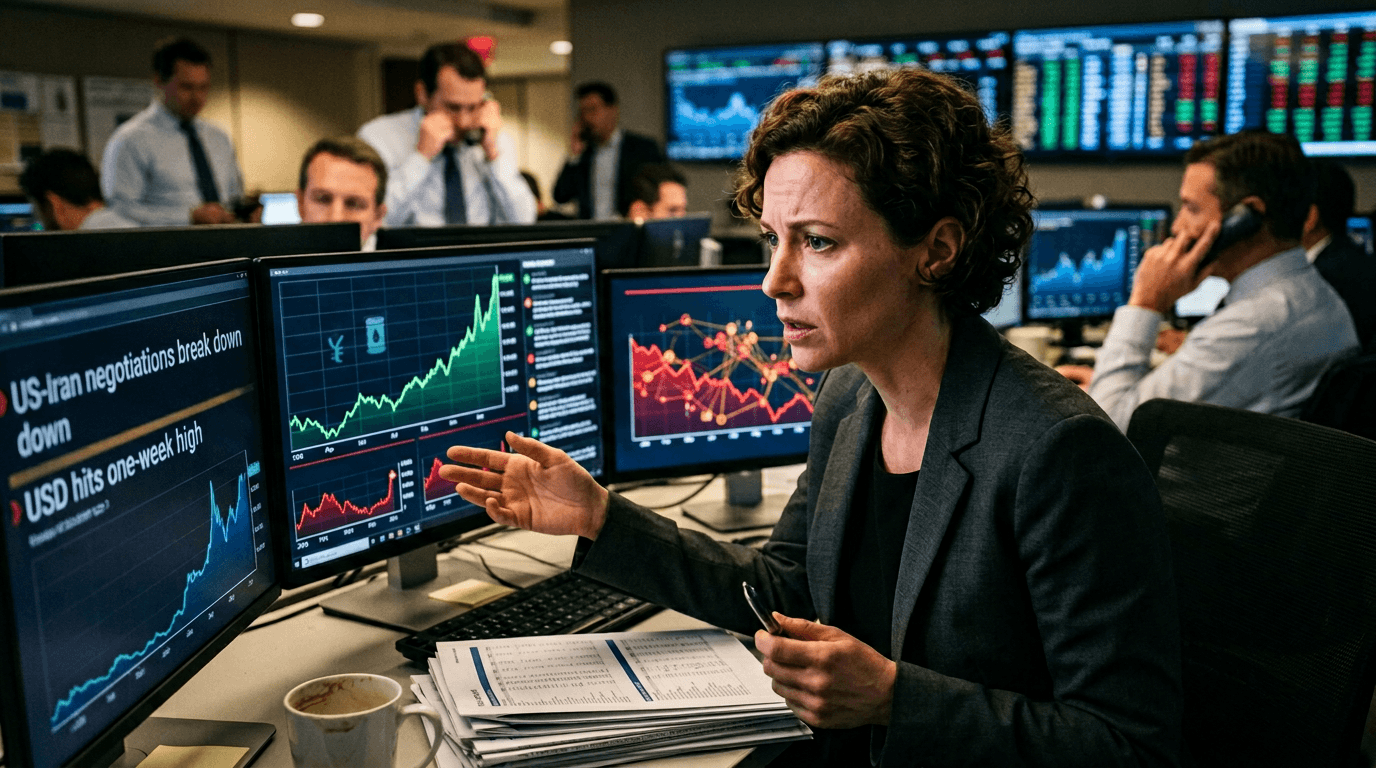
The U.S. dollar has surged to its highest point in a week amid escalating tensions between Washington and Tehran, following the collapse of peace negotiations in Islamabad. This development has triggered a classic flight-to-safety response in global markets, with investors seeking secure and liquid assets. The dollar's role as the global reserve currency and its access to the deepest debt markets position it as the world's ultimate safe-haven currency during times of heightened uncertainty.
The Mechanics Of Safe-haven Demand
When geopolitical threats rise, investors don't just sit on cash—they actively shift their capital into perceived secure stores of value. Historically, during international crises, the U.S. dollar, Japanese yen, and Swiss franc have been the preferred safe-haven currencies. The dollar, however, holds a unique advantage due to its status as the global reserve currency and the unmatched depth and liquidity of U.S. Treasury markets. The recent tensions between the U.S. and Iran have underscored this phenomenon, with the dollar index reaching 98.36 on April 22, 2026.
This movement is driven by both psychological and structural factors. As news impacts global markets, algorithmic trading systems adjust risk parameters instantaneously, leading to a cascade of sell orders in equities and emerging market currencies, while simultaneously purchasing U.S. Treasuries and dollars. The dollar's strength is not just a reflection of its own merits, but of its critical role in the world's most trusted debt market. As one analyst puts it, the dollar gains strength because institutional investors require dollars to buy Treasury bonds during uncertain times.
The Current Crisis And Market Response
The breakdown of U.S.-Iran peace talks has significantly altered market sentiment. Earlier hopes for successful negotiations vanished when Tehran insisted on maintaining its nuclear ambitions, prompting the U.S. to threaten blocking Iranian tankers in the Strait of Hormuz. This impasse has widened the dollar's value gap and renewed safe-haven demand.
The oil market has reacted strongly to these events. The ongoing Middle East conflict has already removed about 13 million barrels per day from the global oil supply. The potential restriction of 2 million barrels per day in Iranian exports is pushing Brent crude prices upwards, which could have ripple effects on currency markets. In recent months, the U.S. dollar index and Brent crude have moved in tandem, creating a feedback loop where rising oil prices bolster dollar strength through inflationary expectations and safe-haven positioning.
Additionally, Federal Reserve nominee Kevin Warsh's hawkish remarks during Senate hearings have further supported the dollar's strength. His comments, viewed by markets as indicating a more aggressive monetary stance, coupled with strong U.S. retail sales data, reinforce perceptions of American economic resilience. This narrative complements the safe-haven demand, forming a multifaceted foundation for the dollar's appreciation.
Broader Economic Implications
The current scenario poses a double-edged sword for global economies. A prolonged closure of the Strait of Hormuz could severely impact Europe and Asia, whose economies are heavily reliant on stable energy supplies through this crucial passage. Analysts have already increased the probability of a U.S. recession within the next year from 27 percent to 33 percent, also projecting slower GDP growth and higher inflation than previously expected.
Specifically, Wall Street experts now anticipate U.S. GDP growth of 2 percent instead of 2.2 percent, with inflation expected to rise to 3.2 percent by the end of 2026, up from an earlier estimate of 2.6 percent. In March, U.S. core inflation saw a modest 0.2 percent month-over-month increase and 2.6 percent year-over-year growth. However, April figures are likely to show acceleration due to higher oil prices and secondary inflationary effects permeating the economy. This stagflationary environment fuels speculation about possible Federal Reserve rate hikes, which could further bolster the dollar through increased yield differentials attracting foreign capital.
What Traders Should Consider
The current dynamic offers distinct scenarios for investors. In a pessimistic scenario, Tehran might target Saudi Arabia's alternative oil routes while Houthis block the Bab al-Mandeb Strait, causing extensive supply disruptions. Conversely, potential resumption of negotiations could lead to dollar weakness if tensions ease. This binary outlook creates significant trading opportunities for those well-positioned across currency, energy, and fixed-income markets.
The dollar's rise is a direct indicator of growing geopolitical anxiety. As tensions heighten, its fundamental role as the world's preeminent safe-haven asset is reaffirmed. However, the long-term trajectory will depend on diplomatic developments, energy market stability, and the Federal Reserve's response to the shifting currents of risk aversion and inflationary pressures. Both investors and policymakers are closely watching the situation, recognizing that in times of crisis, capital seeks the security of depth and liquidity above all else.