
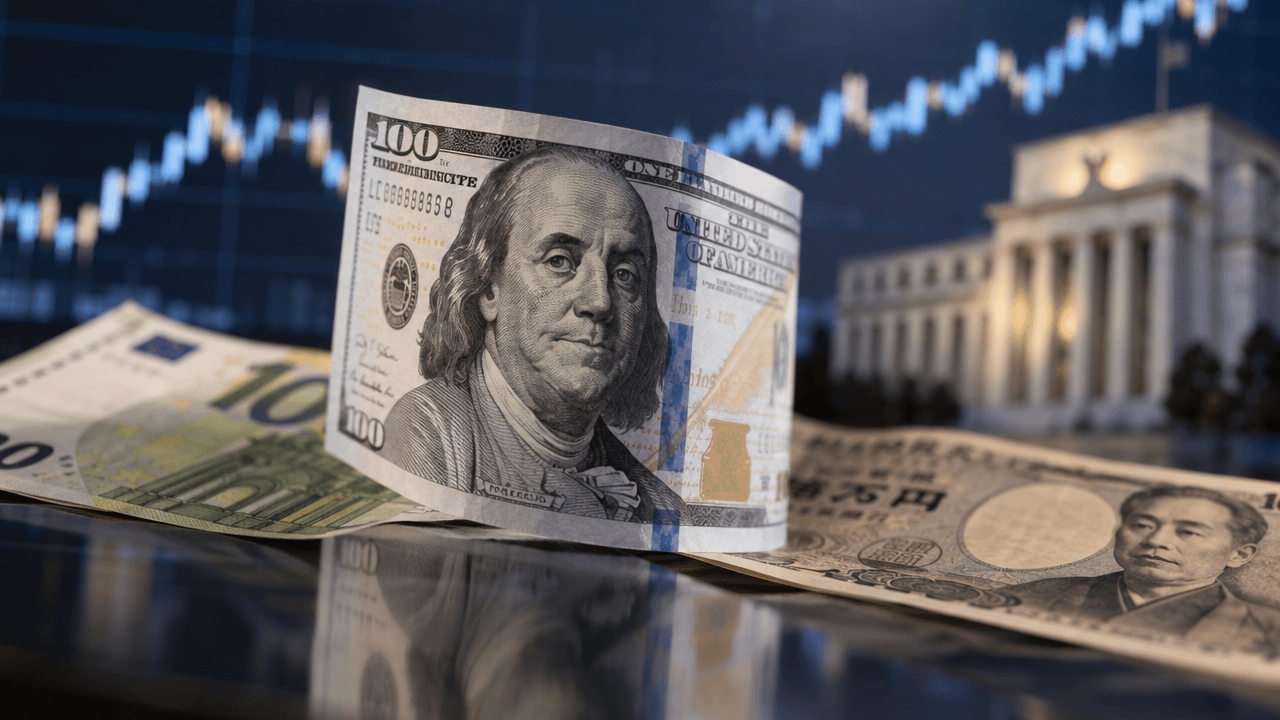
The U.S. dollar has climbed to a 19-month high as resilient economic data and renewed confidence in Federal Reserve rate increases reshape expectations across global markets. The dollar index rose to approximately 103.8, its strongest level since April 2025, after U.S. retail-sales and inflation data strengthened the case for another increase in borrowing costs. Markets are now fully pricing a 25-basis-point Federal Reserve hike in December, with a smaller possibility of a larger move. [1]
For traders, the dollar’s advance is more than a headline about currency strength. It reflects changing expectations about interest rates, economic growth and the relative appeal of U.S. assets. The move also highlights the pressure a stronger dollar can place on the euro, yen, commodities and emerging-market currencies.
Why The Dollar Is Rising
Currency markets are driven largely by differences in expected interest rates. When traders anticipate that U.S. rates will remain higher for longer, demand for dollar-denominated assets can increase. Higher yields on government bonds and other investments may attract international capital, creating additional demand for the currency.
Recent U.S. data has reinforced that outlook. Retail sales rose 0.2% in October, matching expectations, while the underlying control group increased 0.6%. Import prices also rose 1.1%, above the 0.7% forecast, suggesting that price pressures may remain more persistent than previously expected. [10]
The data does not necessarily indicate that the U.S. economy is overheating. Instead, it suggests that consumers and businesses retain enough momentum to withstand higher interest rates. That gives policymakers more room to focus on inflation without immediately prioritizing economic support.
Federal Reserve officials have also adopted a more cautious tone toward easing. If inflation remains stubborn and demand continues to hold up, traders may expect the central bank to maintain restrictive policy for longer. That expectation can support the dollar even before the Federal Reserve formally changes rates.
What The December Hike Means
A 25-basis-point increase would be relatively small in historical terms, but its market impact depends on what follows. Investors are constantly comparing the actual policy decision with the outcome already reflected in asset prices.
Because markets are already pricing a December hike with a high degree of confidence, the decision itself may not generate a dramatic dollar rally. The larger question will be whether Federal Reserve officials signal another increase in early 2027, or whether they suggest that December could be the final move in the tightening cycle.
This distinction matters for SimFi traders. A trader who buys the dollar immediately before the meeting may be positioned for an outcome that is already priced in. If the Fed raises rates but communicates caution about future increases, the dollar could weaken as traders take profits. Conversely, a stronger-than-expected message on inflation or additional hikes could push Treasury yields and the dollar higher.
The practical lesson is to analyze both the rate decision and the accompanying guidance. Interest-rate expectations, not simply the current policy rate, are often the most important short-term driver of currency markets.
Euro Pressure And Relative Growth
The euro fell toward $1.0965 as the dollar strengthened. [1] The decline illustrates how foreign-exchange markets compare economies rather than evaluating each currency in isolation.
If U.S. growth remains more resilient than growth in the eurozone, investors may continue to favor dollar assets. A wider expected interest-rate gap between the Federal Reserve and European Central Bank would reinforce that preference. Weakness in the euro can also reflect concerns about industrial activity, consumer demand or the pace of future European rate adjustments.
However, the euro’s decline should not automatically be interpreted as the beginning of a one-way move. Currency markets can reverse quickly when economic data changes. A softer U.S. inflation reading, weaker employment report or more dovish Federal Reserve communication could reduce the dollar’s yield advantage.
For traders, key levels should be treated as areas of decision-making rather than guaranteed turning points. Combining price action with economic calendars, bond yields and central-bank communication can provide a more complete view than relying on a single exchange-rate level.
The Yen And Intervention Risk
The yen remained near 159.3 per dollar, close to levels associated with previous Japanese intervention. [1] The currency’s weakness reflects the continuing influence of interest-rate differentials: U.S. rates are expected to remain relatively high, while Japan’s monetary policy remains more accommodative despite signs that further tightening may be possible.
A weaker yen can support Japanese exporters, but it also increases the cost of imported energy, food and raw materials. That can intensify political pressure on Japanese authorities to respond if currency movements become disorderly.
Intervention risk makes dollar-yen trading especially sensitive near the 160 level. A trader may correctly identify the broader trend but still face a sharp reversal if Japanese officials act or issue unusually forceful warnings. Position sizing, stop-loss discipline and awareness of official comments are therefore essential.
Practical Takeaways For Traders
First, distinguish between a confirmed rate hike and a change in expectations. The dollar often moves before the central bank meeting because traders adjust positions as new data arrives.
Second, monitor U.S. Treasury yields. A rising dollar accompanied by higher yields may indicate that markets are pricing a more restrictive Federal Reserve. If the dollar rises while yields fall, the move may reflect safe-haven demand or weakness in other regions instead.
Third, watch for data that could challenge the current narrative. Inflation, employment, retail sales and consumer spending will help determine whether the December hike becomes the start of a longer tightening phase or the final increase.
Finally, avoid treating a 19-month high as proof that the dollar must continue rising. Strong trends can persist, but extended moves also create conditions for profit-taking and volatility. A disciplined plan should define the trade thesis, invalidation level and maximum acceptable loss before entering a position.
Conclusion
The dollar’s climb to approximately 103.8 reflects a powerful combination of resilient U.S. demand, persistent inflation concerns and rising expectations for Federal Reserve tightening. The euro has weakened toward $1.0965, while the yen remains under pressure near a politically sensitive level. [1]
The next major market question is not simply whether the Fed raises rates in December. It is whether policymakers validate expectations for additional tightening. Until that answer becomes clearer, traders should expect interest-rate expectations, bond yields and central-bank communication to remain the main forces shaping the dollar.