
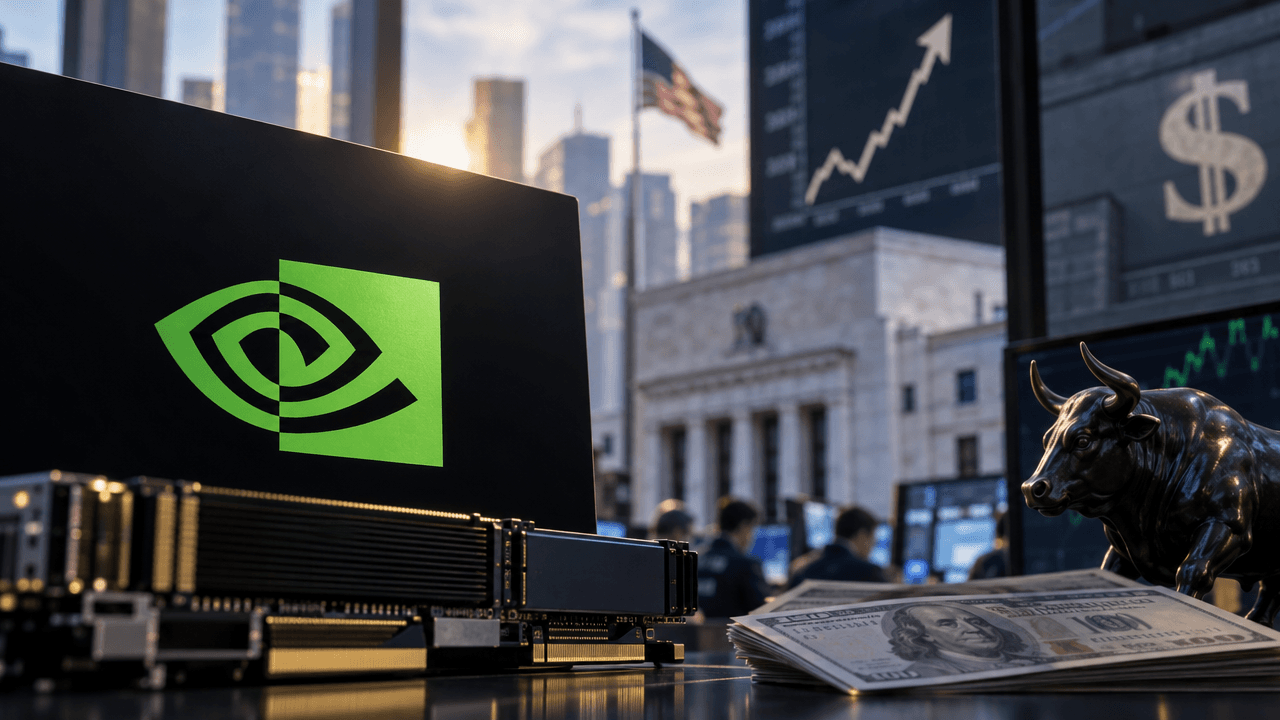
U.S. equity futures moved higher after Nvidia delivered another powerful earnings report, with Nasdaq 100 futures leading the advance. S&P 500 futures gained about 0.8%, while Nasdaq 100 futures rose approximately 1.4%, signaling renewed demand for technology and artificial-intelligence shares. The reaction shows how heavily investor sentiment still depends on the AI growth story, even as higher interest rates and a stronger dollar continue to create challenges for risk assets.
Nvidia’s results helped calm investors after a difficult stretch for technology stocks. The chipmaker reported third-quarter revenue of approximately $115.8 billion, up 103% from the same period a year earlier, while adjusted earnings reached $2.68 per share. Both figures exceeded analyst expectations. Nvidia also offered a stronger revenue outlook, reinforcing the view that demand for data-center infrastructure and advanced AI computing remains resilient. [5][6]
WHY NVIDIA’S RESULTS MATTERED
Nvidia has become more than just one company in the semiconductor industry. Its earnings are widely treated as a real-time indicator of corporate spending on artificial intelligence. Cloud providers, technology companies, and large enterprises continue to invest heavily in computing capacity, and Nvidia supplies many of the chips and systems required to support that expansion.
The company’s forward guidance was especially important. Nvidia indicated that fourth-quarter revenue could reach roughly $130 billion, plus or minus 3%, while its longer-term revenue growth outlook also improved. That guidance gave investors fresh evidence that AI infrastructure demand has not yet slowed materially. [9][11]
For markets, the message was straightforward: the earnings power behind the AI trade remains strong enough to offset at least some concerns about stretched valuations, market volatility, and a possible slowdown in technology spending.
Why Nasdaq Futures Led The Move
The Nasdaq 100 has a high concentration of technology and growth companies, many of which are directly or indirectly linked to artificial intelligence. When Nvidia rises, the impact can spread across chipmakers, cloud-computing providers, software companies, data-center operators, and firms that are investing in AI tools.
That explains why Nasdaq futures rose more sharply than S&P 500 futures. Nvidia’s gains can influence index performance both through its own market capitalization and through the broader confidence it creates across the technology sector. Early reports showed Nasdaq 100 futures rising between 0.8% and more than 1%, while S&P 500 futures also moved higher. [3][12]
The advance should not automatically be interpreted as a complete reversal of the recent market weakness. Futures reflect expectations before the opening bell, and those expectations can change as investors assess bond yields, economic data, Federal Reserve communication, and the actual trading behavior of technology shares during the session.
The Macro Headwinds Remain
A strong Nvidia report improves the earnings outlook for technology stocks, but it does not eliminate macroeconomic pressure. The U.S. dollar remains firm, and higher real yields can make growth-oriented equities less attractive. When bond yields rise, the present value of future corporate earnings declines, which can place pressure on companies whose valuations depend on profits expected several years from now.
Recent market conditions have reflected this tension. Even as Nvidia delivered strong numbers, the 10-year Treasury yield was around 5.09% and the U.S. Dollar Index was above 103, both of which can restrict the upside for risk assets. [7]
A stronger dollar can also affect multinational companies by reducing the value of overseas revenue when converted back into U.S. currency. Higher rates may increase financing costs and encourage investors to demand more attractive valuations before buying growth stocks. As a result, Nvidia’s earnings may support a rally, but the durability of that rally will depend partly on whether yields stabilize.
What Traders Should Watch Next
The first issue is breadth. If the rally remains concentrated in Nvidia and a small group of mega-cap technology companies, the market may be vulnerable to sharp reversals. A healthier advance would involve participation from semiconductor stocks, software companies, industrial firms, consumer sectors, and smaller companies.
The second issue is price action. Traders should watch whether the Nasdaq can hold gains after the opening bell, whether Nvidia remains above its pre-earnings range, and whether trading volume confirms the move. A strong opening followed by heavy selling could indicate that investors are using good news to reduce exposure rather than initiate new positions.
The third issue is interest-rate sensitivity. Strong equity performance alongside stable or falling Treasury yields would provide a more supportive backdrop. Conversely, rising yields could limit the market’s response even if corporate earnings remain impressive.
For SimFi traders, this is an opportunity to practice separating news from trade execution. A positive earnings surprise does not guarantee a profitable long position. Traders can define a setup in advance, identify key support and resistance levels, establish a maximum risk amount, and avoid chasing a sharp move after the market has already reacted.
Conclusion
Nvidia’s earnings gave U.S. equity futures a powerful lift and renewed optimism around the AI investment cycle. The stronger reaction in Nasdaq futures reflects the company’s influence across the technology ecosystem and the market’s continued focus on earnings growth.
However, the broader environment remains mixed. A stronger dollar, elevated Treasury yields, and uncertain rate expectations could limit follow-through. The most important question is not simply whether futures rise after Nvidia’s report, but whether the gains broaden across the market and hold through changing macroeconomic conditions.
For traders, the practical lesson is clear: major earnings reports can create opportunity, but disciplined risk management matters more than headline excitement. Strong fundamentals may start a rally; sustained price action, market breadth, and favorable macro conditions determine whether it lasts.