
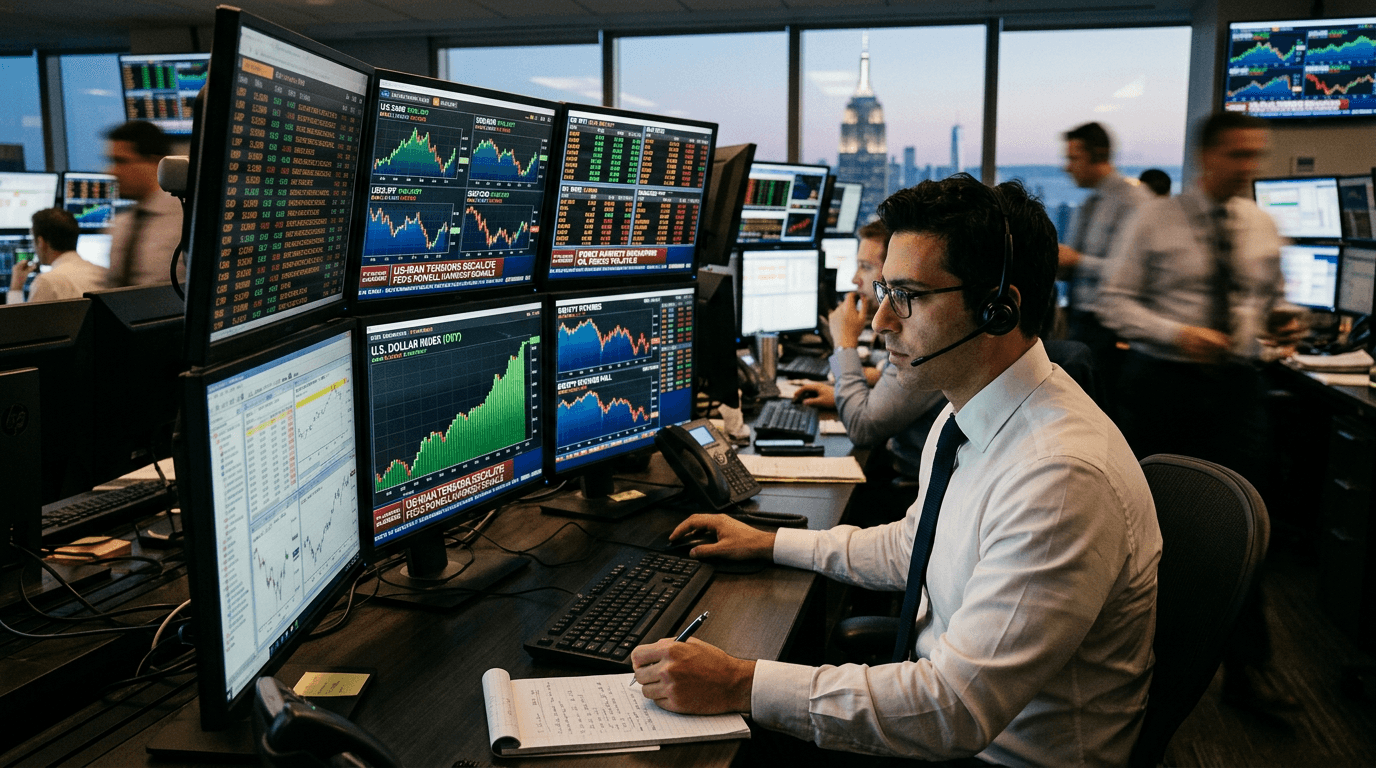
The US dollar is climbing as traders weigh a tense U.S.–Iran standoff against a Federal Reserve that is signaling it may need to keep rates higher for longer, pulling capital into the greenback and away from risk‑sensitive assets.[8][10][12] Safe‑haven demand and elevated U.S. yields are pushing the dollar index toward recent highs, pressuring major currencies, oil‑linked FX, and equity futures that are tightly tied to global risk sentiment.[6][8][15]
Market Backdrop: A Dollar Dominated Session
Recent sessions have seen the U.S. dollar index grind higher, with moves of roughly 0.1–0.2% on the day taking the gauge back into the low‑101 area, near its strongest levels since early July.[6][8] In some instances, the index has touched one‑week or multi‑week highs as geopolitical headlines intensified, underscoring how quickly risk aversion can feed into FX markets.[10][12] For traders, this backdrop reflects a classic “risk‑off” rotation: capital leaves cyclical and higher‑beta assets and migrates into the perceived safety of the world’s reserve currency.[5][8]
The U.S.–Iran confrontation has added a geopolitical risk premium to markets, with reports of airstrikes, maritime tensions, and sharper diplomatic rhetoric raising fears of supply disruptions and wider regional instability.[8][10][12] This risk premium is visible not only in the dollar but also in firmer oil prices, as traders price in potential pressure on Gulf shipping lanes and energy infrastructure.[5][12] As energy benchmarks edge higher, the inflation outlook becomes more complex, keeping the focus squarely on the Fed’s response.[11][13]
Why Geopolitical Tensions Boost The Greenback
Geopolitical shocks tend to drive a flight to quality, and the U.S. dollar remains one of the world’s preferred safe‑haven assets, alongside Treasuries, the Swiss franc, and gold.[5][7] In the current U.S.–Iran faceoff, analysts have highlighted that the dollar’s rise has been closely linked to a surge in demand for safe assets as investors hedge against escalation risk.[8][12] The move has been reinforced by higher U.S. yields, creating a combination of “safety plus carry” that is particularly attractive in periods of uncertainty.[10][14]
History shows that the dollar does not always strengthen during conflicts, but when geopolitical stress coincides with a relatively hawkish Fed, the greenback often outperforms.[4][9] During the Ukraine conflict, for instance, aggressive rate hikes helped drive a double‑digit percentage gain in the dollar index over six months, illustrating how policy can amplify safe‑haven flows.[4] Today’s U.S.–Iran tensions are interacting with similar monetary dynamics, though markets are also aware that sustained energy shocks could eventually weigh on growth and risk appetite more broadly.[11][13]
Fed Rhetoric: Higher For Longer Supports Usd
On the monetary side, recent communications from the Fed have emphasized a willingness to keep rates elevated and even entertain additional hikes if inflation proves sticky, particularly in the wake of war‑driven moves in oil and gas.[9][13][14] Fed minutes and public remarks from policymakers have highlighted concern that higher energy prices could rekindle price pressures, pushing the central bank to keep policy tight for an extended period.[11][13][14] That stance has pushed key Treasury yields to multi‑month highs, with some benchmark maturities rising well above 4%, a move that directly supports the dollar via rate differentials.[10][14]
For FX markets, the message is clear: as long as the Fed is perceived as hawkish relative to other major central banks, the dollar retains a structural advantage.[9][10] In recent weeks, this combination of geopolitics and policy has helped the dollar log its best weekly performance in months, with weekly gains exceeding 1% against a basket of peers.[10] Traders are increasingly pricing a “higher for longer” scenario where rate cuts come later and slower than previously expected, cementing support for the greenback even if growth moderates.[9][13]
Cross-asset Ripple Effects: Forex, Oil-linked Fx, Equity Futures
The dollar’s climb is weighing on several major and emerging‑market currencies, especially those tied to commodity exports and external funding needs.[5][8] Oil‑linked FX such as the Canadian dollar and certain Middle Eastern currencies have faced a tug‑of‑war between higher energy prices (supportive) and a stronger dollar plus risk‑off flows (negative).[5][15] Emerging‑market FX with large dollar‑denominated debt stocks are particularly vulnerable, as rising U.S. yields increase borrowing costs and can trigger portfolio outflows.[7][10]
Equity futures tied to global risk sentiment have softened as investors reassess earnings and valuations under the dual pressure of geopolitics and tighter financial conditions.[9][10] Higher discount rates compress valuation multiples, while war‑related uncertainty raises the probability of downside surprises in corporate profits, particularly in energy‑intensive sectors.[11][13] In this environment, defensive sectors and companies with strong balance sheets tend to outperform, while high‑beta and heavily leveraged names can lag significantly.[7][10]
Practical Takeaways For Traders And Simulated Finance Users
For discretionary traders, algorithmic strategies, and SimFi participants alike, this episode offers a live case study in how macro shocks propagate through FX, rates, and equities.
Key practical takeaways include
1) Track the dollar index alongside geopolitical headlines Monitoring intraday moves in the DXY against news on U.S.–Iran tensions helps clarify whether markets are in a risk‑on or risk‑off regime.[6][8][12] Sudden spikes in the index often coincide with escalatory events, while periods of diplomatic calm can see modest reversals.[10][12]
2) Respect the rate differential channel A hawkish Fed combined with rising Treasury yields is a powerful driver for dollar strength versus lower‑yielding currencies.[9][10][14] In SimFi environments, traders can test strategies that go long USD against currencies where central banks are closer to easing, and examine how changing yield spreads alter performance over time.
3) Hedge commodity and FX exposure Oil‑linked FX and energy‑sensitive sectors face conflicting forces from higher crude prices and tighter dollar liquidity.[5][15] Simulated portfolios allow traders to explore hedging structures—such as pairing long energy exposure with short high‑beta FX or equity indices—to reduce drawdowns in volatile regimes.
4) Stress‑test risk models with geopolitical scenarios SimFi platforms are well suited to running scenario analyses where volatility, correlations, and liquidity assumptions are shocked based on historical conflict episodes.[4][9] By stress‑testing portfolios against sudden dollar surges and equity sell‑offs, traders can identify leverage points and refine position sizing before deploying capital in live markets.
Conclusion: Risk, Policy, And The Value Of Preparation
The latest rise in the U.S. dollar underlines how quickly geopolitical tensions and central bank rhetoric can reshape global markets, rewarding those who pay attention to macro drivers and penalizing strategies that ignore cross‑asset linkages.[8][9][10] As the U.S.–Iran faceoff continues, the combination of safe‑haven flows and elevated U.S. yields is likely to keep the greenback supported, with implications for forex majors, oil‑linked currencies, and equity futures that hinge on global risk appetite.[5][8][15] While no one can predict the exact trajectory of either the conflict or the Fed, traders can prepare by building robust frameworks, running realistic simulations, and stress‑testing portfolios against a range of outcomes.
In a world where geopolitical risk and monetary policy increasingly interact, simulated finance offers a controlled environment to learn, experiment, and refine strategies before the next bout of volatility hits live markets.[4][9] Using episodes like the current dollar surge as learning laboratories helps traders move beyond headline reactions toward disciplined, data‑driven decision‑making—an edge that becomes invaluable when risk spreads quickly across the global financial system.[7][10]