
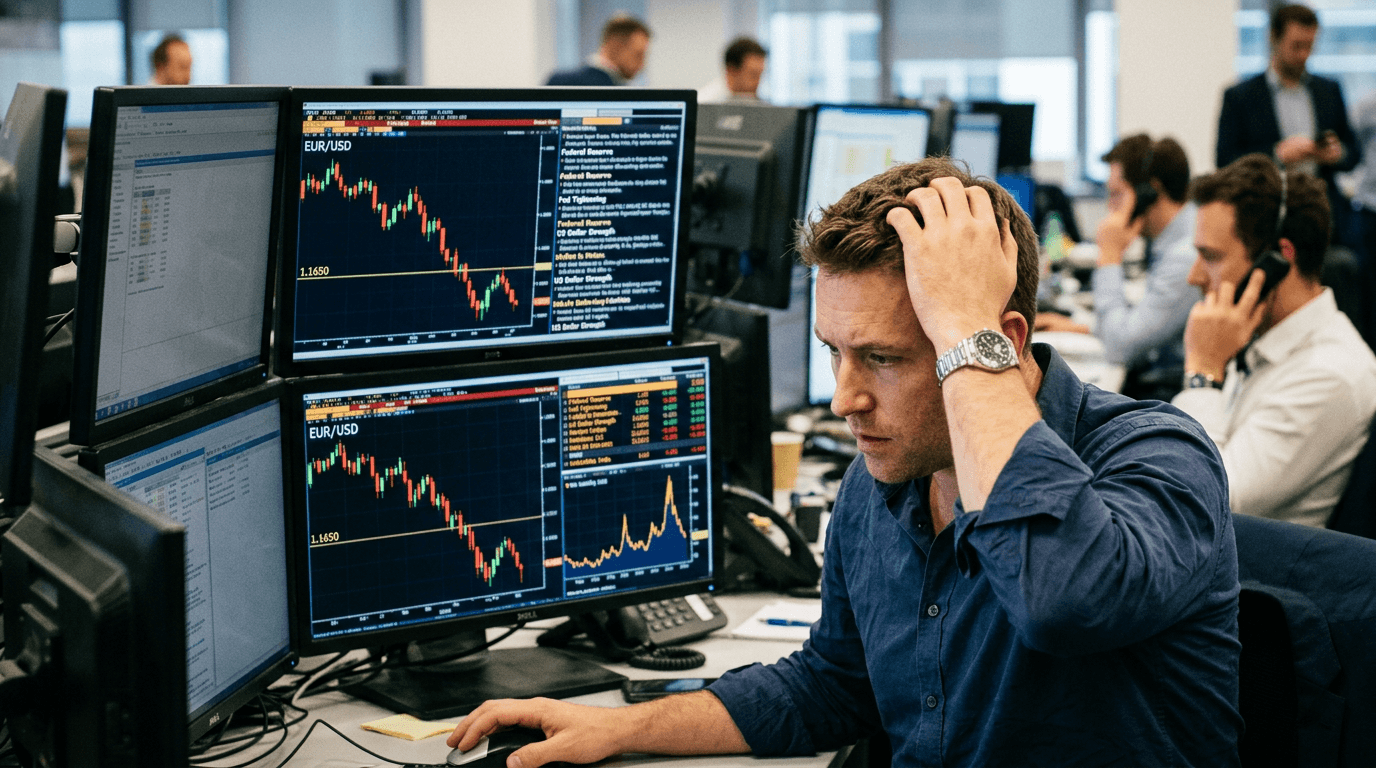
The U.S. dollar is tightening its grip on global markets as the euro slips below the 1.1650 threshold, signalling a renewed phase of dollar strength tied to rising expectations for Federal Reserve tightening.[7][8][9] This move is already feeding into broader forex volatility, with traders reassessing risk across major currency pairs and equity markets as policy divergence between the U.S. and Europe comes back into focus.[7][8][13]
Market Snapshot: Dollar Surge And Euro Slip
The latest leg higher in the dollar was sparked by stronger-than-expected U.S. inflation data, which pushed the dollar index to a two-week high and nudged Treasury yields higher.[7][8][15] A hotter CPI print reinforced the view that the Fed may need to keep policy tighter for longer, with markets now pricing a meaningful chance of a larger rate hike at upcoming meetings.[7][8]
On the other side of the trade, EUR/USD has broken below 1.1650 after reversing from levels above 1.1700 earlier in the week, leaving the pair at weekly lows and extending a two-day losing streak.[7][9] The move has taken the euro back toward multi-week low territory against the dollar, undoing part of the recovery seen in recent months as investors briefly bet on a softer U.S. stance.[1][6][11]
The combination of stronger U.S. data, higher yields and a firmer dollar index has revived the discussion around policy divergence, with traders again rewarding the currency backed by relatively higher expected real yields.[8][13][14] The result is a market environment where dollar strength and euro weakness are not just price action stories but reflections of shifting macro expectations.
WHY THE U.S. DOLLAR IS BACK IN DEMAND
There are three core drivers behind the renewed demand for the greenback: interest rate expectations, yield dynamics and risk sentiment. As U.S. inflation data surprises to the upside, futures markets have increased the implied probability of a 25–50 basis point hike at the next Fed meeting, or at least a longer period of restrictive policy.[7][8][13] Higher expected policy rates translate directly into higher discount rates and more attractive dollar-denominated yields for global investors.[15]
At the same time, commentary from Fed officials has pushed markets to reassess the timing of any easing cycle, reducing expectations of near-term rate cuts and reinforcing the “higher for longer” narrative.[13][14] In contrast, some other major central banks are either nearer to the end of their tightening cycles or facing softer domestic growth, which limits their ability to match U.S. yields.[13][14] That policy divergence is a classic backdrop for a stronger dollar.
Risk sentiment is also playing a role. Periods of higher volatility and uncertainty often drive investors into perceived safe-haven assets, and the dollar still sits at the core of that complex.[2][3] Recent swings in tech stocks and broader risk assets have supported defensive flows into cash and short-dated U.S. instruments, reinforcing the bid for the U.S. currency.[2][3][15]
What A Weaker Euro Means For Global Markets
The euro’s slip below 1.1650 is more than a simple technical break; it carries implications for European assets, global trade and cross-border capital flows.[4][5][9] A weaker euro can be a double-edged sword for the Eurozone: it helps exporters by making their goods cheaper in dollar terms, but it raises the local currency cost of imported commodities and energy, potentially complicating the inflation outlook.
For global equity markets, sustained dollar strength has historically acted as a headwind for risk assets, particularly in emerging markets that borrow heavily in U.S. dollars.[2][3] As the dollar appreciates, servicing that debt becomes more expensive in local currency terms, which can pressure corporate earnings and sovereign balance sheets in those regions. That dynamic often leads investors to reassess exposure to higher-beta assets when the dollar moves sharply.
Commodity markets are another key transmission channel. Because most major commodities are priced in dollars, a stronger greenback can weigh on prices in local currency terms for non-U.S. buyers, potentially dampening demand.[2][3] At the same time, producers receiving dollar revenues may experience relative gains versus domestic costs, creating sector-specific opportunities and risks.
For forex traders, the euro’s move back toward multi-week lows versus the dollar revives familiar themes: trend-following strategies, carry trades and volatility-based positioning.[1][6][9] Price action around 1.1650 is now a live test of whether the market accepts a new, lower trading range for EUR/USD or treats this as a temporary overshoot.
How Traders Can Navigate Heightened Forex Volatility
From a trading perspective, levels like 1.1650 matter because they often act as pivot points for both discretionary and systematic strategies.[4][5] Analysts have flagged that a confirmed break and close below this area shifts the structural bias more decisively to the downside, opening room for further euro weakness if dollar strength persists.[4][5] That kind of level-based framework is useful not just for chartists but for any trader trying to map risk.
In periods of heightened volatility, risk management becomes as important as directional views. Position sizing, clear stop-loss placement and scenario planning around key macro events—such as Fed meetings, inflation releases and central bank speeches—are essential. Traders can benefit from stress-testing their portfolios against scenarios where the dollar index retests or exceeds recent highs while EUR/USD explores lower ranges.
Technical compression in EUR/USD seen around the 1.1650 cap earlier in recent months suggested the pair was poised for a larger break once macro clarity emerged.[5] The current downside move is consistent with that view and underlines why traders should pay attention to consolidation zones: once the range resolves, follow-through can be swift, especially when macro catalysts align.
Role Of Simulated Finance In This Environment
For traders using Simulated Finance platforms such as E8 Markets, this type of environment is ideal for building and testing robust strategies without immediate capital at risk. SimFi allows market participants to replay scenarios where the dollar index moves toward previous highs, EUR/USD breaks key technical levels, and risk sentiment shifts rapidly, all while tracking how different approaches perform.
Participants can design experiments that vary key assumptions: how positions behave if the Fed delivers a larger-than-expected hike; what happens to P&L if the euro extends losses toward lower support zones; or how a multi-asset portfolio responds when equity volatility spikes alongside dollar strength. Running these scenarios repeatedly helps traders understand both the sensitivity of their strategies and the practical impact of macro shocks.
SimFi environments are also well-suited to testing risk management rules. Traders can simulate tighter versus looser stop-loss policies, explore different hedging structures using correlated pairs, and evaluate diversification across currencies, indices and commodities. The goal is to build muscle memory around disciplined decision-making so that, when similar moves occur in live markets, the response is structured rather than reactive.
Conclusion
The euro’s drop below 1.1650 and the dollar’s push toward recent highs are clear signals that the macro narrative is shifting back toward U.S. policy dominance and renewed volatility in global markets.[7][8][9][13] For traders, this is both a risk and an opportunity: dollar strength can pressure portfolios, but it also creates trending conditions and cross-asset dislocations that reward prepared, data-driven strategies.
By combining an understanding of the macro drivers—Fed expectations, yield dynamics and risk sentiment—with disciplined technical and risk frameworks, traders can navigate this environment more effectively. Simulated Finance platforms offer a powerful way to practice that discipline, refine playbooks and build confidence before committing capital. In a world where policy paths are uncertain and currencies can move sharply on a single data print, preparation and adaptability are the real edge.