
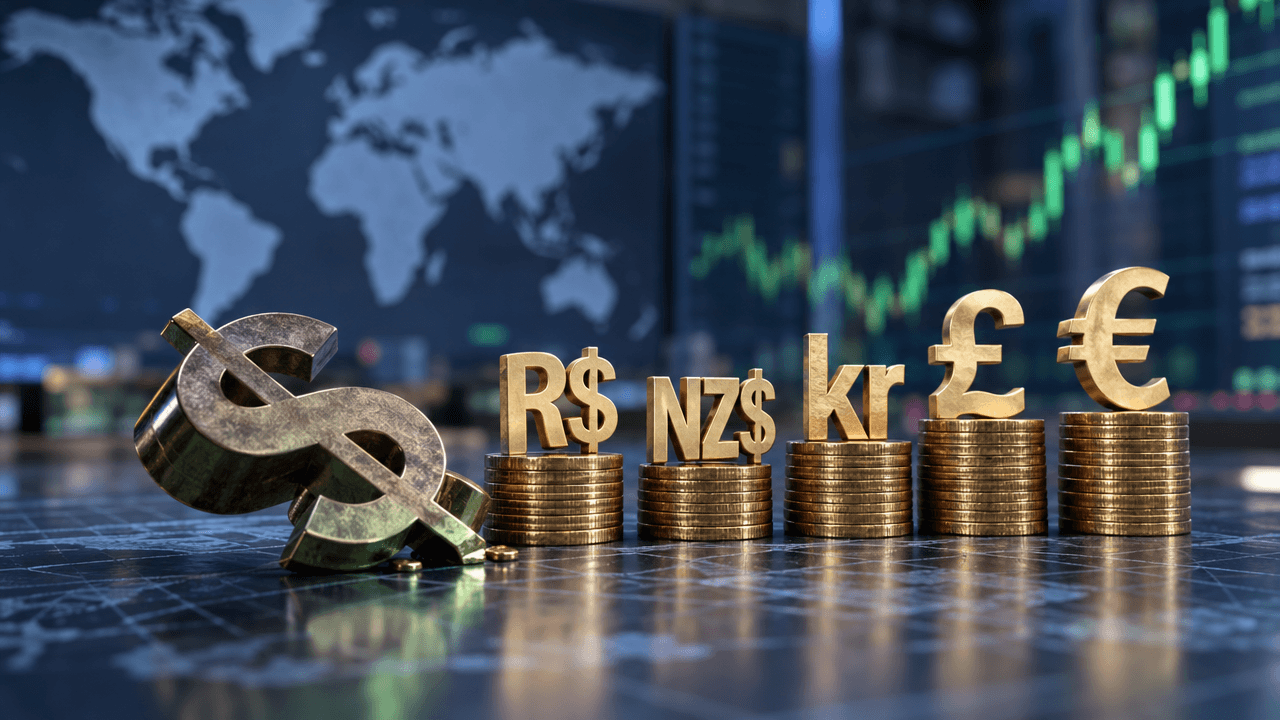
A 0.75% decline in the dollar index has placed foreign-exchange traders on alert, particularly as several higher-beta currencies moved higher at the same time. The Brazilian real gained 0.62%, the New Zealand dollar rose 0.54%, the Norwegian krone advanced 0.49%, the British pound added 0.39%, and the euro increased 0.16%. [1] The broad nature of the move suggests that investors were reducing dollar exposure rather than simply rotating between two individual currencies.
For traders, the session offers a useful reminder: currency markets are driven not only by economic data but also by risk appetite, interest-rate expectations, positioning, and capital flows. When the dollar weakens across both major and emerging-market currencies, the market may be expressing greater confidence in global growth or a reduced need for defensive assets.
What A Falling Dollar Index Signals
The U.S. Dollar Index, commonly known as DXY, measures the dollar against a basket of major currencies, with the euro representing the largest share. A decline in the index generally means the dollar is losing value relative to its peers, although the size and consistency of the move matter.
A one-day fall of 0.75% is notable in the foreign-exchange market, where daily movements are often smaller than those seen in equities or cryptocurrencies. The simultaneous gains in the real, New Zealand dollar, krone, pound, and euro make the move more significant than a simple technical fluctuation.
A weaker dollar can affect markets in several ways. It may reduce the local-currency cost of dollar-denominated debt for emerging economies, improve the appeal of commodities priced in dollars, and encourage investors to seek opportunities in higher-yielding or more economically sensitive assets.
However, a falling DXY does not automatically mean that global risk conditions are stable. Traders still need to distinguish between a sustained trend and a short-term adjustment caused by profit-taking, option flows, or changes in interest-rate expectations.
Why High-beta Currencies Are Benefiting
High-beta currencies tend to move more aggressively when investors become comfortable taking risk. The New Zealand dollar and Brazilian real are often treated as examples because their performance can be influenced by global growth expectations, commodity prices, interest-rate differentials, and investor demand for carry.
The Brazilian real’s advance is especially relevant because Brazil offers relatively high interest rates compared with many developed economies. That yield advantage can attract international capital when investors believe currency volatility is manageable. Recent market commentary has also highlighted the real’s attractive carry and its ability to remain comparatively strong among emerging-market currencies. [10]
The New Zealand dollar can respond strongly to shifts in global sentiment because New Zealand is closely linked to international trade and commodity demand. The Norwegian krone has similar sensitivity to global conditions, with energy markets and European economic expectations playing important roles.
The gains in the pound and euro indicate that the dollar’s weakness was not limited to emerging markets or commodity-linked currencies. This broader participation gives the move greater credibility, although it does not guarantee that the trend will continue.
THE ROLE OF INTEREST RATES AND U.S. YIELDS
Interest-rate expectations remain one of the most important forces behind dollar movements. Investors compare expected returns across countries, including government bond yields and the potential path of central-bank policy.
When U.S. Treasury yields decline or expectations for future Federal Reserve tightening weaken, the dollar can lose some of its interest-rate advantage. Lower yields may also encourage investors to move into currencies offering higher potential returns, particularly when market volatility is subdued.
The relationship is not mechanical. A weaker dollar can sometimes occur alongside falling stock markets if investors are reassessing U.S. policy or growth prospects. Conversely, the dollar can rise during periods of market stress because investors seek liquidity and perceived safety in U.S. assets.
Recent market analysis has emphasized the importance of U.S. ten-year Treasury yields for currencies such as the Brazilian real. A move higher in yields could place renewed pressure on emerging-market currencies, while softer yields may provide relief. [2] This makes upcoming inflation, employment, and central-bank communications important catalysts for foreign-exchange traders.
What Traders Should Watch Next
The first priority is whether the dollar index can hold below its recent trading range. A single session establishes momentum, not confirmation. Traders should monitor follow-through over several sessions, paying attention to whether the euro, pound, and high-beta currencies continue to outperform together.
The second priority is relative performance. If the real and New Zealand dollar continue rising while the euro remains firm, the market may be showing broad risk appetite. If only one currency advances, the move may instead reflect a local event, such as an interest-rate decision, political development, or commodity-price shift.
The third priority is volatility. A weaker dollar combined with declining volatility can support carry trades, but a sudden volatility spike may reverse those positions quickly. High-beta currencies can deliver stronger gains during favorable conditions, but they can also experience sharp losses when investors reduce exposure.
For SimFi traders, this environment is an opportunity to practice disciplined scenario planning. Instead of assuming that dollar weakness will continue, define what would invalidate the trade. Consider position size, stop placement, correlation between currency pairs, and the impact of scheduled U.S. data. A long NZD/USD position and a long AUD/USD position, for example, may carry more shared exposure to global risk sentiment than a trader realizes.
The Bigger Market Lesson
The dollar index’s 0.75% decline and the coordinated gains across major and emerging-market currencies point to a meaningful shift in near-term market sentiment. [1] Yet the most important question is not whether the dollar fell on one day. It is whether the move reflects a durable change in interest-rate expectations and global risk appetite.
Traders should combine price action with macroeconomic analysis, yield movements, and volatility measures. The best opportunities often appear when several of these signals align, but risk management remains essential because currency trends can reverse quickly.
For now, the market is rewarding currencies with higher sensitivity to growth, carry, and global risk appetite. That can create attractive opportunities, but it also demands patience. A strong trading plan should treat dollar weakness as a developing market theme—not as a guarantee that every high-beta currency will continue moving higher.