
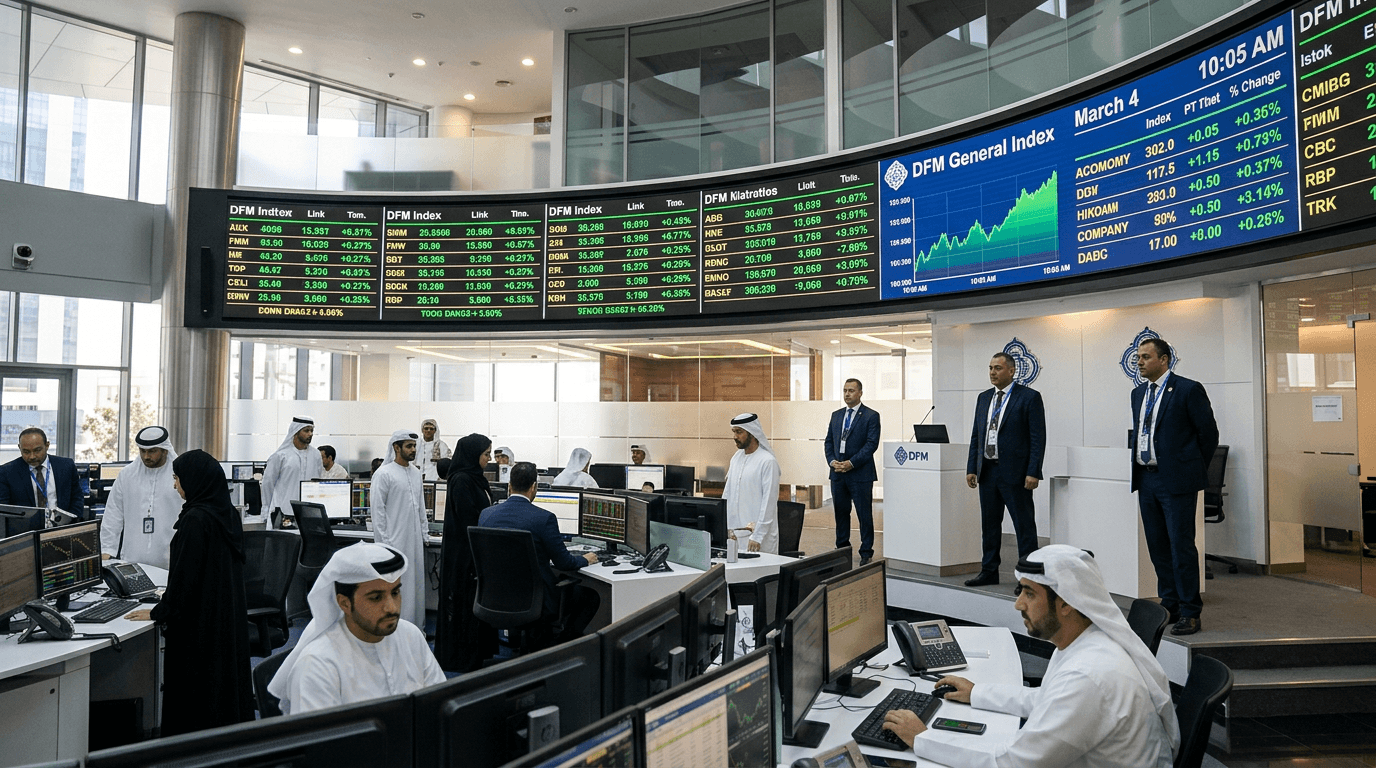
Dubai's financial markets are reopening their doors after an unprecedented two-day closure, marking a significant moment for regional traders and investors. On Wednesday, March 4, 2026, the Dubai Financial Market (DFM) and Abu Dhabi Securities Exchange (ADX) resumed trading operations following a suspension that began on Monday, March 2. This closure, announced by the UAE Capital Market Authority, was implemented as a precautionary measure in response to escalating regional tensions stemming from Iran's missile and drone strikes targeting Gulf countries, including the United Arab Emirates.[1][3]
The decision to temporarily halt trading reflected broader concerns about market stability during an uncertain geopolitical period. For over 48 hours, market participants were unable to execute trades, a rarity for the UAE's financial infrastructure. Outside of regularly scheduled holidays and periods of national mourning, such closures are uncommon for the UAE exchanges. The last significant closure occurred in May 2022 following the death of President Sheikh Khalifa bin Zayed Al Nahyan, demonstrating how unusual this suspension was for regional markets.[3]
Understanding The Market Closure Decision
The UAE Capital Market Authority made the difficult decision to close both major exchanges as tensions escalated between Iran and Israeli-US coalition forces. Iran's retaliatory strikes, which involved hundreds of missiles and drone attacks across the Gulf region, created significant uncertainty about the economic impact on key sectors. While most attacks were intercepted with few reported casualties, the psychological and economic implications were substantial enough to warrant protective measures for the region's financial stability.[1][3]
This closure aligned with international precedent for market management during crisis periods. Turkey closed its markets for a week following a devastating earthquake in 2023, while Russia halted trading for approximately one month after invading Ukraine in 2022. Greece's Athens Stock Exchange remained closed for five weeks during its sovereign debt crisis in 2015. These examples demonstrate that market authorities globally recognize the importance of strategic closures during periods of extreme uncertainty to prevent panic-driven trading and potential market collapse.[3]
Implications For Traders And Investors
The reopening on March 4 carries significant weight for the region's financial ecosystem. The UAE stock exchanges control market capitalization of approximately $1.1 trillion, making them the 19th largest in the world.[3] This scale means that even temporary disruptions affect not just local investors but global portfolio managers with exposure to Gulf markets. The exchanges maintain a 1.4% weighting on MSCI Inc.'s emerging markets benchmark, reflecting their importance to international investment strategies.[3]
For traders looking to resume positions, the resumption marks an opportunity to reassess portfolios in light of regional developments. However, market participants should be aware of potential volatility as the market processes two days' worth of geopolitical risk reassessment. The initial trading session following the reopening could see elevated volume and price movement as investors rebalance positions and respond to accumulated news.
The Capital Market Authority has indicated it would implement a 5% limit-down threshold to ensure orderly market conditions during the resumption period. This protective mechanism helps prevent panic selling and allows the market to digest information in a controlled manner, reducing the risk of cascading sell orders that could amplify losses.
Broader Economic Concerns
The market closure reflected deeper worries about the UAE's economic health beyond just stock trading. Analysts noted that prolonged regional instability could create significant demand shocks for property sales, potentially affecting the absorption of 350,000 units of new supply in the market. Dubai's tourism sector, which typically draws 120 million visitors annually to flagship attractions like Dubai Mall, also faces uncertainty from travel concerns related to regional tensions.[3]
Major companies with significant UAE exposure faced added scrutiny during the closure period. Developers such as Emaar, along with UAE banks with greater cyclical exposure to the broader economy, experienced heightened risk assessments from global investors. The two-day halt allowed market regulators and institutional players to evaluate these concerns and implement appropriate risk controls.
Moving Forward: Regulatory Monitoring And Market Stability
The UAE Capital Market Authority emphasized its commitment to ongoing monitoring of regional developments and readiness to implement additional measures if necessary.[1] This adaptive approach signals that market authorities remain vigilant and willing to act decisively to protect investors and maintain orderly market conditions.
For market participants, the resumption offers both opportunity and caution. While trading activity resumes, investors should remain informed about regional developments and prepared for potential volatility. Following official announcements from the Securities and Commodities Authority, ADX, and DFM remains essential for staying updated on any further regulatory measures or developments that could affect trading conditions.
The closure and reopening of UAE markets demonstrates the sophisticated mechanisms that modern financial systems employ to manage crisis periods. Rather than allowing panic-driven trading during maximum uncertainty, strategic closures provide time for regulators to assess risks, implement safeguards, and prepare markets for an orderly return to operations. As the DFM and ADX resume trading on March 4, investors can proceed with confidence that comprehensive measures are in place to maintain market integrity and protect their interests.