
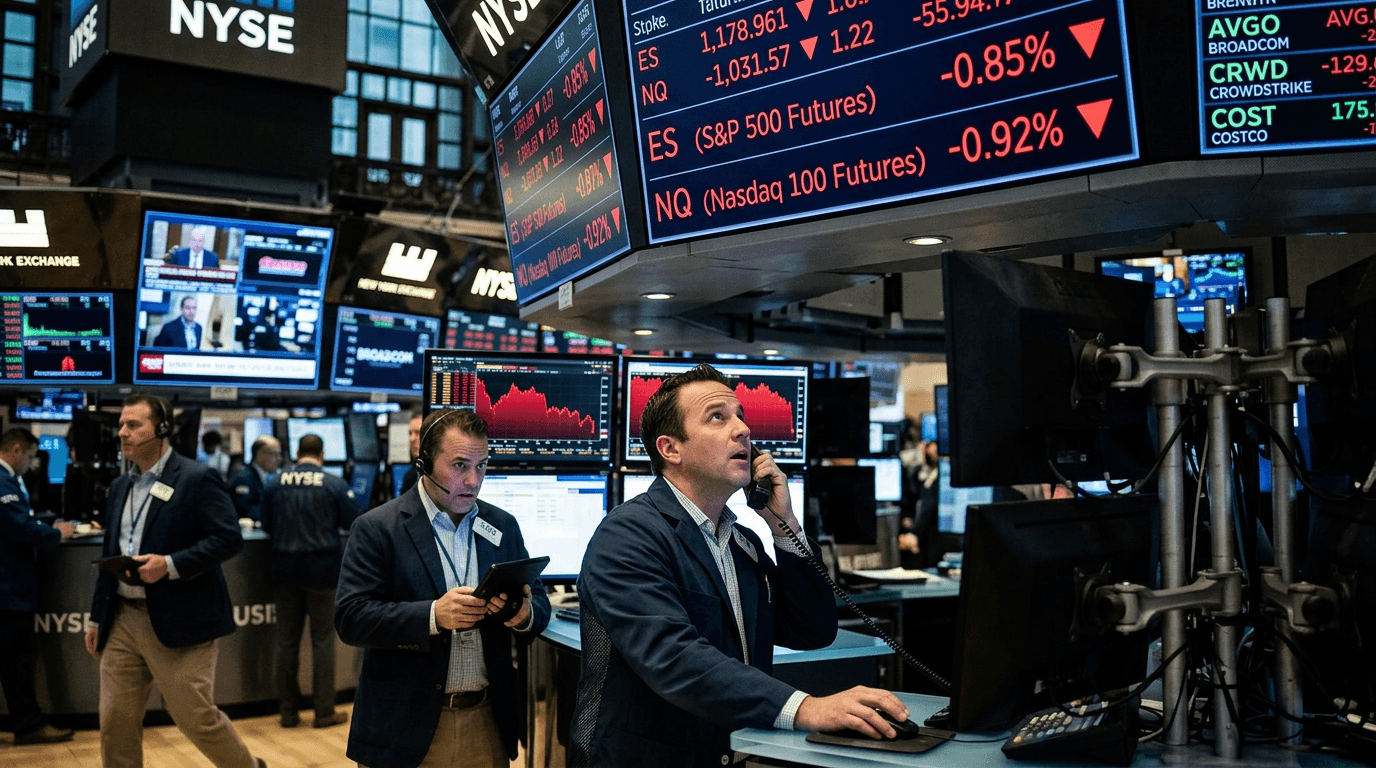
U.S. equity futures opened sharply lower on Monday morning as investors digested a weekend marked by significant geopolitical escalation in the Middle East. The Nasdaq 100 futures fell 0.9%, while the S&P 500 and Dow futures both declined approximately 0.8%, signaling a notable shift in market sentiment as traders rotate toward defensive positioning.[1][2] This sharp reversal comes at a critical juncture for the markets, as the week ahead promises substantial earnings announcements from major technology and retail players, creating a complex backdrop for investors navigating both macroeconomic and geopolitical risks.
Geopolitical Shock Reshapes Market Focus
The catalyst for this morning's decline stems from a dramatic escalation in U.S.-Iran tensions. Over the weekend, the U.S. and Israeli forces launched a major military operation resulting in the death of Iran's Supreme Leader Ali Khamenei, followed by retaliatory strikes targeting American and Israeli interests across the Middle East.[1] These developments have fundamentally shifted market focus away from domestic concerns like inflation and credit stress, redirecting investor attention toward supply chain disruption and energy price stability.
The escalation has created palpable uncertainty in energy markets, where the real economic impact could be most severe. The Islamic Revolutionary Guards Corps warned against shipping traffic through the Strait of Hormuz and claimed to have struck three oil tankers with missiles, prompting hundreds of tankers to remain stationary near the critical chokepoint.[1] For traders, this scenario raises serious questions about energy supply continuity and global inflation dynamics, potentially undermining the equity rally that has characterized recent months.
Safe-haven Flows Signal Risk-off Sentiment
The defensive positioning is evident across multiple asset classes. Gold surged as much as 3.1% to $5,410 per troy ounce, while silver rose 1%, reflecting a classic flight-to-safety pattern.[1] The U.S. dollar index strengthened 0.3%, and Treasury yields saw modest movement with the 10-year yield ticking up to 3.97%.[1] Bitcoin, often viewed as a risk asset, tumbled over 2% to around $66,239, confirming broader risk aversion among investors.[1]
Yet market participants emphasize that current volatility remains contained and orderly rather than panicked. Chris Weston, head of research at Pepperstone, noted that "the cross-asset moves are orderly, and the more outsized volatility appears largely contained to the energy complex."[1] This distinction is important for traders evaluating the true magnitude of market stress. The energy sector is bearing the brunt of uncertainty, while broader equity markets are experiencing moderated moves despite headline risk.
Retail Traders Hold Their Ground
Interestingly, despite institutional positioning shifting defensively, retail traders are largely maintaining their investment stance. A Stocktwits poll revealed that 48% of respondents identified as long-term investors, with only 8% sitting in cash.[2] This divergence between retail conviction and institutional caution creates an intriguing dynamic, suggesting that smaller traders remain focused on longer-term opportunities despite short-term turbulence.
This retail resilience reflects a broader recognition that geopolitical shocks, while disruptive in the near term, often produce temporary drawdowns rather than fundamental bear market reversals. Strategists across major investment firms have echoed this sentiment, with some pointing to historical patterns where markets stabilize once the initial uncertainty passes.[2]
Earnings Week Offers Critical Clarity
The timing of this geopolitical flare-up is particularly significant given that earnings season intensifies this week. Major announcements from Broadcom, CrowdStrike, and Costco will provide crucial data on corporate profitability and economic health across technology and consumer sectors.[1] These earnings reports could serve as anchors for market valuation, offering perspective on whether current equity prices remain justified despite elevated geopolitical risk.
Earnings growth has been mixed in recent weeks, with U.S. companies delivering strong profit growth overall but facing narrowing market breadth, according to recent market analysis.[2] This divergence is prompting some analysts to suggest diversification opportunities in European and Asian equities, where valuations appear more attractive relative to earnings growth expectations.
Key Takeaways For Traders
The confluence of geopolitical uncertainty and critical earnings announcements creates a challenging but potentially rewarding trading environment. Investors should maintain a balanced perspective between defensive positioning and the recognition that volatility often presents buying opportunities. Energy prices and Strait of Hormuz disruptions will remain key monitoring points, with oil potentially reaching $100 per barrel if supply disruptions prove sustained.[1]
For traders, this week demands heightened attention to both headline risk and fundamental data. The earnings calendar offers concrete information to counter uncertainty, while safe-haven flows provide defensive alternatives for risk-averse positions. Success will require balancing conviction in longer-term trends against tactical positioning for near-term volatility.