
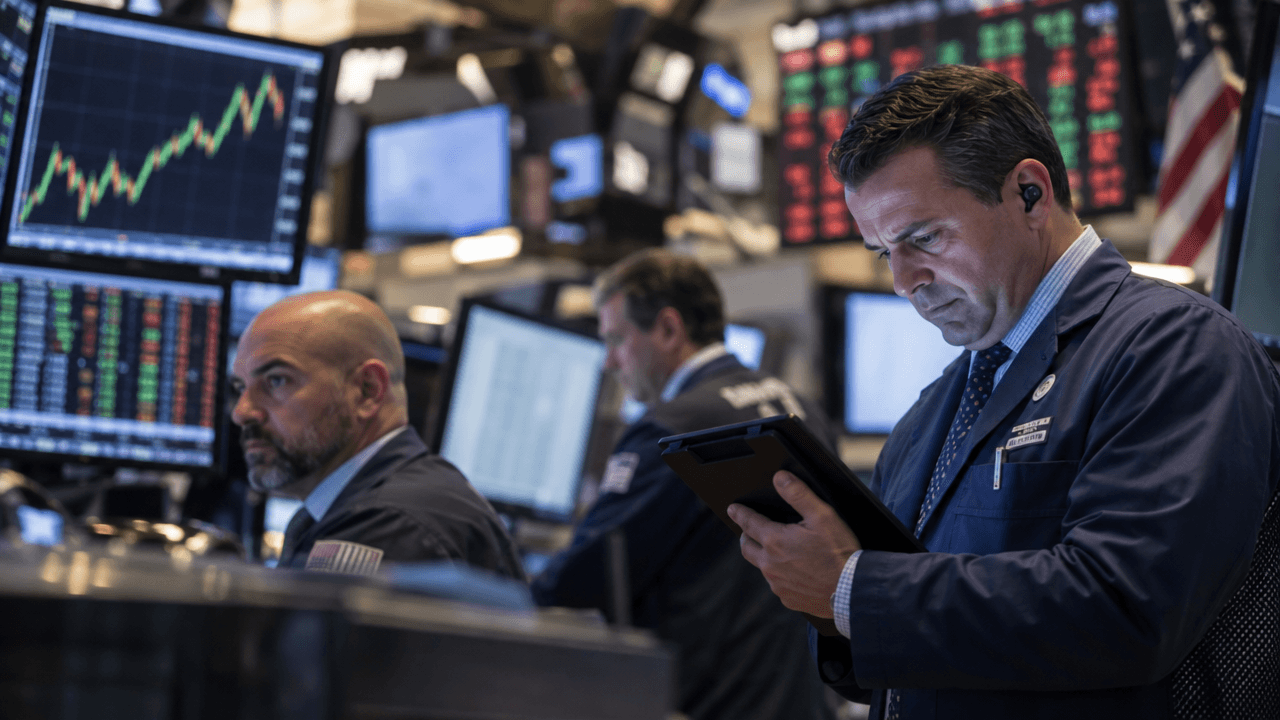
Equity index futures are firming into Friday’s session as traders digest the Federal Reserve’s latest rate hike and position around September’s triple‑witching expiry, with S&P 500 contracts up roughly 0.3% in early trade and volatility gauges easing from recent highs.[3][6][15] For risk‑asset participants, the message is clear: markets are shifting from shock to recalibration, and derivatives flows are now in the driver’s seat.[12][15]
Markets Steady After The Fed Hike
On Wednesday, the Fed raised its target range by 25 basis points to 3.75%–4.00%, extending a gradual tightening cycle aimed at containing persistent inflation pressures.[12] Equity benchmarks initially wobbled on the announcement but have since stabilized, with futures on the Dow, S&P 500 and Nasdaq all modestly higher as traders reassess the rate path rather than react to a single move.[3][6][8]
This pattern—brief volatility followed by a measured recovery—is typical when hikes are broadly anticipated and in line with futures‑market pricing.[11][12] Fed‑watch tools had already priced in a high probability of a quarter‑point increase, so the real market driver is now the forward guidance embedded in the dot plot and subsequent commentary from policymakers.[3][12] As expectations coalesce around a “higher for longer” backdrop but with limited surprise, equities are finding support from the idea that growth can persist even under tighter financial conditions.[3][12]
For index traders, the key takeaway is that the directional shock from the hike is largely behind us; the focus shifts to how earnings, economic data and cross‑asset flows interact with this new rate level. In a simulated environment, that creates a useful backdrop for stress‑testing strategies that depend on both valuation multiples and macro‑sensitive sectors such as growth tech and cyclicals.
What Triple Witching Really Means
Today’s session adds an extra layer of complexity: September triple witching, when quarterly equity index futures, equity index options and single‑stock options expire in the same trading day.[12][15] This event occurs on the third Friday of March, June, September and December and often coincides with elevated volumes, concentrated hedging flows and intraday price swings as positions are rolled or closed.[12]
Importantly, triple witching has no fixed directional impact on markets.[12] Price action depends on the net positioning of dealers and asset managers: whether large books need to buy futures to hedge short gamma, unwind long index exposure, or roll risk into the next quarter’s contracts.[12][15] This quarter, the expiry lands just two days after the Fed hike and at the tail end of a volatile stretch in rates and commodities, magnifying the potential for sharp but technically driven moves.[11][12][15]
For traders on platforms like E8 Markets, triple witching is a prime opportunity to observe how derivatives mechanics can dominate price behavior, even when the macro narrative seems benign. Simulated trading around this event lets you test intraday breakout strategies, mean‑reversion tactics, or index‑options overlays without the immediate P&L stress that often leads to over‑trading in live accounts.
CROSS‑ASSET SIGNALS: EQUITIES, CRYPTO AND OIL
While equity index futures look relatively calm—Nasdaq 100 and S&P 500 contracts are only modestly higher into the open—other risk assets are sending more mixed signals.[3][6][15] Bitcoin and major cryptocurrencies have struggled to sustain a trend as rising yields, shifting Fed expectations and volatile oil prices alternately suppress and revive risk appetite.[1][2][9][11] In recent sessions, crypto has seen both sharp pullbacks and tentative bounces as traders weigh the drag from tighter policy against the appeal of “digital risk” in a still‑growing ecosystem.[1][3][9][11]
Commodities, particularly crude oil, have been a key swing factor in this equation. Earlier in the month, Brent and WTI pushed above key psychological levels—WTI even briefly topped $100 per barrel—heightening inflation concerns and reinforcing the case for continued Fed hawkishness.[10][11] More recently, oil has snapped a multi‑day winning streak, easing some of the pressure on both equities and crypto and helping broader risk sentiment recover.[9][15]
The cross‑asset lesson is that index futures do not trade in isolation. Their tone today reflects an intersection of policy expectations, commodity‑driven inflation fears and the risk‑on/risk‑off rhythm in crypto markets. For simulated traders, building scenarios that link equity indices with oil and digital assets can deepen understanding of how macro shocks propagate through different asset classes.
Practical Takeaways For Simulated Traders
Triple‑witching days and post‑Fed environments are ideal laboratories for strategy development in SimFi because they compress several market drivers into a short window: macro surprises, derivatives expiries, and cross‑asset rotations.[12][15] To make the most of this backdrop in a simulated account, consider three practical approaches:
1. Map the event timeline Structure trading plans around known catalysts: the Fed decision, subsequent speeches, and today’s expiry times for major index futures and options.[12] In simulation, track how liquidity and spreads change as the session progresses and avoid assuming that the open and close behave similarly.
2. Focus on order‑flow proxies Triple witching tends to amplify the impact of large institutional flows, especially near key strikes and futures roll levels.[12][15] In a SimFi environment, practice reading price behavior around these inflection points—such as sudden accelerations without obvious news—to infer where hedging flows might be concentrated.
3. Stress‑test risk management Because today’s price moves may be technically driven rather than fundamentally motivated, it is easy to get whipsawed by chasing short‑term swings. Use simulation to refine rules on position sizing, maximum intraday loss, and time‑based exits, then evaluate how those rules perform in high‑volume, event‑driven conditions.
By approaching the session as a structured test rather than a one‑off gamble, traders can turn an inherently noisy trading day into a rich source of data about their own behavior and strategy robustness.
Conclusion: Turning Event Risk Into Learning Edge
Equity index futures holding firm after a widely telegraphed Fed hike signal that markets are transitioning from reacting to single events to integrating a higher‑rate regime into longer‑term valuations.[3][6][12] Triple witching adds technical volatility, but not necessarily new fundamental information, making today’s price action more about positioning than policy.[12][15] Meanwhile, crypto and oil underline that risk sentiment is still fluid, with commodities and digital assets alternately amplifying and dampening the equity narrative.[9][10][11]
For traders using simulated finance platforms, this environment is an invitation to do disciplined experimentation: connect macro context to derivatives flows, refine playbooks for event‑heavy sessions, and observe how different strategies behave when markets are driven by both fundamentals and mechanics. The goal is not to predict every tick of triple‑witching day, but to build a repeatable process that treats such events as opportunities to learn, adapt, and strengthen your edge before capital is truly at risk.