
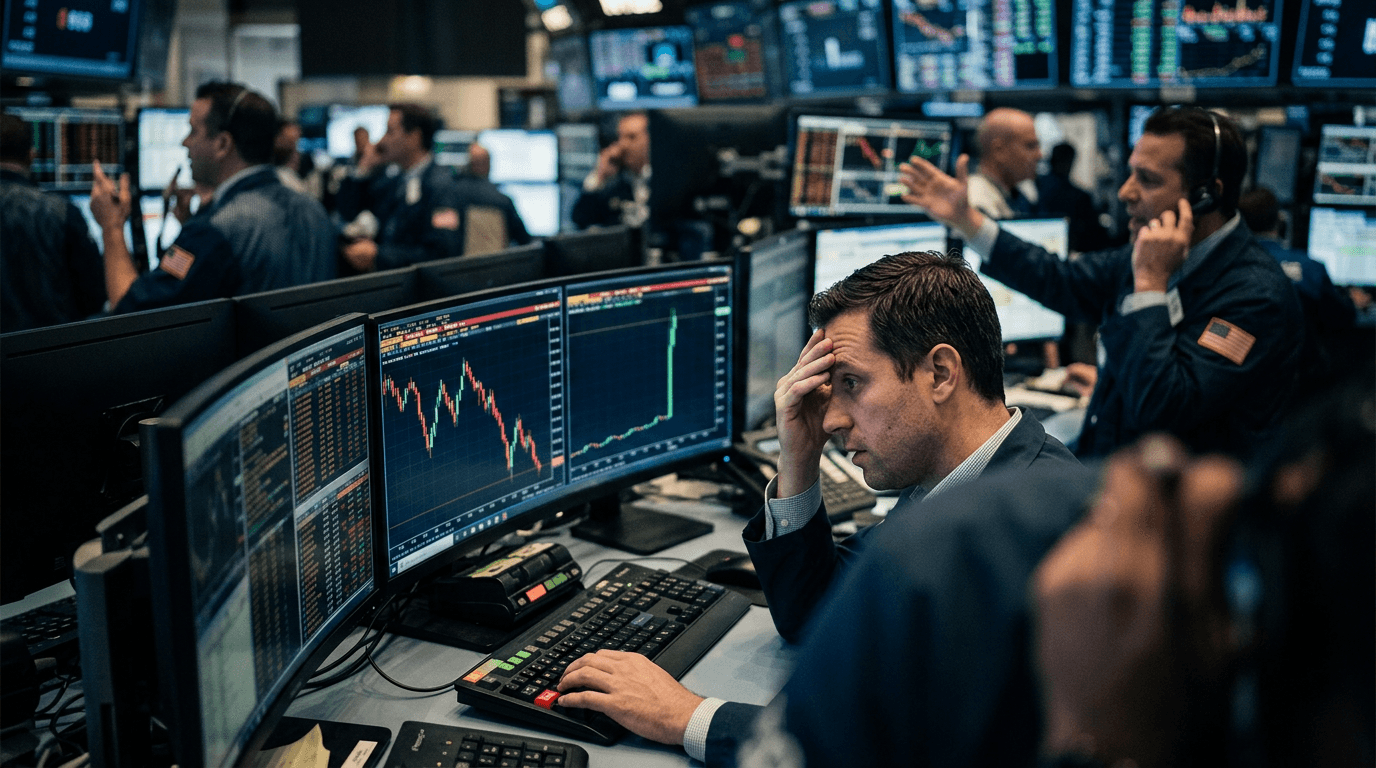
Global markets have been jolted back into classic “risk-off” mode as the United States announced tariff hikes on Chinese goods of up to 145%, triggering a swift response from Beijing with retaliatory tariffs reaching as high as 125%. China’s warning that it will “ignore” Washington if further measures are imposed has revived full-blown trade-war fears, sending global equities and cyclical currencies lower while boosting safe-haven currencies such as the yen and Swiss franc, alongside a strong bid for gold futures.[2][3]
Markets React: Risk Off, Safe Havens On
The immediate market reaction has followed a familiar pattern from previous rounds of US–China trade tension. Equity indices in export-sensitive and cyclical sectors have underperformed as investors rapidly reassessed global growth expectations and corporate earnings prospects.[1][2] Risk-sensitive currencies tied to global trade and commodities, such as the Australian dollar and some emerging-market FX, have weakened as capital rotated away from perceived higher-risk assets.
At the same time, traditional safe havens have caught a strong bid. The Japanese yen and Swiss franc have appreciated as investors sought shelter in currencies backed by large net foreign asset positions and stable domestic financial systems. Gold futures have also rallied on renewed demand for store-of-value assets amid rising geopolitical and policy uncertainty, in line with previous research showing that trade-war shocks tend to reduce equities and boost gold prices.[1] For traders, this is a textbook example of how quickly risk sentiment can flip when policy shocks hit the tape.
Why Tariff Shocks Hit Risk Assets
Tariffs work through several powerful channels that are inherently negative for risk assets. First, they act as a tax on trade, raising costs for importers and exporters and ultimately weighing on margins and demand. Studies of the 2018 US–China trade war found that when export prices rose due to tariffs, profit margins of Chinese exporters fell materially, highlighting how tariffs can compress earnings along the supply chain.[6] In the US, earlier episodes showed that equity prices fell, credit spreads widened, and oil futures declined after trade-war news shocks as investors priced in slower growth and higher uncertainty.[1]
Second, tariffs generate what economists call “growth news” and “risk premium” shocks.[1] Growth expectations decline because higher trade barriers disrupt supply chains, reduce investment incentives, and dampen global trade volumes. At the same time, the required risk premium rises because policy uncertainty makes future cash flows harder to forecast. Together, these effects justify lower equity valuations and wider credit spreads.
Third, the current tariff escalation is broad and aggressive. Research on the latest US tariff wave estimates that the average effective US tariff rate has jumped from around 2.4% to roughly 17% in a short period, with some scenarios pushing the effective rate above 25% when high headline tariffs (like the 145% on some Chinese goods) are taken into account.[3][5] Model-based analysis from international institutions suggests such broad-based tariffs produce substantial short-run output losses and inflationary pressures, particularly for economies deeply integrated into US supply chains.[5] That combination—slower growth but higher inflation—creates an especially challenging backdrop for risk assets.
Implications For Currencies And Gold Traders
For FX traders, an escalating tariff war tends to reward safe-haven currencies and penalize trade-linked and high-beta FX. Historical evidence from the earlier US–China trade conflict shows that trade-war shocks were associated with US dollar appreciation against the Chinese yuan as capital flowed toward perceived safer jurisdictions.[1] In the current episode, the pattern extends to other safe havens: the yen and Swiss franc gain as carry trades are unwound and hedging demand rises.
Gold sits at the intersection of these dynamics. It is not tied to any one country’s balance sheet, and it has historically benefited when geopolitical risk, policy uncertainty, or concerns about fiat currencies increase. During past trade-war flare-ups, gold prices rose alongside declines in the S&P 500, underscoring its role as a hedge against both equity market drawdowns and systemic uncertainty.[1] For traders, this environment often supports long-gold, long-yen/CHF, and short-cyclical-FX themes—though position sizing and risk control are critical, given that headlines can reverse quickly.
What This Means For Equities And Commodities
Equity markets, particularly in sectors with high exposure to global trade—technology hardware, industrials, autos, and luxury goods—are likely to remain volatile. Empirical work on the prior trade war shows that firms with substantial output exposure to China suffered larger negative equity responses than those less dependent on the Chinese market, while input exposure alone was less decisive.[1] This suggests that investors are especially concerned about demand risk and market access, not just cost pressures.
At the macro level, major asset managers have noted that though economies can be more resilient than feared, higher tariffs eventually pass through to consumers and earnings.[4] Initially, companies absorbed a large share of tariff costs, but over time, the burden shifted toward consumers as firms passed on higher input prices.[4] This evolution can squeeze real disposable income, weigh on discretionary spending, and ultimately hurt sectors tied to consumer demand.
Commodities such as oil also respond to tariff shocks through the growth channel. When markets price in weaker global industrial activity and trade, oil demand expectations soften, typically pressuring prices.[1] This can reinforce the downbeat tone in cyclical assets and commodity-linked currencies, while supporting importers of energy.
How Traders Can Navigate A Prolonged Tariff War
For traders and investors—whether in live or simulated environments—the key is to treat tariff headlines as catalysts within a broader macro framework, not as isolated noise. Several practical approaches stand out:
- Monitor policy risk as a core macro variable. Trade-war shocks have explained a significant share of short-term variance in the S&P 500 and other financial metrics in past episodes.[1] That means headlines can create large, abrupt moves that are not fully captured by traditional economic data alone.
- Think in regimes, not single events. A one-off tariff announcement can create a short burst of volatility, but a sustained tit-for-tat escalation can establish a persistent risk-off regime with recurring pressure on equities and cyclical FX, and ongoing support for havens and gold.
- Map exposures across asset classes. Tariffs are not just an equity story; they affect currencies, rates, credit spreads, and commodities. For example, previous episodes saw lower Treasury yields and wider corporate spreads as markets priced weaker growth and higher risk premia.[1] Cross-asset awareness can help identify better hedges and relative-value trades.
- Focus on risk management and scenario testing. Trade tensions are inherently political, and outcomes can change quickly with new negotiations or policy surprises. Using defined risk (e.g., options), clear stop-loss levels, and scenario analysis (e.g., deeper escalation vs. partial rollback) is essential in this kind of event-driven environment.
For those using simulated trading environments, tariff-driven volatility offers a valuable testing ground to practice trading around macro news without real capital at risk—experimenting with safe-haven strategies, hedging tactics, and cross-asset positioning under changing regimes.
In the coming weeks, markets will watch closely for signs of de-escalation or further retaliation. Until there is clarity, the bias is toward elevated volatility, cautious positioning in risk assets, and continued demand for safe-haven currencies and gold. Understanding how tariffs transmit through growth expectations, risk premia, and cross-border capital flows can equip traders to navigate this phase of the US–China relationship with more discipline and less emotion—turning policy shocks into structured trading plans rather than reactive decisions.