
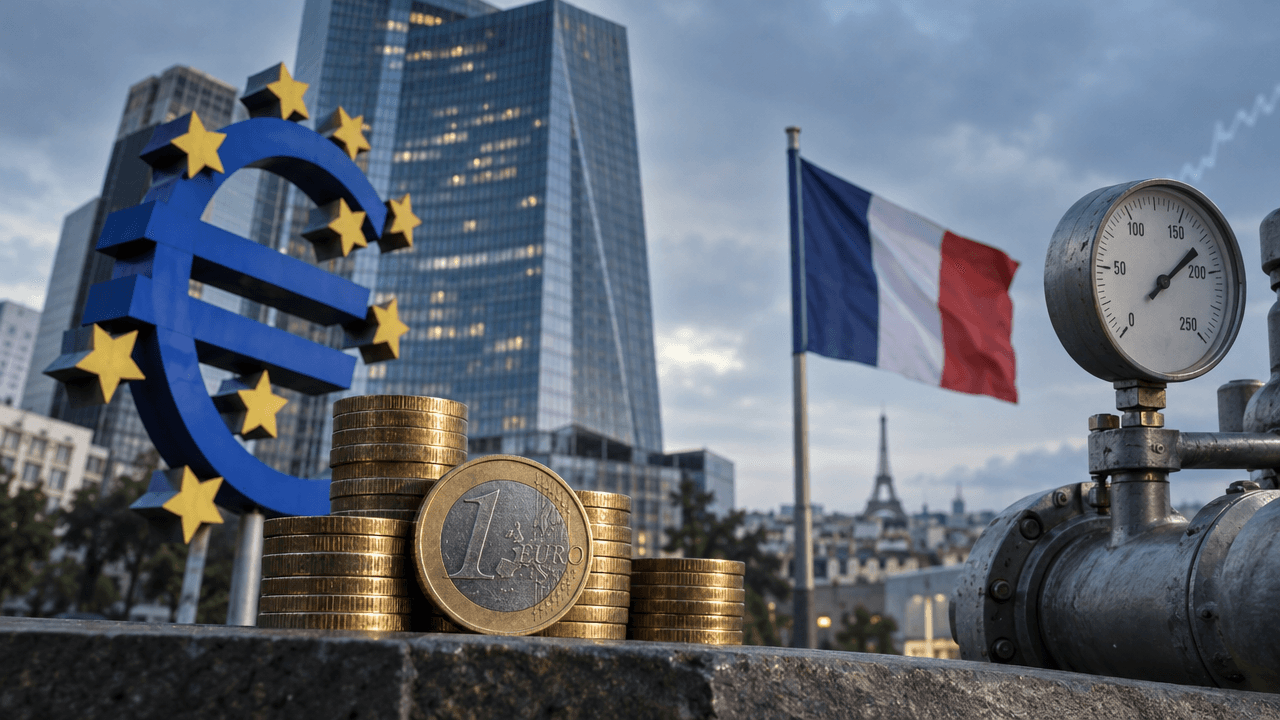
Euro-area economic growth delivered a welcome surprise in the third quarter, but the region’s inflation outlook remains difficult. Gross domestic product expanded 0.4% from the previous quarter, twice the 0.2% increase economists had expected. The result reduces immediate fears of a renewed recession, yet accelerating prices in France—particularly for energy—create a more complicated policy challenge for the European Central Bank. [1][3]
For traders, the message is not simply that Europe is recovering. Instead, the latest data point to an economy that is still expanding while facing renewed cost pressures. That combination could support the euro in the short term, but it may also limit the ECB’s ability to provide additional monetary-policy support if growth weakens later.
Growth Beats Expectations, But Momentum Is Moderating
The 0.4% quarterly increase in euro-area GDP was stronger than forecast, although it represented a slowdown from the 0.6% expansion recorded in the second quarter. The broader European Union economy performed slightly better, growing 0.5% during the same period. [1][3]
Beating expectations matters because financial markets respond not only to the level of economic activity but also to the difference between actual results and forecasts. A stronger-than-expected GDP reading can reduce recession concerns, improve confidence in European companies, and encourage investors to reassess expectations for interest rates and currency values.
However, quarterly growth of 0.4% is still moderate rather than exceptionally strong. It does not eliminate concerns about weak industrial activity, fragile consumer confidence, or the impact of elevated energy costs. The data suggest resilience, but not an unambiguous boom.
Country-level performance also remains uneven. France contracted 0.1% in the third quarter, according to the preliminary data, showing that national economies can diverge significantly even when the region as a whole expands. Political uncertainty and concerns about France’s budget deficit have weighed on business confidence, adding another layer of risk to the euro-area outlook. [1][15]
French Inflation Reignites The Price Debate
France’s preliminary October inflation figures provided the more concerning side of the data release. Consumer prices rose 3.4% over the year, up from 3.1% in September and above the 3.2% forecast. This was the highest inflation rate since December 2023. [4][10]
Energy was the main driver. Energy prices increased 24.1% year over year, accelerating from 21.3% in September as gas and petroleum costs moved higher. Monthly consumer prices rose 0.4%, reversing a 0.3% decline in September and also exceeding expectations. [4][6]
Energy-led inflation can be especially challenging for policymakers. A central bank cannot directly increase the supply of natural gas or lower global oil prices through interest-rate decisions. Yet higher energy costs can spread through the economy by raising transportation expenses, business operating costs, and household utility bills.
That creates a difficult distinction between temporary headline inflation and broader, persistent price pressure. If energy prices stabilize, headline inflation could eventually fall. But if businesses pass higher costs to customers and workers demand compensation for reduced purchasing power, inflation may become more entrenched.
What This Means For The Ecb
The latest figures complicate the ECB’s policy outlook. Stronger GDP reduces the urgency for emergency support, while higher inflation makes policymakers more cautious about cutting interest rates. The combination could produce a “higher for longer” environment in which rates remain restrictive even as growth loses momentum.
That does not mean the ECB must immediately tighten policy. Policymakers will likely examine whether the inflation increase is concentrated in energy and whether services prices, wages, and underlying inflation are also accelerating. They will also assess whether weak national economies could turn a temporary slowdown into a wider contraction.
For markets, the key issue is the balance between growth and inflation. Better GDP data can push investors to reduce expectations for rapid rate cuts, potentially supporting euro-area bond yields and the euro. At the same time, concerns about France, energy prices, and household purchasing power can limit enthusiasm for European risk assets.
Currency traders should also watch the response from other major central banks. The euro’s direction depends not only on the ECB’s outlook but also on interest-rate expectations in the United States, the United Kingdom, and other major economies. A stronger European growth surprise may support the euro, but that effect can fade if external markets price in even tighter policy elsewhere.
Practical Takeaways For Traders
First, separate the growth signal from the inflation signal. The GDP result is positive, but it does not mean that economic risks have disappeared. A slowing expansion combined with rising prices can create unusually volatile markets.
Second, monitor the composition of inflation. Energy prices drove much of France’s acceleration, so future readings on services, wages, and core inflation will help determine whether price pressure is broadening.
Third, pay attention to revisions and incoming data. The GDP figure is a preliminary flash estimate and may change as more information becomes available. Retail sales, industrial production, employment, consumer confidence, and business surveys will help clarify whether the economy is gaining durable momentum.
Finally, manage risk around central-bank expectations. Economic releases can quickly change interest-rate pricing, especially when growth and inflation point in opposite directions. Traders should avoid treating a single report as a complete trend and should consider position size, stop placement, and event volatility before entering a market.
A Resilient But Fragile Outlook
The euro-area economy has shown more resilience than expected, and that is an important improvement over recession fears. Yet France’s inflation surprise demonstrates why the outlook remains fragile. Growth is strong enough to complicate the case for aggressive policy easing, while energy-driven inflation threatens consumers and businesses.
The most likely market interpretation is cautiously constructive for the euro in the near term, with continued sensitivity to inflation data and energy prices. The region is expanding, but the path forward will depend on whether that growth can continue without allowing temporary price shocks to become a lasting inflation problem.