
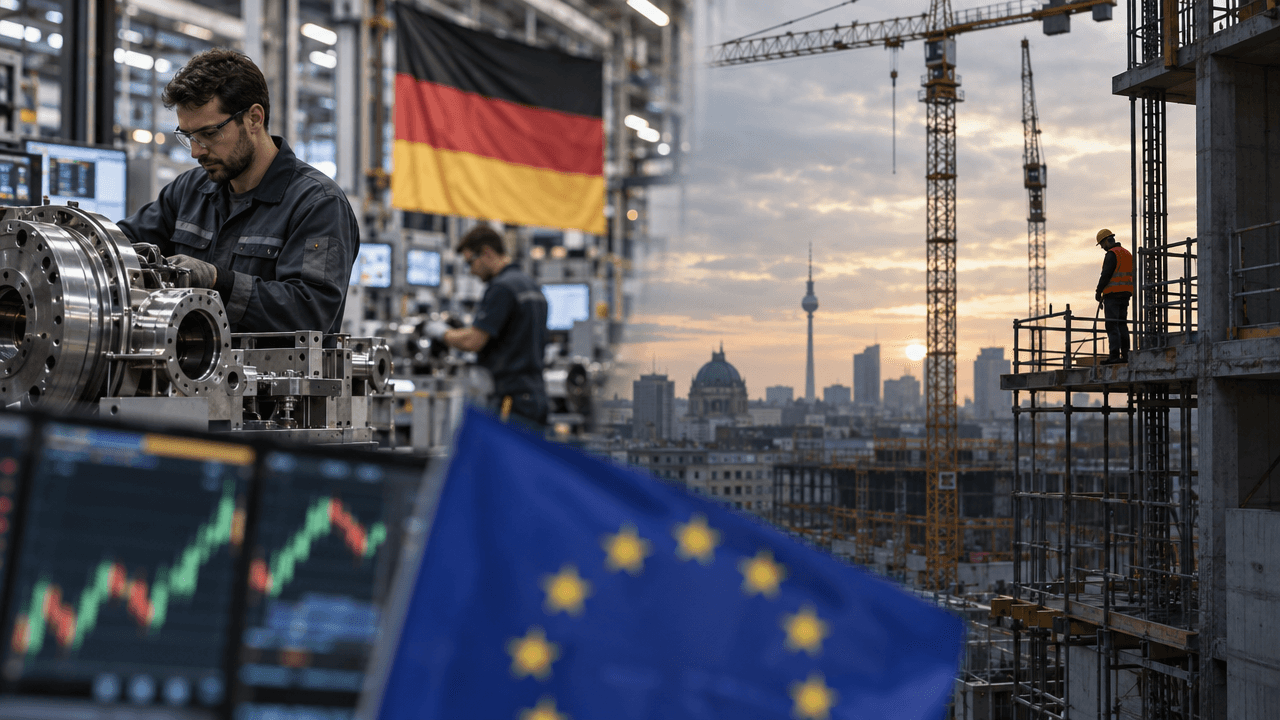
European economic data is sending a message that is difficult to summarize with a single headline. Germany, the euro area’s largest economy, recorded a sharp rebound in factory orders in September, yet construction activity deteriorated significantly in October. At the same time, European equities have found support from falling bond yields and lower energy prices. Together, these developments point to an economy that is not in free fall, but is still struggling to establish a broad and durable recovery.
The Manufacturing Rebound
German manufacturing orders increased 4.4% month over month in September, according to provisional data from the Federal Statistical Office. The rise followed a revised 10.1% decline in August and was driven in part by a strong recovery in automotive demand. Orders in the automotive sector climbed 10.5%, while mechanical engineering orders increased 8.3%. [4][2]
The headline improvement is encouraging, but it needs to be placed in context. A rebound after a very weak previous month does not necessarily signal a sustained acceleration. September’s result was also slightly weaker than market expectations, which had generally anticipated an increase of approximately 4.5% to 4.8%. [3][6]
The composition of the data offers additional clues. Domestic orders rose 6.6%, while foreign orders increased 2.8%. Demand from the euro area advanced 4.5%, compared with a 1.6% rise from non-euro-area markets. Excluding large-scale contracts, orders still gained 5.1%, suggesting that the improvement was not entirely dependent on a small number of unusually large transactions. [2][4]
For traders, this distinction matters. A manufacturing recovery supported by broad-based demand is generally more reliable than one driven by temporary contracts or a single industry. September’s figures contain positive elements, but they remain evidence of resilience rather than proof that German industry has entered a new expansion phase.
Construction Shows A Different Picture
The construction sector is sending a considerably weaker signal. Germany’s construction Purchasing Managers’ Index fell to 41.6 in October from 43.5 in September, reaching its lowest level since March 2025. A reading below 50 indicates contraction, and the latest figure points to a faster decline in activity, new orders and tender opportunities. [2][14]
Construction is particularly sensitive to interest rates, financing conditions and business confidence. Even as bond yields have softened, borrowing costs remain restrictive for many households, developers and companies. Tighter budgets and cautious customer spending are limiting new projects, while weak demand can discourage firms from expanding capacity or hiring.
The contrast between manufacturing and construction illustrates why economic analysis cannot rely on one indicator. Factory orders may improve because companies are replenishing inventories, restarting production lines or completing delayed investment plans. Construction activity, by comparison, can remain weak when financing costs and uncertainty continue to suppress long-term commitments.
The practical takeaway is that Germany’s economy may be experiencing uneven stabilization rather than a synchronized recovery. Industrial companies could be benefiting from improving order flow, while domestic sectors tied to property and investment remain under pressure.
Markets Are Looking Beyond The Data
European equities have benefited from a more supportive market backdrop. Falling government bond yields can reduce financing costs and improve the relative appeal of stocks. Lower yields can also support valuations, particularly for companies whose expected cash flows extend far into the future, such as technology, infrastructure and renewable-energy businesses.
Lower energy prices are another important source of relief. European manufacturers, transport companies, chemical producers and other energy-intensive businesses have faced substantial input-cost pressures in recent years. A decline in oil and other energy prices can improve profit margins, reduce inflationary pressure and support household purchasing power. Recent European market gains have been linked to softer yields, lower oil prices and strong corporate earnings. [9][13]
However, lower energy prices can also reflect concerns about global demand. If prices fall because investors expect weaker economic activity, the benefit to consumers and businesses may be accompanied by a less favorable growth outlook. Energy producers may also face weaker revenues, creating divergent performance across sectors.
This is why market reactions can appear optimistic even when economic data remains mixed. Equity investors may be focusing on future conditions, while economic indicators are still reporting the effects of earlier weakness.
What Traders Should Watch Next
The next stage of the European outlook will depend on whether the manufacturing rebound continues beyond one month. Traders should monitor future German factory orders, industrial production, export activity and business-confidence surveys. Particular attention should be paid to whether gains spread beyond autos and mechanical engineering.
Construction and housing indicators also deserve close observation. A continued decline in construction activity would suggest that restrictive financial conditions are still weighing on domestic demand. Conversely, stabilization in new orders and tender activity could signal that lower yields are beginning to filter through to the real economy.
For SimFi traders, this environment rewards scenario planning rather than one-directional conviction. A bullish scenario would involve improving factory orders, easing energy costs and lower yields supporting cyclical equities. A bearish scenario would feature renewed weakness in industrial demand, continued construction contraction and falling energy prices caused by deteriorating global growth.
Risk management remains essential. Traders can define an economic thesis before entering a position, identify the data that would invalidate it and size trades so that a single release does not determine the outcome. Economic indicators should be treated as pieces of a wider market narrative, not as automatic buy or sell signals.
A Mixed Outlook With Selective Opportunities
Germany’s September factory-orders rebound is a constructive sign, but the sharp deterioration in construction activity shows that the recovery remains uneven. Falling yields and lower energy prices are providing support for European equities, yet those market tailwinds do not eliminate underlying economic risks.
The most balanced interpretation is that Europe is stabilizing in selected areas while domestic investment and construction remain fragile. Traders who separate temporary rebounds from durable trends will be better positioned to assess the next phase of the market. In a mixed-data environment, patience, cross-checking indicators and disciplined risk control are often more valuable than reacting to any single headline.