
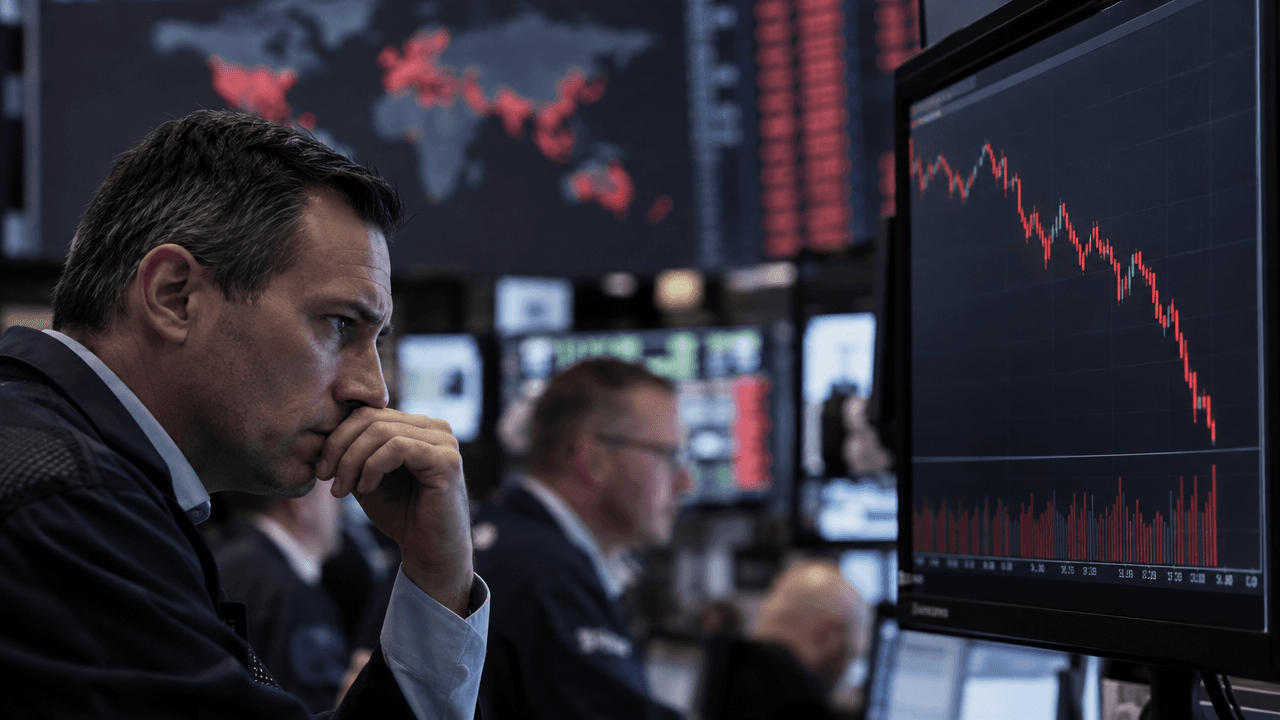
Risk-off trading is putting renewed pressure on U.S. equities and futures as investors reduce exposure to the market’s most crowded trades. Artificial intelligence stocks remain at the center of the selloff, with concerns about elevated valuations, heavy capital spending, and the pace of future earnings growth encouraging traders to move toward liquidity and relatively safer assets. Wall Street’s retreat has also weakened market sentiment across regions, with S&P 500 futures pointing lower and ASX 200 futures indicating a softer open. [1][2]
What Risk-off Trading Means
Risk-off trading describes a market environment in which investors become less willing to hold assets perceived as volatile or economically sensitive. Equities, high-growth technology companies, emerging-market assets, and commodities can all face pressure as capital moves toward cash, government bonds, defensive sectors, or other havens.
The shift does not necessarily mean that investors expect an immediate recession or financial crisis. Often, it reflects a reassessment of risk. Traders may decide that prices have risen too quickly, that earnings estimates are too optimistic, or that an upcoming policy decision could create greater uncertainty. When many investors make that adjustment simultaneously, selling can spread quickly across markets.
Recent weakness in AI-linked shares illustrates this process. Technology stocks had benefited from powerful momentum and expectations of sustained spending on chips, data centers, and AI infrastructure. However, market participants are now questioning whether the investment cycle can continue at its previous pace and whether current valuations adequately compensate investors for the risks involved. [4][14]
Why Ai Stocks Are Driving The Pressure
AI-related companies have played an outsized role in the performance of major U.S. indexes. As a result, selling in a relatively small group of large technology stocks can have an unusually large impact on the Nasdaq, the S&P 500, and index futures.
The latest decline has affected more than individual software or semiconductor names. Chipmakers, data-center suppliers, and other companies connected to the AI buildout have also faced pressure. A sharp drop in major constituents can force portfolio managers to reduce overall equity exposure, particularly when risk models identify rising volatility or deteriorating market breadth.
Valuation is another important factor. Investors are not only asking whether an AI company can grow; they are asking how much growth is already reflected in its share price. If expectations are extremely high, even strong earnings may fail to satisfy the market. Any indication of slower data-center expansion, reduced project funding, or a longer path to profitability can therefore trigger aggressive repricing. [12][14]
WHAT LOWER U.S. FUTURES SIGNAL
Futures markets provide an early indication of how investors are positioned before the regular trading session begins. Lower S&P 500 futures suggest that selling pressure is not limited to one company or one narrow industry. They can also influence opening prices, overnight hedging decisions, and the behavior of global investors watching U.S. markets for direction.
However, futures are not a guarantee of where the cash market will finish. Prices can change substantially before the opening bell as economic data, corporate announcements, bond yields, or geopolitical developments alter expectations. Traders should treat futures as a sentiment gauge rather than a definitive forecast.
The same principle applies to ASX 200 futures. A weaker indication for Australia’s benchmark suggests that the risk-off mood is traveling across time zones. Asian markets are sensitive to global technology valuations, commodity demand, interest-rate expectations, and the direction of U.S. equity markets. When investors reduce risk in New York, the effects can appear in Sydney, Tokyo, Hong Kong, and other regional markets soon afterward. [1][3]
How Traders Can Respond
The first practical step is to reduce position size when volatility rises. A trade that appears manageable during a calm session can become much more dangerous when index futures are moving rapidly and spreads widen. Smaller positions allow traders to maintain discipline without placing excessive capital at risk.
Second, avoid assuming that a sharp decline automatically creates a buying opportunity. Oversold conditions can persist, particularly when the original catalyst involves valuation, liquidity, or changing expectations rather than a temporary technical imbalance. Waiting for stabilization, improving market breadth, or a confirmed change in momentum may provide a clearer setup.
Third, monitor correlations. During a normal market, a trader may expect defensive stocks, bonds, or alternative assets to offset equity losses. In a broad risk-off episode, correlations can become unstable, and even traditionally defensive positions may experience selling as investors raise cash. This makes portfolio-level risk management more important than relying on a single hedge.
Finally, define exit levels before entering a trade. Stop-loss placement, maximum daily loss limits, and a written trading plan can help prevent emotional decisions when headlines intensify. Simulated trading is especially useful for testing these rules because traders can study execution, sizing, and reactions to volatility without putting live capital at immediate risk.
Key Takeaways
The current weakness in U.S. equities and futures reflects a broader reassessment of risk rather than a single isolated market move. AI-related selling is leading the decline because the sector has become so important to index performance and investor expectations.
For traders, the most important signals to watch are market breadth, volatility, bond yields, futures price action, and whether selling spreads beyond technology. A sustained recovery would likely require buyers to return across a wider range of sectors, not merely a rebound in one or two large AI stocks.
Risk-off markets reward preparation more than prediction. Traders who control leverage, respect changing correlations, and wait for evidence of stabilization are better positioned to navigate uncertainty. Whether the current episode develops into a deeper correction or eventually gives way to renewed buying, disciplined risk management remains the most reliable advantage.