
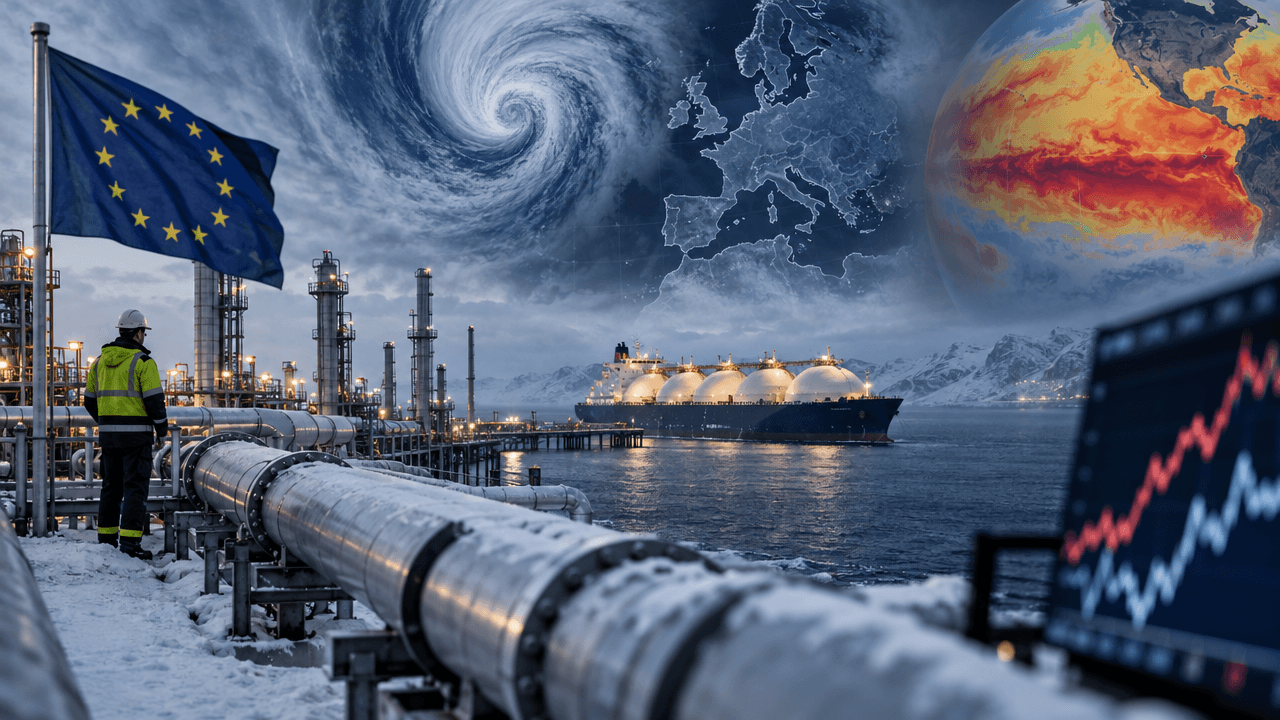
European natural-gas markets are entering winter with a difficult balance between reassuring seasonal forecasts and increasingly serious downside risks. An unusually early breakdown of the stratospheric polar vortex, combined with a powerful El Niño pattern, could increase the odds of disruptive cold spells across parts of Europe. If temperatures fall sharply, heating demand may rise just as gas inventories are already under pressure, creating a direct threat to prices, industrial activity, and inflation. [1]
Why Weather Matters More This Winter
Weather is always a major variable in Europe’s gas market, but its importance increases when storage levels are low and supply flexibility is limited. A mild winter allows households and businesses to reduce heating consumption, giving inventories time to last until spring. A cold winter does the opposite: it accelerates withdrawals and forces buyers to compete for replacement supplies.
The polar vortex is a band of strong winds high in the atmosphere that normally helps contain frigid Arctic air near the North Pole. When it weakens or breaks down, cold air can move southward into Europe and other regions. The timing of this year’s breakdown has attracted particular attention because it occurred unusually early.
El Niño adds another layer of uncertainty. The climate pattern can influence atmospheric circulation and make sudden stratospheric warming events more likely. Research cited by the Federal Reserve suggests that El Niño can be associated with cold late-winter conditions in northern Europe, even though very strong El Niño events may also improve the odds of a generally mild European winter. [2]
The key point for traders is that seasonal averages may matter less than short, intense cold spells. A winter can be warmer than normal overall and still create major market stress if a severe freeze arrives when storage is already depleted.
Storage And Supply Vulnerability
Europe has reduced gas consumption substantially since the energy crisis that followed Russia’s invasion of Ukraine. European Union gas consumption fell from 413 billion cubic meters in 2021 to 332 billion cubic meters in 2024, a reduction of roughly 20%. [2] Efficiency improvements, demand reduction, renewable generation, and fuel switching have all made the region less dependent on gas than it once was.
However, lower structural demand does not eliminate short-term supply risk. Gas remains essential for residential heating, industrial processes, and electricity generation during periods when wind and solar output are weak. Storage facilities are also not an unlimited safety net. If withdrawals begin quickly, market participants must assess whether remaining supplies can last through the end of winter and support the following injection season.
A cold-weather shock could therefore produce a rapid change in market psychology. Traders may move from assuming adequate supply to pricing a race for LNG cargoes. Europe could be forced to attract more liquefied natural gas from the global market, potentially bidding against Asian buyers. This would increase the importance of shipping availability, production outages, geopolitical developments, and weather conditions outside Europe.
The risk is not necessarily an immediate physical shortage. Even the possibility of a shortage can lift prices as utilities, industrial users, and governments compete to secure supply in advance.
Impact On Gas And Power Prices
Natural-gas prices typically respond to expectations before actual demand changes appear in official data. Forecast models indicating a higher probability of cold weather can encourage utilities to purchase additional volumes, while traders may increase exposure to winter contracts and options.
Electricity markets are particularly sensitive because gas-fired power plants often help balance the grid when renewable generation is insufficient. If gas becomes more expensive, the marginal cost of electricity generation can rise as well. A cold spell may therefore create a two-sided squeeze: households need more power for heating, while gas-fired generators face higher fuel costs.
The impact can spread across regional markets. Higher European LNG demand may pull cargoes away from Asia, particularly if colder conditions emerge in both regions. Stronger competition for flexible supply could lift benchmark prices beyond what local European weather alone would suggest.
For businesses, the consequences depend on their hedging strategies. Energy-intensive industries such as chemicals, metals, glass, and fertilizers may face higher operating costs or choose to reduce production. Retailers and households may experience the effect through utility bills, while governments could face renewed pressure to subsidize consumers or impose emergency measures.
Inflation And The Broader Economy
Energy prices influence inflation directly through household gas and electricity bills and indirectly through transportation, manufacturing, food production, and other input costs. The European Central Bank has warned that gas can have a persistent impact on both consumers and producers. It has also noted that a harsh winter would likely cause greater damage to GDP and real incomes than a mild winter. [7]
A sustained energy rally could complicate monetary policy. Central banks must distinguish between a temporary weather-driven price increase and a broader inflation shock. If businesses pass higher energy costs to customers and workers demand compensation for reduced purchasing power, a short-lived gas spike could become more persistent.
Governments may respond with price caps, tax relief, demand-reduction programs, or support for vulnerable households. These measures can cushion consumers but may increase fiscal costs and distort market signals. For investors, this creates an additional policy risk alongside the underlying commodity risk.
What Traders Should Watch
The first indicator is the weather forecast, but traders should focus on forecast changes rather than a single model output. Persistent revisions toward colder conditions are generally more market-moving than one isolated cold-weather projection.
The second is storage withdrawal speed. Inventory levels matter, but the rate at which gas is being consumed can provide a clearer signal of whether the market is moving toward a late-winter shortage.
The third is LNG competition. Cargo flows, Asian weather, shipping disruptions, and production outages can determine whether Europe can replace withdrawn storage efficiently.
Finally, traders should monitor the spread between winter and summer contracts, regional price differences, power prices, and government intervention. Widening spreads may signal rising concern about near-term availability.
Practical Takeaways
A cold winter is not guaranteed, and El Niño can sometimes support milder conditions in parts of Europe. The unusual combination of climate signals means historical comparisons are less reliable than usual; analysts have noted there is no clear precedent for an early polar-vortex breakdown occurring alongside a super El Niño. [1]
For market participants, the sensible approach is to treat weather as a risk distribution rather than a single forecast. Prepare for a mild base case, but stress-test portfolios and operating plans against cold snaps, faster storage depletion, higher LNG competition, and renewed electricity-price volatility.
Europe’s gas market has become more efficient and diversified since the energy crisis, but it remains exposed to timing. A few weeks of severe weather at the wrong point in the season could matter more than a mild average across the entire winter. That is why the polar vortex, El Niño, and storage data deserve close attention: together, they could determine whether Europe experiences a manageable winter or another sharp energy-market shock.