
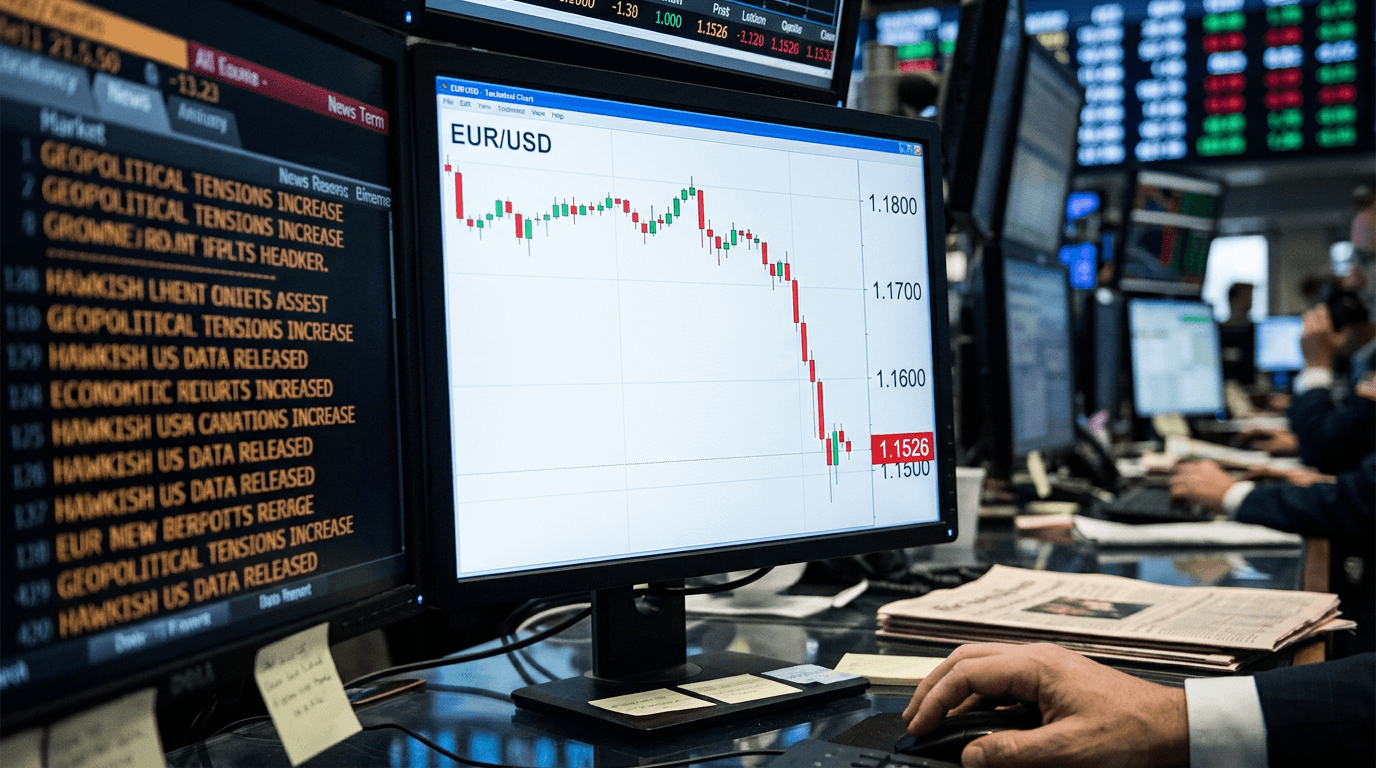
The euro has faced considerable headwinds in early March 2026, with the EUR/USD exchange rate dropping to 1.1618 on March 6 before sliding further to 1.1526 on March 9 amid intensifying safe-haven demand for the US dollar.[1][2] This sharp decline below the psychologically significant 1.17 level reflects a broader shift in market sentiment, driven by geopolitical tensions in the Middle East and a hawkish tilt in US economic data that has bolstered the appeal of dollar-denominated assets. For traders and investors monitoring currency markets, understanding the forces behind this move is essential for navigating the elevated volatility expected in the weeks ahead.
The Perfect Storm For Dollar Strength
The recent euro weakness stems from a convergence of factors that have created ideal conditions for dollar appreciation. Geopolitical uncertainty, particularly tensions in the Middle East, has triggered classic risk-off trading behavior. When investors fear economic disruption or escalating conflict, they typically retreat to safe-haven assets, and the US dollar remains the world's most trusted reserve currency.[1] Simultaneously, hawkish signals from US economic data have reinforced the dollar's appeal. The Federal Reserve maintains its Fed Funds rate at 3.75 percent, while the Euro Area's interest rate stands at 2.15 percent, creating a significant yield advantage for dollar holdings that attracts carry traders and yield-seeking investors.[1]
This combination of geopolitical risk aversion and interest rate differentials has proven powerful enough to push EUR/USD below key technical support levels that had held through much of early 2026. The weakness represents more than mere short-term volatility; it reflects a genuine repricing of the relative attractiveness of euro and dollar assets in an uncertain environment.
Technical Breakdown And Support Levels
Technical analysis reveals concerning patterns for euro bulls. The EUR/USD pair has now broken below the 1.17 support level, a threshold that carries psychological importance in forex markets.[2] Chart-watchers are now focused on lower support around 1.15, which could prove vulnerable if selling pressure persists. From a technical perspective, the damage already done suggests further downside risk remains a distinct possibility.
Looking at the broader context for 2026, the year has been volatile for the euro. The highest level reached was 1.2081 on January 27, representing a peak for the year, while the lowest point was 1.153 on March 3, a near six-week low at that time.[2] The average EUR/USD rate for 2026 stands at 1.1765, placing the current level of 1.1526 significantly below the year-to-date mean.[3] This deviation suggests either a temporary oversold condition or a more sustained repricing of euro weakness—a distinction traders must carefully evaluate.
Market Expectations And The Forward Outlook
Despite current weakness, market forecasts from major analysts suggest some stabilization may arrive by quarter-end. Trading Economics' global macro models project EUR/USD to trade around 1.16 by the end of the first quarter, implying a slight recovery from the March 9 lows.[1] Looking further ahead, the consensus expectation is for EUR/USD to settle around 1.19 within 12 months, representing a meaningful recovery from current levels.[1] This forecast reflects optimism that current headwinds will ease and that the euro may regain ground as geopolitical tensions moderate.
Over the past month, the euro has weakened 2.47 percent against the dollar, yet this one-month weakness masks a longer-term narrative of strength—EUR/USD remains up 7.25 percent over the past 12 months.[1] This tells traders that the recent March decline, while sharp, must be contextualized within a year of euro outperformance. Mean reversion patterns suggest the euro may attract buyers near current lows if safe-haven demand eventually subsides.
Implications For Traders And Investors
The current EUR/USD environment demands heightened vigilance from active traders. Volatility is elevated, with swings of 50-150 basis points occurring within single sessions. For carry traders, the widening interest rate differential between dollars and euros may offer opportunities, but only with careful risk management given the current geopolitical environment. For corporates with hedging needs, the sharp moves present both challenges and potential opportunities to execute important currency transactions.
Risk management becomes paramount when technical support levels break decisively. If 1.15 support fails to hold, additional downside toward 1.14 and beyond becomes technically plausible. Conversely, any stabilization of geopolitical concerns could trigger rapid euro recovery given oversold conditions and positive expectations for the 12-month outlook.
The EUR/USD story in early March 2026 is ultimately a tale of competing forces—fundamental economic and interest rate dynamics clashing with temporary geopolitical disruption. Traders monitoring this pair must balance the near-term technical weakness against the longer-term backdrop of euro strength and positive forward guidance from market consensus forecasts.
---