
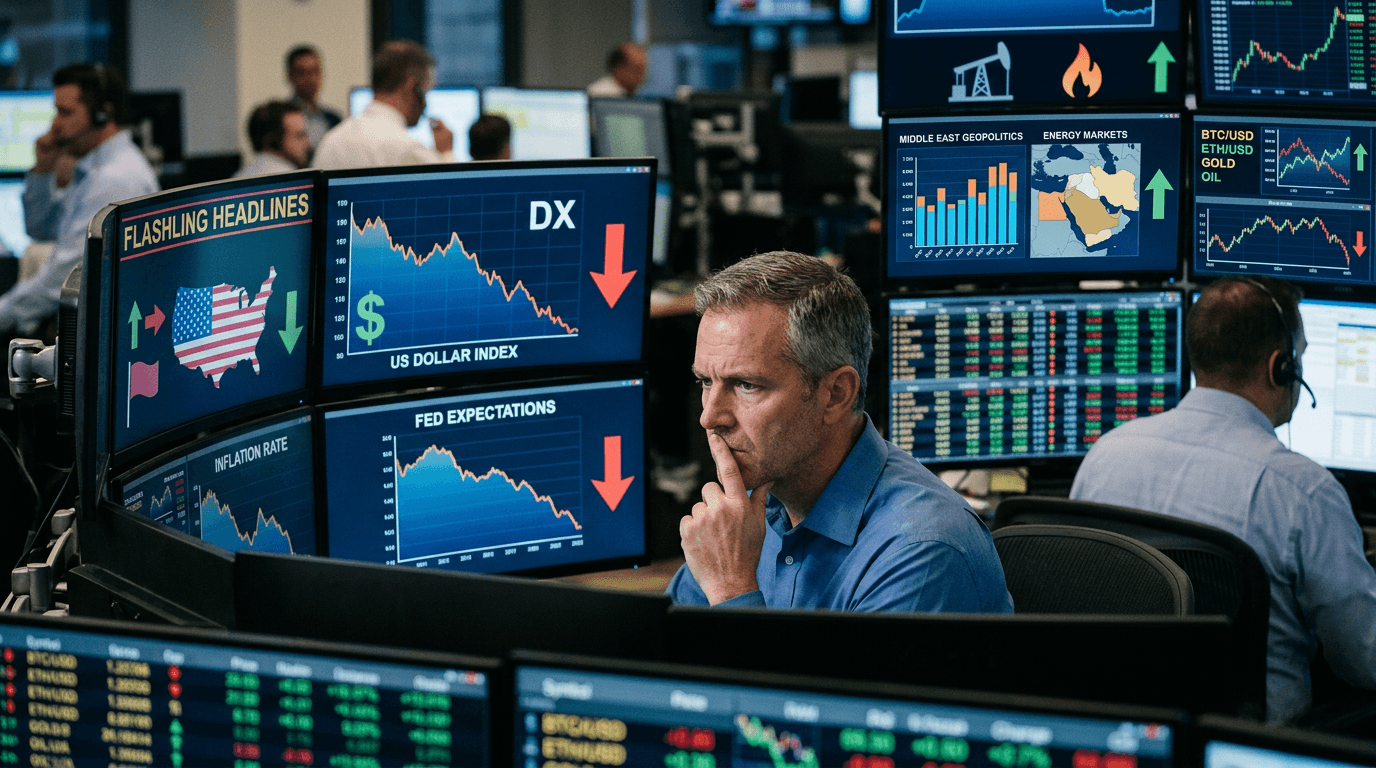
Traders across FX, futures, commodities, and crypto are navigating a macro environment defined by two powerful but competing forces: ebbing expectations of further Federal Reserve rate hikes as U.S. inflation cools, and persistent geopolitical tensions in the Middle East that keep risk premia and haven demand elevated.[2][4][9][13] This push‑and‑pull between softer data and hard geopolitical realities is driving cross‑asset rotations rather than a one‑way risk‑on or risk‑off trend.
Macro Backdrop: Fed Expectations Reset
Recent U.S. inflation prints have come in benign, with consumer prices rising only modestly and core measures showing limited underlying pressure.[3][4][6] In July, overall inflation slowed to around the mid‑3% area year‑on‑year, with core prices rising roughly 0.1% month‑on‑month, reinforcing the narrative that the post‑pandemic inflation spike is losing momentum.[2][3][4] Coupled with softer labor market data, including weaker payrolls and pockets of job losses, markets have sharply recalibrated the path for Fed policy.[1][8][12][14]
Fed funds futures now imply that a near‑term hike is no longer the base case, with probabilities for a single 25 bp increase at upcoming meetings oscillating in a broad 30–60% range rather than converging on an aggressive tightening path.[2][6][7][15] Several major research houses explicitly expect the Fed to stay on hold for an extended period, suggesting that the next big debate may be about “how long at peak” rather than “how high”.[2][12][15] For traders, that shift matters because it changes the primary driver of asset prices from policy shocks to data‑dependent fine‑tuning and risk sentiment.
Key takeaways: - The Fed is moving from a hiking bias toward a prolonged hold, with cuts a growing medium‑term discussion.[2][8][15] - Macro surprises now matter more at the margin: a single inflation or jobs miss can swing hike odds within that 30–60% band.[7][8][15] - Cross‑asset trades built solely on a “higher for longer” dollar story are giving way to more nuanced, relative‑value ideas.
Dollar, Fx, And The Haven Tilt
As rate‑hike odds fade, the U.S. dollar has lost some of its yield advantage, with broad dollar indices retreating from recent highs and, at times, testing multi‑week lows.[2][7][10][12] The re‑pricing in U.S. rates has encouraged selective rotation into higher‑yielding or undervalued currencies, especially where local central banks still sound hawkish or economic momentum looks sturdier.[3][6][10] However, the dollar’s downside is being cushioned by its persistent role as a global safe asset whenever volatility spikes.
Geopolitical risk is a central part of that story. Episodes of heightened tension and military action involving Iran and the wider Middle East have periodically boosted demand for havens such as the Japanese yen and gold, even as the dollar itself behaves defensively.[5][9][11] At times, traditional havens have been less reliable—there have been episodes when both Treasuries and gold came under pressure as risk assets sold off—but yen and bullion tend to benefit when investors worry about escalation, shipping routes, or energy supply disruptions.[9][11][13]
Key takeaways: - A softer Fed path weighs on the dollar via lower rate differentials, but haven flows still provide support during risk‑off episodes.[2][6][10] - Yen and gold can outperform in periods of geopolitical stress, especially when the dollar is already rich on valuation metrics.[9][11][13] - FX traders should think in terms of regimes: “data‑driven dollar” vs “geopolitics‑driven havens”, and be ready for rapid switches between them.
Energy, Commodities, And Crypto Volatility
The Middle East remains a crucial node for oil supply, and episodes of conflict or fears of disruption have fed directly into higher crude prices and volatility in energy‑linked assets.[9][13] From late 2025 into early 2026, oil saw a sharp upswing—over 50% in some measures—taking benchmark prices above the $100 per barrel mark as supply concerns rose.[13] Subsequent pauses in hostilities or diplomatic signals have often triggered equally abrupt pullbacks, underlining how geopolitics can overpower traditional supply‑demand fundamentals in the short term.[9][13]
For commodity‑linked currencies such as the Canadian dollar or Norwegian krone, this environment creates a complex mix of support from higher energy prices and headwinds from global risk aversion.[9][13] In crypto, the macro narrative has also been influential. As Fed hike bets have faded, some investors have revisited the “digital gold” thesis, rotating into major tokens during periods when real yields stabilize and dollar strength moderates, while de‑risking rapidly when headlines hint at escalation or regulatory shocks.[2][5][11]
Key takeaways: - Oil and energy‑linked assets are highly sensitive to headlines, creating short, sharp trends rather than long, smooth cycles.[9][13] - Commodity FX can be pulled in opposite directions by stronger terms of trade and weaker global risk appetite. - Crypto tends to trade like a high‑beta macro asset: it benefits when real yields and the dollar ease, but suffers when volatility turns disorderly.[2][5][11]
How Traders Can Use A Simulated Environment
In this kind of cross‑asset, headline‑driven market, a simulated trading environment is a powerful way to test macro ideas before deploying real capital. When Fed expectations swing between “one more hike” and “on hold for the year”, strategies that look robust on a static backtest can break down in live, news‑heavy conditions.[2][7][8][15] Simulated portfolios let traders rehearse how they would adjust positions when, for example, a benign inflation print suddenly collides with a geopolitical flare‑up.
Practical ways to use simulation in this backdrop include: - Running scenario drills: Build playbooks for “soft data + calm geopolitics” (carry trades, risk assets) versus “soft data + conflict escalation” (yen, gold, volatility hedges).[2][9][11][13] - Stress‑testing correlations: Observe how FX, gold, oil, and crypto co‑move during event weeks such as CPI, payrolls, OPEC meetings, or major geopolitical milestones.[3][4][5][9][13] - Practicing risk management: Use simulated trades to refine position sizing, stop‑loss placement, and hedging tactics when markets gap on headlines rather than move gradually.
By iterating through these scenarios in a SimFi environment, traders can refine not only their trade ideas but also their decision‑making process—how quickly they cut losers, whether they overtrade on noise, and how they respond when macro narratives flip.
Conclusion
The current macro backdrop is defined by slowing U.S. inflation, fading Fed hike bets, and a dollar that is no longer an unchallenged yield champion—but still a core safe asset during shocks.[2][4][6][10][12] At the same time, unresolved geopolitical risks in the Middle East keep haven demand for yen and gold alive and inject persistent volatility into energy, FX, and crypto markets.[5][9][11][13] Instead of a simple risk‑on or risk‑off label, markets are oscillating between “data mode” and “geopolitics mode”, often within the same week.
For traders, the edge lies in recognizing which mode the market is in, aligning exposure with the dominant driver, and avoiding over‑commitment to any single macro story. A disciplined, simulated approach—where strategies are tested against both benign and stressed scenarios—can help build the adaptability needed to navigate these cross‑currents. In a world where Fed probabilities and geopolitical headlines can both move assets, the most valuable asset is a robust, well‑rehearsed playbook.