
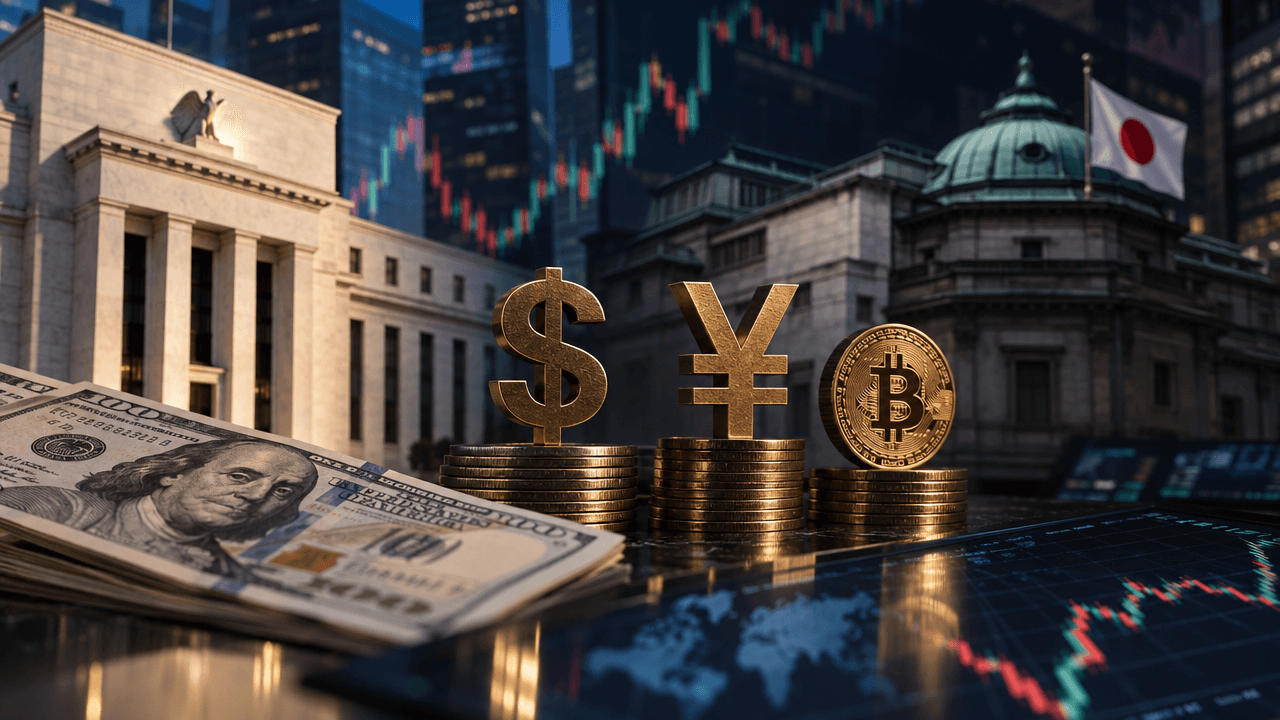
In mid-September, the Federal Reserve and the Bank of Japan both lifted policy rates, signalling a decisive turn toward a higher‑for‑longer global rates regime[2][4][11]. The Fed raised its federal funds target range by 25 basis points to 3.75%–4.00%, the first hike since 2023 and a clear response to persistent inflation pressures[1][2][4]. Days later, the Bank of Japan increased its policy rate from 1.0% to 1.25%, pushing Japanese borrowing costs to their highest level in 31 years[8][9][11]. Together, these moves have reshaped the macro backdrop for FX, bonds, equities, and even crypto.
Macro Regime Shift: From Normalization To Higher-for-longer
The latest Fed decision is notable not just for the 25‑basis‑point hike, but for the path it sketches for the coming years[2][4]. Updated projections show policy rates rising toward the 4.00%–4.25% range by year‑end and remaining elevated through 2027, anchoring expectations for a prolonged period of tight financial conditions[2]. Implementation details reinforce this stance: the interest rate paid on reserve balances was raised to 3.90%, and the primary credit (discount) rate to 4.0%, aligning the operational tools with the new target range[3][10]. This is no longer a short, sharp tightening cycle; it is an extended plateau designed to lean against sticky inflation.
The Bank of Japan’s move is equally historic in its own context. After decades of near‑zero rates, the BOJ has now lifted its policy rate to 1.25%, a level last seen in the mid‑1990s[8][9][11][13]. The decision, approved by a majority of the policy board, reflects concerns that inflation is approaching and potentially overshooting the 2% target[8][11][12]. Officials have framed the hike as part of a new phase focused on preventing excessive price pressures, implicitly keeping the door open to further gradual increases[8][11]. Japan’s shift from ultra‑easy policy to cautious tightening adds another pillar to the global higher‑for‑longer narrative.
Key takeaway: The world’s most influential central bank and its most dovish holdout are both signalling that restrictive policy is not a short‑term experiment. Traders should assume elevated policy rates are the baseline, not the tail risk.
Dollar, Yen, And The New Fx Reality
When the Fed hikes while projecting rates to stay near 4% for years, it raises the relative appeal of dollar‑denominated assets versus lower‑yielding currencies[2]. That spread dynamic typically supports the dollar against peers, especially those where central banks are slower to tighten. At the same time, a BOJ hiking toward multi‑decade highs stiffens the yen’s yield profile, narrowing one of the most important interest rate differentials in global FX[8][11]. For USD/JPY, the tug‑of‑war between a still‑hawkish Fed and a newly assertive BOJ sets the stage for more two‑sided volatility rather than a one‑way dollar trend.
Beyond the headline pairs, carry strategies must be reconsidered. The classic play of borrowing yen at negligible cost to fund higher‑yielding positions now carries more interest expense and a different risk profile[8][11][12]. In a higher‑for‑longer environment, FX traders need to look beyond nominal rate levels and focus on real yields, policy credibility, and the sequencing of future moves across central banks.
Key takeaway: FX markets are re‑pricing not just current rates but entire policy paths. Simulated trading environments are ideal for testing how different rate scenarios affect dollar strength, yen recovery, and cross‑currency carry trades before committing capital.
Cross-asset Ripple Effects: Bonds, Equities, And Crypto
Higher policy rates transmit into bond markets through expectations for the path of short‑term rates and term premia. With the Fed guiding the policy rate toward 4.00%–4.25% and signalling it may stay there through 2027, investors face a materially higher “risk‑free” benchmark[2]. That tends to pressure longer‑duration government bonds, steepen parts of the curve, and force a reassessment of credit spreads as refinancing costs rise. For equity index futures, the discount rate used in valuation models moves up alongside policy rates, dragging on high‑growth, long‑duration sectors that rely more on future cash flows.
In Japan, the BOJ’s rate hikes mark a shift from yield suppression to gradual normalization[8][11][15]. As the short‑term policy rate climbs, the logic behind decades of yield‑curve control and negative‑rate experiments is being unwound, with implications for global bond flows and equity allocations into Japan[8][15]. Crypto markets are not immune: higher real yields and more attractive cash returns reduce the relative appeal of non‑yielding or highly volatile assets, especially for institutional portfolios that benchmark against traditional fixed‑income.
Key takeaway: In a higher‑for‑longer world, duration risk is front and center. Traders across bonds, equity index futures, and crypto need to stress‑test strategies against scenarios where rates stay elevated longer than consensus expects.
What This Means For Traders And Simfi Participants
For discretionary traders, the new regime elevates the importance of macro awareness. Central bank decisions are no longer incremental tweaks; they re‑anchor the entire cross‑asset risk‑reward spectrum. A Fed funds range at 3.75%–4.00% and BOJ policy rate at 1.25% are not simply data points, but anchors for yield curves, FX differentials, and equity risk premia[2][4][8][11]. Ignoring these anchors can lead to mis‑sized positions and underestimation of tail risks.
Participants on SimFi platforms such as E8 Markets can treat this environment as a live macro laboratory. Simulated portfolios allow traders to experiment with:
- Rotating between growth and value equity indices as discount rates rise.
- Adjusting bond futures exposure to manage duration and curve slope.
- Testing FX strategies that balance dollar strength against a structurally changing yen.
- Observing how crypto beta responds to shifts in real yields and risk sentiment.
Because capital at risk is virtual, traders can iterate quickly, learning how different asset classes respond to the same macro shock before deploying strategies in real markets.
Practical Playbook: Navigating Higher-for-longer
A practical framework for this new landscape starts with the macro calendar. Track major central bank meetings, minutes, and projections, especially from the Fed and BOJ, as these shape expectations for future rate levels[2][4][11]. Integrate market‑implied probabilities from futures and options into your analysis to understand how much tightening is already priced in. In a SimFi setting, build scenario analyses where rates overshoot, match, or undershoot these expectations and observe the impact on your P&L across FX, rates, equities, and crypto.
Risk management needs to evolve alongside the macro regime. Elevated policy rates raise financing costs for leveraged positions and can amplify drawdowns during risk‑off episodes. Shorter holding periods, tighter stop‑loss levels, and more explicit hedges—such as options on equity indices or rate futures—can help align strategy risk with the new volatility profile. Finally, treat cross‑asset correlations as dynamic rather than static; in a world where both the Fed and BOJ are tightening, relationships that held during zero‑rate periods may break down, creating both hazards and opportunities.
Conclusion
The recent rate hikes from the Federal Reserve and the Bank of Japan mark more than just incremental policy moves; they formally usher in a higher‑for‑longer global rates regime[2][4][11]. With the Fed’s benchmark range now at 3.75%–4.00% and the BOJ at a 31‑year high of 1.25%, the cost of money has been re‑rated across major economies[1][2][8][9][11]. For traders and investors, this demands a shift in mindset—from chasing yield in a low‑rate world to actively managing duration, leverage, and cross‑asset exposure in a structurally tighter environment. Simulated finance platforms provide a powerful sandbox to adapt, experiment, and build robust playbooks before committing real capital. Those who embrace the new macro anchors rather than fight them will be better positioned to navigate the next phase of the cycle.