
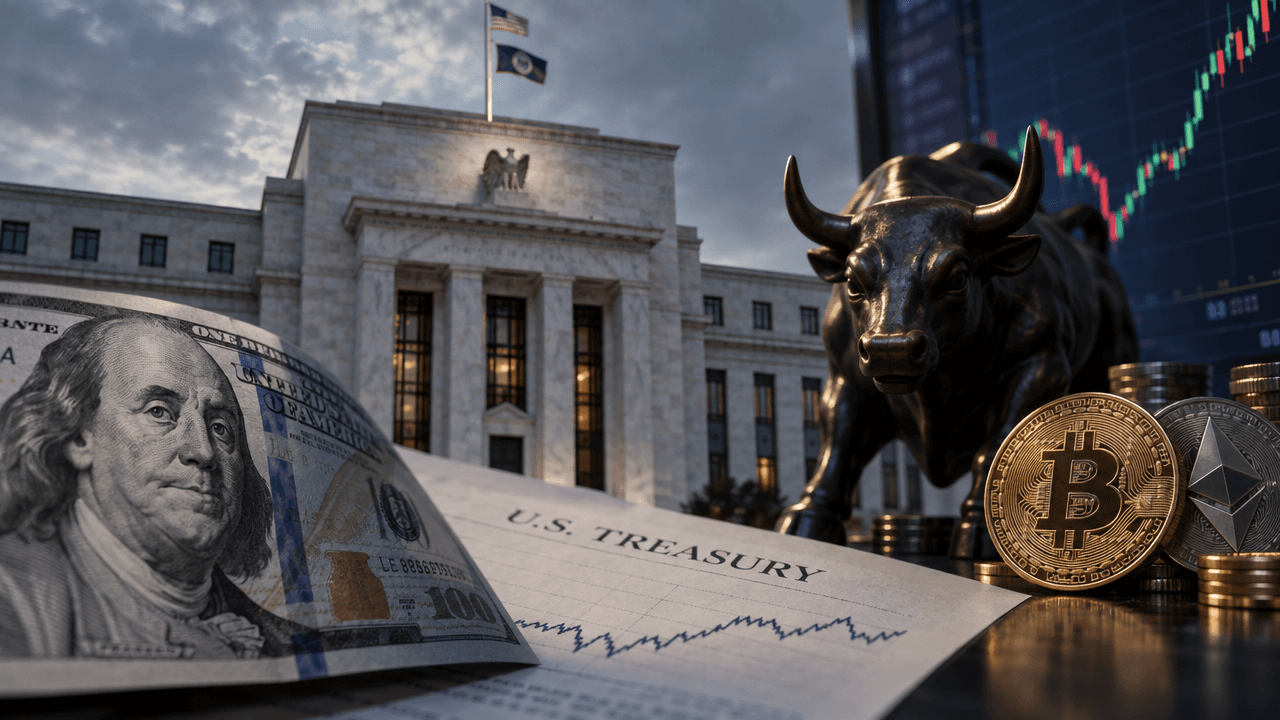
Markets are approaching the Federal Reserve’s October decision with a familiar outcome largely priced in: policymakers are broadly expected to leave the federal funds target range unchanged at 3.75% to 4.00%. Fed funds futures recently implied about a 91% probability of a hold, making the decision itself less important than the language surrounding it. [2][10]
That leaves traders focused on the dollar, Treasury yields, equity futures, and cryptocurrency markets. A pause may be widely anticipated, but any change in the Fed’s assessment of inflation, economic growth, or the likelihood of another move in December could quickly reshape market expectations.
THE DECISION MAY BE PRICED IN, BUT THE MESSAGE IS NOT
When markets expect a central-bank decision, the initial policy announcement can produce only a limited reaction if it matches forecasts. The larger moves often come from the details: the statement, the press conference, dissenting votes, and any clues about the next meeting.
The central question is whether the Fed presents October as a temporary pause or as evidence that the tightening cycle is complete. Current market pricing has kept a December rate increase firmly in view. A Reuters survey found that 94 of 100 economists expected rates to remain unchanged in October, while many also anticipated another quarter-point increase before year-end. [10]
A firm signal that inflation remains too persistent could lift the dollar and short-term Treasury yields. Conversely, a more cautious message emphasizing slower growth, financial conditions, or rising economic risks could reduce expectations for a December hike. Traders should therefore avoid treating a “hold” as automatically dovish or bullish for risk assets.
THE DOLLAR’S NEXT MOVE DEPENDS ON RATE EXPECTATIONS
The U.S. dollar has held near a two-week high ahead of the decision as investors wait for clarity on the Fed’s next step. [2] Currency markets are forward-looking, meaning the dollar responds less to today’s interest-rate level than to the expected path of rates relative to other major economies.
A hawkish hold could support the dollar. This would occur if the Fed leaves rates unchanged but indicates that another increase remains likely, or if officials push back against expectations of eventual easing. Higher expected U.S. rates can make dollar-denominated assets more attractive and increase demand for the currency.
A dovish hold could have the opposite effect. If policymakers suggest that inflation is cooling sufficiently or that policy is already restrictive, traders may reduce bets on a December hike. The dollar could then weaken, particularly against currencies whose central banks are perceived as less likely to ease.
For traders, the practical lesson is to monitor both the dollar index and key currency pairs after the announcement. A dollar move that initially appears strong but quickly reverses may indicate that markets interpreted the statement differently from the first headline reaction.
Treasury Yields Could Break Out Of Their Range
Treasury yields are another important transmission channel. The two-year yield is especially sensitive to expectations for the Fed’s policy rate, while longer-term yields also reflect inflation, economic growth, Treasury issuance, and investor demand for duration.
Recent market commentary has described Treasury yields as trading within a relatively narrow range, with the Fed decision viewed as a potential catalyst for a breakout. [5] The 10-year yield has also remained sensitive to safe-haven demand, government borrowing needs, and expectations for future inflation.
A hawkish message would likely place upward pressure on two-year yields first. If traders conclude that rates may remain higher for longer, the move could spread across the curve. A dovish communication could push yields lower, especially if it reduces expectations for a December increase.
However, bond traders should not assume that every Fed-driven move will be uniform. A stronger growth outlook could lift long-term yields even if short-term rate expectations fall, while concerns about growth could produce the opposite pattern. Watching the relationship between two-year and 10-year yields can provide additional information about how markets are interpreting the policy outlook.
Risk Assets Face A Test Of Positioning
Equity futures and crypto markets have benefited at times from expectations that monetary policy will eventually become less restrictive. Lower expected rates can support asset valuations by reducing discount rates and encouraging demand for riskier investments. But a hawkish surprise can challenge those assumptions quickly.
For stocks, the most vulnerable areas may be highly valued growth companies whose prices depend heavily on future earnings. Higher Treasury yields can make those future cash flows less valuable in today’s terms. Financial stocks, defensive sectors, and companies with strong current cash flow may respond differently.
Crypto can be even more sensitive to changes in liquidity and risk appetite. Bitcoin and other digital assets often react to shifts in real yields, the dollar, and broader market positioning. A hawkish Fed message could pressure crypto if it strengthens the dollar and reduces appetite for speculative assets. A dovish interpretation could provide support, although volatility may remain elevated.
The key is to distinguish a genuine change in policy expectations from a short-lived headline reaction. Traders should compare the movement in equities and crypto with the dollar and Treasury yields rather than viewing any single market in isolation.
Practical Takeaways For Traders
The most important event is not simply whether the Fed holds rates. It is whether the communication changes the expected path for December and beyond.
Before trading, identify the levels that would confirm a breakout in the dollar, Treasury yields, or major equity indexes. Avoid entering positions solely because the first price move appears decisive. Liquidity can be unstable around the announcement, and initial reactions frequently reverse as traders digest the full message.
Position sizing is equally important. A smaller position, a defined risk level, and patience after the release can be more useful than trying to predict every word of the statement. SimFi traders can use the event to practice scenario planning: one plan for a hawkish hold, one for a dovish hold, and one for an unexpected rate change.
Conclusion
The October Fed decision is widely expected to leave rates unchanged, but that consensus does not eliminate market risk. The dollar, Treasury yields, equities, and crypto are all positioned for new information about the possibility of a December move.
For traders, the central task is to focus on expectations rather than headlines. A hold is already largely priced in; the market-moving information will come from the Fed’s guidance on inflation, growth, and the path of policy. The strongest preparation is a disciplined plan that accounts for multiple outcomes and treats volatility as a factor to manage, not a signal to chase.