
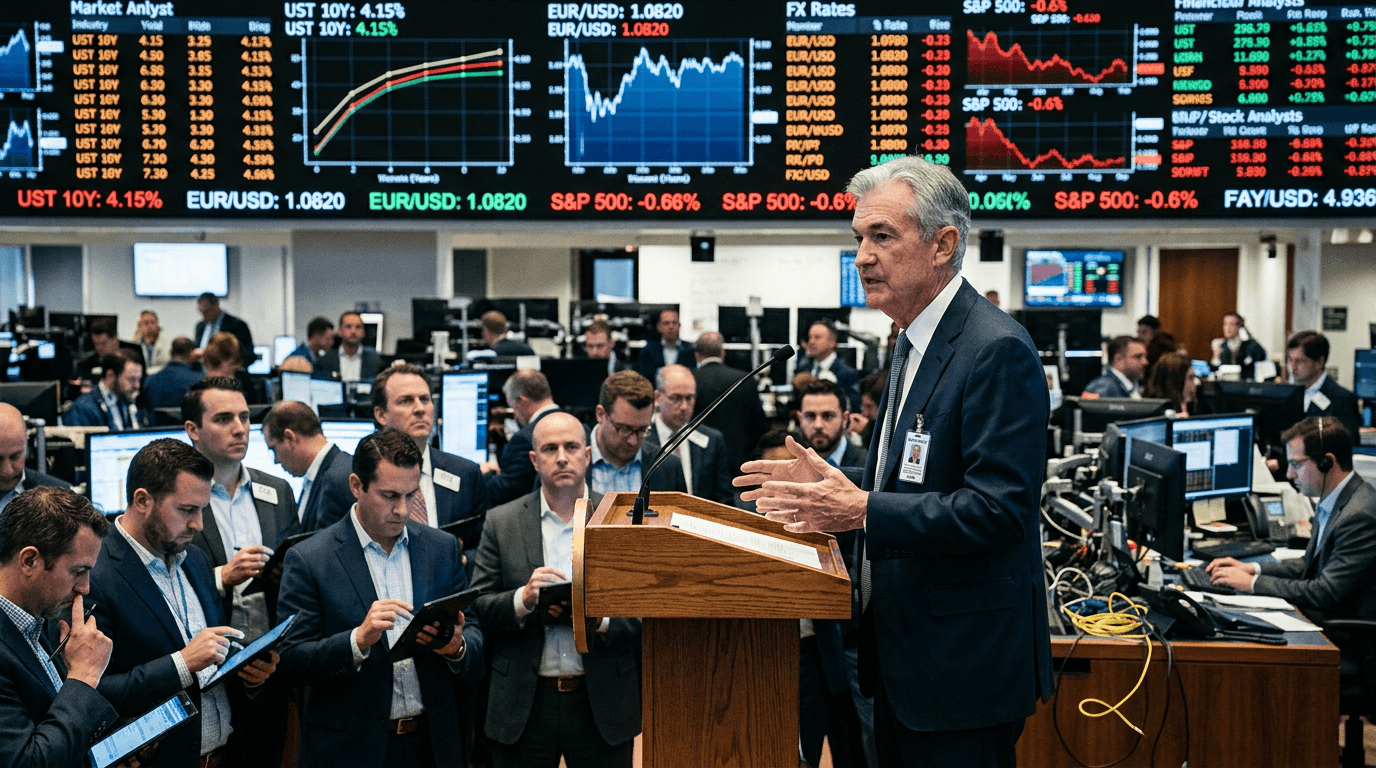
The latest messaging from Federal Reserve officials is clear: policy is likely to stay restrictive “for some time,” even as parts of the market continue to bet on faster rate cuts. For traders, that tension between Fed guidance and market pricing is where opportunity—and risk—lives.
Markets Vs Fed: A Growing Gap
Short‑term interest‑rate futures and swaps curves have been quick to lean dovish after softer inflation prints and a weaker‑than‑expected payrolls report. In those moments, traders tend to pull forward the timing of cuts, assuming the Fed will respond rapidly to any sign of cooling growth or labor demand.
Fed officials are pushing back. Cleveland Fed President Beth Hammack recently stressed there is no imminent need to change the stance of monetary policy, explicitly noting that inflation remains “too high” despite better data. Her comments have helped temper some of the dovish reaction and have fed directly into repricing at the front end of the curve, the dollar, and risk assets.
The broader policy backdrop is consistent with that stance. The FOMC has held the federal funds rate at 3.50%–3.75% for multiple meetings, including in June, and continues to describe inflation as elevated relative to its 2% goal.[3][5][7] Economic projections—via the dot plot—show many officials still see at least one rate hike as possible this year, and they have pushed out any forecasted cuts into 2027–2028.[3][7] In other words, officials’ baseline is “higher for longer,” not “cuts coming soon.”
For traders, the key takeaway is that single data surprises can move pricing in the short term, but the Fed’s reaction function is driven by trends, not one‑off prints. When officials remind markets of that, it can trigger sharp, rapid reversals in rate‑cut expectations.
Why The Fed Is In No Rush To Cut
To understand why officials are comfortable signaling a prolonged hold, it helps to go back to the Fed’s dual mandate: maximum employment and price stability. After cutting rates by 75 basis points in late 2025, they have repeatedly argued that policy is now restrictive enough to cool the economy, but not so tight as to break it.[3][6]
Recent statements and press conferences reinforce this stance. Chair Kevin Warsh has described policy as “in a good place,” highlighting a broad consensus to hold rates and “no rush to cut” until there is more confidence that inflation is on a durable path back to 2% and the labor market has clearly stabilized.[6] At the same time, official FOMC communications continue to emphasize that inflation remains above target, in part due to sector‑specific supply shocks such as energy.[5]
Projections back this up. The latest dot plot removed earlier expectations for a rate cut this year, with the median forecast now showing at least one potential hike and no cuts until later years.[3][7] That is a meaningful shift: instead of debating how quickly to ease, policymakers are debating whether additional tightening may still be necessary if inflation proves sticky.
Three practical implications follow
1. The bar for rate cuts is higher than markets often assume. The Fed wants clear, sustained evidence on inflation and labor, not just a few soft prints.
2. Cuts are more likely to be gradual and data‑dependent than front‑loaded and aggressive, unless there is a genuine shock.
3. Surprise hikes remain on the table if inflation re‑accelerates, which keeps a floor under short‑term yields.
How This Shapes Yield Curves, The Dollar, And Risk Assets
When the Fed signals rates will stay on hold for some time, it anchors the front end of the yield curve. Short‑dated Treasuries and money‑market rates converge on the policy rate range of 3.50%–3.75%, and any move in futures that implies faster cuts has to be reconciled with that official stance.[3][5][7]
In practice, that often means:
- Front‑end yields rise when officials push back against dovish pricing, flattening the curve if longer‑term yields move less.
- The dollar tends to find support when markets pare back rate‑cut bets, as higher relative U.S. yields make dollar assets more attractive.
- Risk assets—equities, credit, high‑beta FX—can stall or correct when the path to easier policy gets pushed out, especially if valuations were predicated on imminent easing.
Beth Hammack’s comments are a textbook example: by reminding investors that inflation is still too high and that there is “no imminent need” to adjust policy, she effectively reinforced the Fed’s higher‑for‑longer narrative. The immediate impact is in short‑term rates, but the knock‑on effects spread quickly through FX and equities as traders reassess the timing and depth of any future easing.
For traders, the lesson is that the yield curve is not just a forecast; it is a battleground between Fed guidance and market belief. When those diverge, volatility tends to increase.
What Traders Should Watch Next
In this environment, successful macro and rates trading hinges on tracking both the data and the dialogue. Key signposts include:
- Inflation reports: Core measures, shelter, and services inflation will be critical in determining whether “too high” becomes “comfortably lower.”
- Labor market data: Payrolls, unemployment, wages, and participation all inform the Fed’s assessment of whether restrictive policy is starting to bite.
- Fed communications: Speeches by regional presidents and governors, FOMC statements, and the dot plot provide direct insight into the committee’s bias.[3][5][6][7]
- Futures and options pricing: The spread between what the Fed projects and what markets price is a useful gauge of potential repricing risk.
For simulated and real‑money traders alike, scenario analysis is essential. Consider three broad paths:
- Sticky inflation, resilient growth: Rates stay on hold or edge higher, supporting the dollar and pressuring long‑duration assets.
- Gradual disinflation, modest cooling in labor: The Fed eventually cuts, but later and slower than markets initially expect.
- Sharp downturn: Faster cuts become likely, but that would come alongside broader risk‑off moves.
STRATEGIES FOR SIMULATED AND REAL‑WORLD TRADERS
On a SimFi platform, traders can stress‑test strategies across these scenarios without capital at risk. A few practical ideas:
- Don’t fight the Fed: Bias rate strategies toward the official guidance, not the most optimistic market narrative. Fading extreme dovish pricing when officials are consistently hawkish can be a fruitful theme.
- Watch the front end: Instruments tied to 1‑3 year maturities are most sensitive to shifts in cut expectations. They are also where Fed‑driven repricings happen fastest when officials push back.
- Link FX and rates: Stronger “higher‑for‑longer” signals typically support the dollar. Simulate FX strategies that respond to moves in short‑term yield differentials, rather than headline sentiment.
- Respect volatility around data: Payrolls and CPI can temporarily overpower Fed messaging. Use simulated trades to practice managing positions through these events and adjusting quickly when officials respond.
The overarching message from the Fed right now is patience. While markets will continue to test the boundaries by pricing faster cuts whenever data allow, officials are signaling that the path back to 2% inflation is more important than appeasing short‑term expectations. For traders, understanding that tension—and positioning intelligently as it resolves—will be one of the key macro themes in the months ahead.