
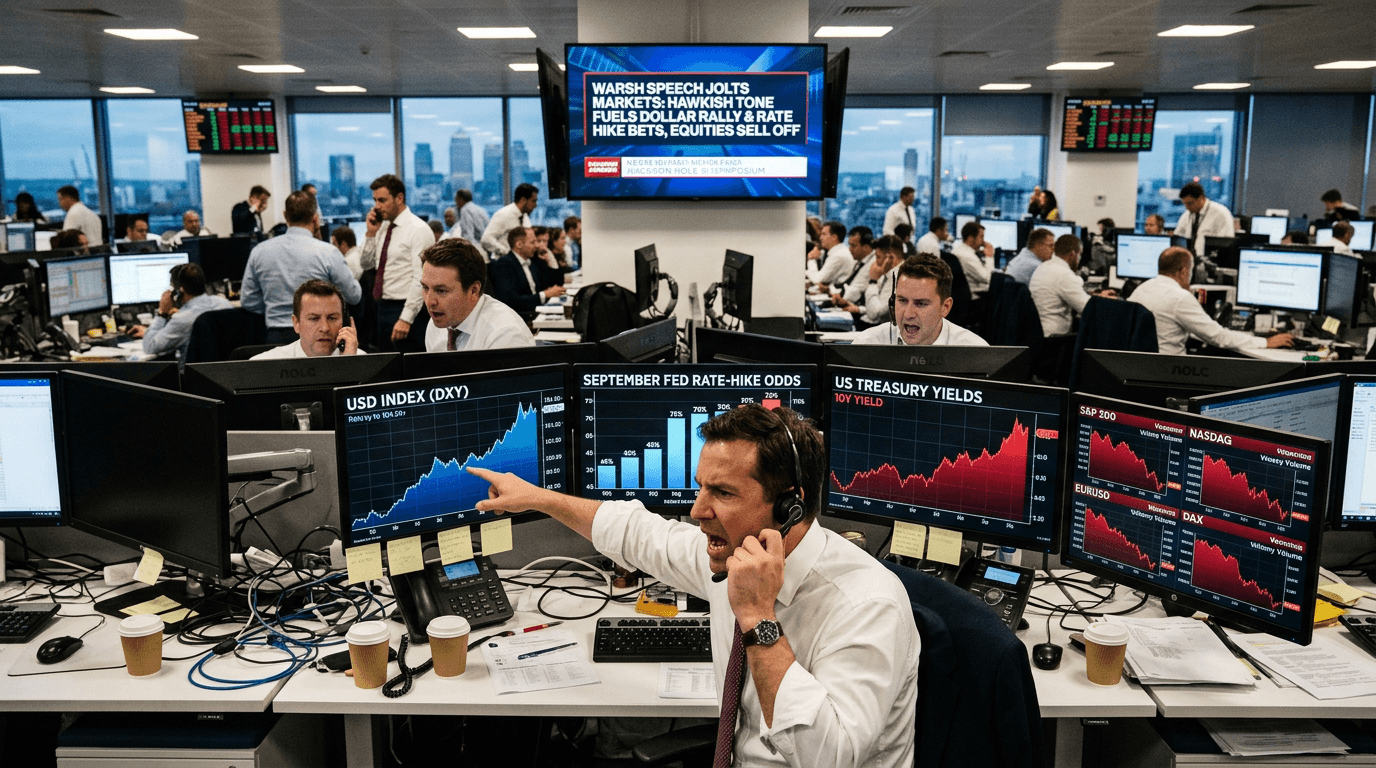
Markets wasted no time in reacting to Federal Reserve Chair Kevin Warsh’s hawkish Jackson Hole speech, aggressively repricing the odds of a September rate hike, boosting the dollar, and putting pressure on risk assets from equities to emerging-market currencies[1][2][6][8]. Within hours, rate futures shifted from treating a hike as a tail risk to regarding it as the base case, turning this keynote into the dominant macro driver across global markets[2][3][6][14].
Market Snapshot: A Clearer Hawkish Message
Warsh used his first Jackson Hole keynote to deliver a sharper warning on inflation than at the July Fed meeting, answering critics who had viewed his previous communication as muddled or overly cautious[1][5]. He reiterated the Fed’s 2% inflation target, emphasizing that prices remain too high and that policymakers’ “predominant focus” must be on bringing inflation back to that goal[1][4][5]. Importantly, Warsh suggested financial conditions are not yet meaningfully restrictive, implying that current rates may not be sufficiently tight to fully contain price pressures[13][14].
Rather than offering detailed forward guidance or a formulaic reaction function, Warsh leaned into a data-dependent, real‑time approach, signaling that the Fed will respond to the evolving inflation and labor market picture rather than pre‑committing to a specific path[3][7][10]. That combination—firm resolve on inflation with flexibility on timing—was interpreted by markets as a willingness to hike again if inflation does not convincingly moderate[1][2][9].
How Rate-hike Odds Repriced In Real Time
Before Warsh took the stage, futures markets were assigning roughly one‑third to two‑fifths odds to a September rate increase, effectively treating it as a coin-flip or slightly less likely outcome[2][11][14]. By the end of the speech, CME FedWatch data and multiple market trackers showed those probabilities jumping to the mid‑50s to near 60%, meaning traders now see a 25‑basis‑point hike next month as more likely than not[2][3][6][8][14].
This kind of fast repricing is typical around high‑stakes central bank events, but the magnitude matters: a 15–25 percentage point swing in rate‑hike odds in a matter of hours reflects a genuine shift in perceived reaction function, not just short‑term noise[2][6][11]. For discretionary traders, it underscores why macro event risk cannot be treated as an afterthought; for algorithmic and SimFi participants, it highlights how quickly regimes can change when policy signals surprise or clarify.
Cross-asset Reaction: Dollar Up, Yields Higher, Risk Under Pressure
The immediate cross‑asset response followed the classic “hawkish Fed” playbook. The dollar strengthened as higher expected U.S. rates improved the currency’s yield advantage and reinforced its defensive appeal[6][12]. Short‑dated Treasury yields, particularly in the 2‑year sector that is most sensitive to Fed policy expectations, moved higher in tandem with the repricing of September hike odds[2][14].
Equities, especially higher‑beta and growth segments, came under renewed pressure as investors digested the prospect of a “higher for longer” rate environment that could weigh on valuations and tighten financial conditions[5][8][12]. Internationally, risk-sensitive assets such as emerging‑market equities and FX faced a double headwind from stronger U.S. yields and a firmer dollar, a pattern observed repeatedly during previous hawkish pivots in Fed communication[6][8].
For traders, the key point is that even without an actual rate move, a single influential speech can simultaneously reprice expectations, shift volatility regimes, and alter cross‑market correlations—turning a quiet late‑summer Friday into a major macro inflection point[1][2][6][14].
What Traders Should Watch Next
Warsh’s message was firm on inflation but deliberately non‑committal on the exact timing of future moves, leaving upcoming data and Fed communications as critical catalysts[1][3][10]. The September 15–16 Fed meeting now looms larger as a live event with meaningful outcome risk, given that markets see a hike as slightly more likely than a hold[10][11][14]. Between now and then, inflation prints, labor market data, and survey‑based indicators of pricing and wage pressures will shape whether markets continue to lean into the hawkish narrative or fade it.
Traders should monitor three things closely. First, any follow‑up remarks from other FOMC members that either reinforce or temper Warsh’s tone; coordinated messaging would cement the repricing, while divergence could re‑introduce uncertainty[2][7][11]. Second, the path of short‑term yields and rate‑sensitive sectors—if the move in front‑end rates persists, it validates the shift in expectations rather than marking a one‑day overreaction[2][14]. Third, volatility measures in FX and equities; elevated implied volatility around macro events can create both opportunity and risk, depending on how exposure is managed[6][8][12].
Simulated Finance: Practicing Macro Risk Without Real Capital
For SimFi traders on platforms like E8 Markets, this Jackson Hole moment is an ideal case study in how macro narratives translate into price action across asset classes. Because simulated environments mirror live market data without putting real capital at risk, users can test strategies designed for hawkish‑surprise scenarios—long dollar versus high‑beta currencies, tactical shorts in rate‑sensitive equities, or positioning for steeper front‑end yield curves—while closely observing how correlations evolve.
One practical exercise is to build parallel scenario books: in one, the Fed delivers a September hike and signals readiness to do more; in the other, it holds but keeps a strong tightening bias. Traders can then structure simulated trades around FX pairs, indices, and bond futures that would perform differently under each outcome, tracking how shifting probabilities alter mark‑to‑market over time. This improves intuition for probabilistic thinking, not just binary “hike vs no‑hike” calls.
Another useful application is stress‑testing risk management rules in volatile macro windows. Simulated trading allows participants to experiment with tighter intraday loss limits, dynamic position sizing around event risk, and hedging tactics such as using options or offsetting positions in correlated markets. By reviewing performance after the Jackson Hole repricing, traders can refine their playbook for the next major central bank moment—whether that is the September Fed meeting or another policy surprise down the line.
Key Takeaways For The Days Ahead
Warsh’s Jackson Hole speech has shifted the macro narrative from “gradual disinflation with cautious Fed” toward “stubborn inflation with a Fed ready to act again if needed,” raising near‑term rate‑hike odds and putting risk assets on notice[1][2][5][11]. The repricing in September hike probabilities—from the mid‑30s to around 55–60%—demonstrates how quickly expectations can move when communication is clearer and more hawkish[2][3][6][8][14].
For traders—whether live or simulated—the lesson is clear: central bank speeches can be as market‑moving as actual decisions, and managing exposure around them requires preparation, scenario analysis, and disciplined risk controls[2][6][11]. By using SimFi platforms to rehearse responses to events like Jackson Hole, market participants can build the skills and confidence needed to navigate real‑world volatility when policy signals shift again.