
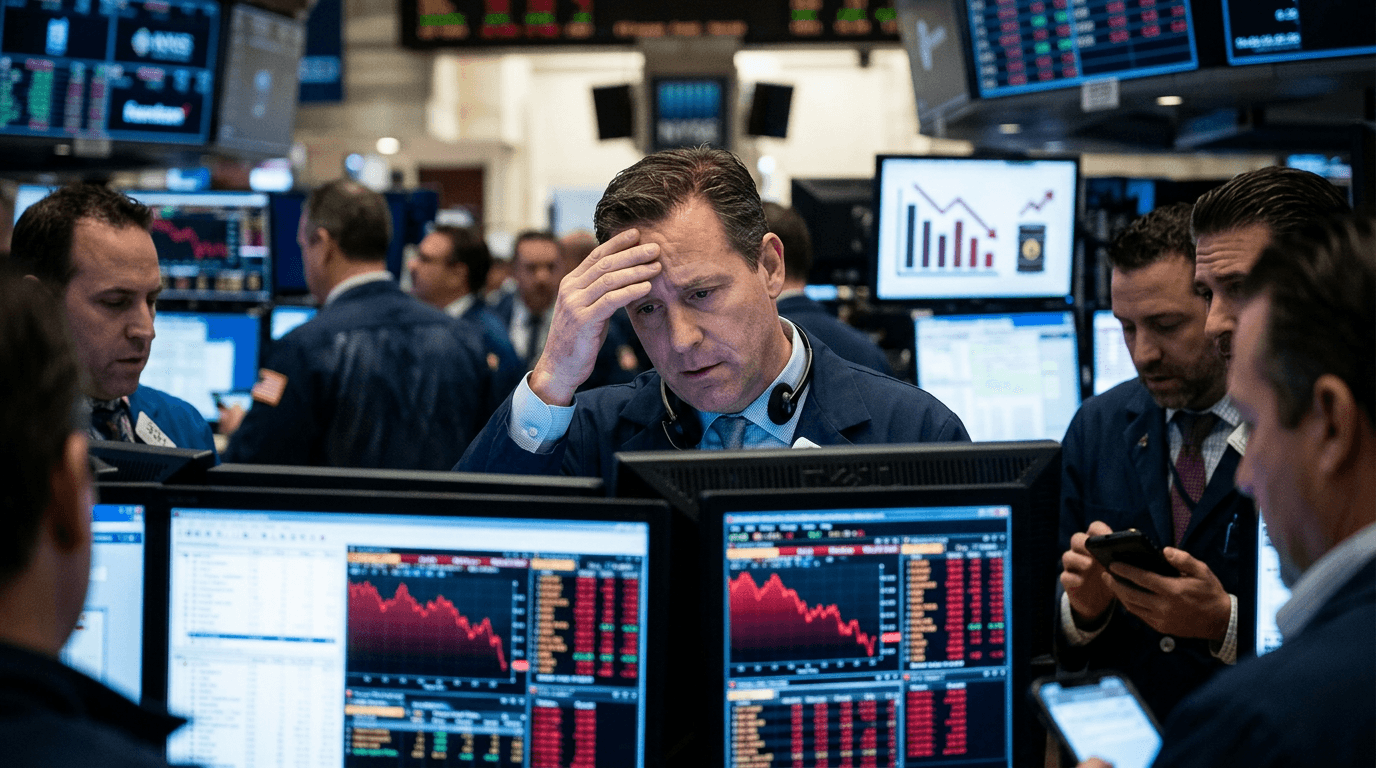
U.S. stock market futures opened Monday under significant selling pressure as investors reassessed their positions in the wake of escalating Middle East tensions. Futures linked to the Dow Jones, S&P 500, and Nasdaq fell more than 1% in early trading, signaling a broadly negative open for the week.[1][2] The decline reflects a sharp rotation toward defensive assets and safe-haven investments as traders grapple with geopolitical uncertainty, rising energy costs, and mounting inflation concerns that could reshape Federal Reserve policy expectations.
Geopolitical Tensions Drive Market Retreat
The primary catalyst for Monday's market weakness stems from fresh military strikes in the Middle East that have escalated regional tensions considerably. Fresh military strikes by the United States and Israel on Iran continued after weekend attacks that killed Ayatollah Ali Khamenei, with Tehran responding with missile barrages across the region.[1] This escalation has raised serious concerns that the conflict could widen and pull in neighboring countries, particularly Lebanon where Hezbollah has already become engaged in the fighting.
The uncertainty surrounding the scope and duration of the conflict has prompted investors to abandon equities in favor of more defensive positions. A media report indicated that U.S. President Donald Trump stated the conflict could last another four weeks, with attacks continuing until the United States achieves its objectives.[1] This timeline projection has spooked markets, as extended geopolitical conflicts create prolonged uncertainty that can severely hamper investor confidence and corporate earnings.
The conflict has already created tangible disruptions to critical infrastructure. Airports have shuttered, and airlines have suspended operations across the region, crippling travel through some of the world's most crowded transit arteries and creating spillover effects for international carriers.[2] These operational disruptions add a real economic dimension to what might otherwise be viewed as a purely geopolitical concern, increasing the probability of meaningful economic impact beyond asset repricing.
Oil Prices And Inflation: The Central Concern
Perhaps the most pressing worry for equity investors is the sharp rise in crude oil prices following the military strikes. Crude oil prices rose significantly, with Wood Mackenzie suggesting prices could hit $100 a barrel if transit flows through the Strait of Hormuz, the world's most critical oil chokepoint, do not resume quickly.[2] The Nasdaq 100 E-minis dropped 464 points, or 1.86%, as the tech-heavy index bore the brunt of selling pressure amid inflation concerns.[1]
The inflation implications of sustained higher oil prices represent a genuine threat to equity valuations, particularly for growth-oriented technology stocks that have been market leaders. A sustained oil spike could lift inflation expectations and bond yields, pressuring long-duration growth valuations by raising discount rates, which directly impacts companies like Nvidia, Microsoft, Apple, and Alphabet whose multiples are sensitive to future revenues and real yields.[2] This dynamic explains why the Nasdaq underperformed on Monday despite the S&P 500 and Dow also posting declines.
Rising oil prices directly increase transport and production costs for businesses across the economy, creating a headwind for corporate profitability and potentially necessitating price increases that filter through to consumers. Traders are already reacting to recent inflation readings that have reduced hopes for interest rate cuts by the U.S. Federal Reserve, making the current oil spike particularly ill-timed from a market perspective.[1]
Safe-haven Flows And Defensive Positioning
The market's risk-off posture is evident in the sharp rotation toward traditionally defensive assets. Gold prices climbed about 2%, while bond prices rose and the U.S. 10-year Treasury yield briefly touched an 11-month low as investors sought safety.[1] The dollar rose to a five-week high against a basket of currencies amid demand for safe-haven assets, while the euro fell to a five-week low against the dollar.[2]
This capital flow dynamic reflects classic risk-aversion behavior where investors abandon equity exposure in favor of assets perceived as less vulnerable to geopolitical shocks and inflation surprises. The elevated demand for government bonds has pushed yields lower despite the inflation concerns, creating a somewhat paradoxical environment where safe-haven demand temporarily overwhelms inflationary concerns.
In stark contrast to the broad equity weakness, energy sector stocks surged on the back of higher oil prices. ExxonMobil and Occidental Petroleum rose 4.7% and 6.3% respectively, while defense stocks also climbed as investors anticipated a prolonged conflict.[2] Meanwhile, airline stocks plummeted as the conflict disrupted regional operations, with American Airlines and United Airlines shares falling 4.9% and 5.7% respectively.[2]
Key Economic Data And Federal Reserve Implications
Beyond the immediate geopolitical shock, markets are preparing for key economic reports that could shape Federal Reserve policy expectations. Manufacturing PMI, retail sales, ADP employment data, and the non-farm payrolls report are all on the docket this week and could significantly influence interest rate decisions by the central bank.[1]
If economic data weakens, markets may expect policy changes from the Federal Reserve. Conversely, if data remains resilient, the central bank may maintain its cautious stance regarding rate cuts, particularly if inflation concerns persist due to higher energy prices. This week's economic calendar introduces additional uncertainty to an already fragile market environment.
Takeaway For Investors
The convergence of geopolitical uncertainty, rising energy prices, and inflation concerns has created a challenging backdrop for equity investors. While Goldman Sachs still expects Brent crude and WTI to fall to $60 and $56 a barrel by the fourth quarter, history shows that oil price spikes driven by geopolitical shocks can be short-lived, though they can also exceed fair-value estimates when uncertainty is high.[2] Market experts say investors should focus on risk management and avoid panic decisions, while closely monitoring developments in the Middle East and upcoming economic data.