
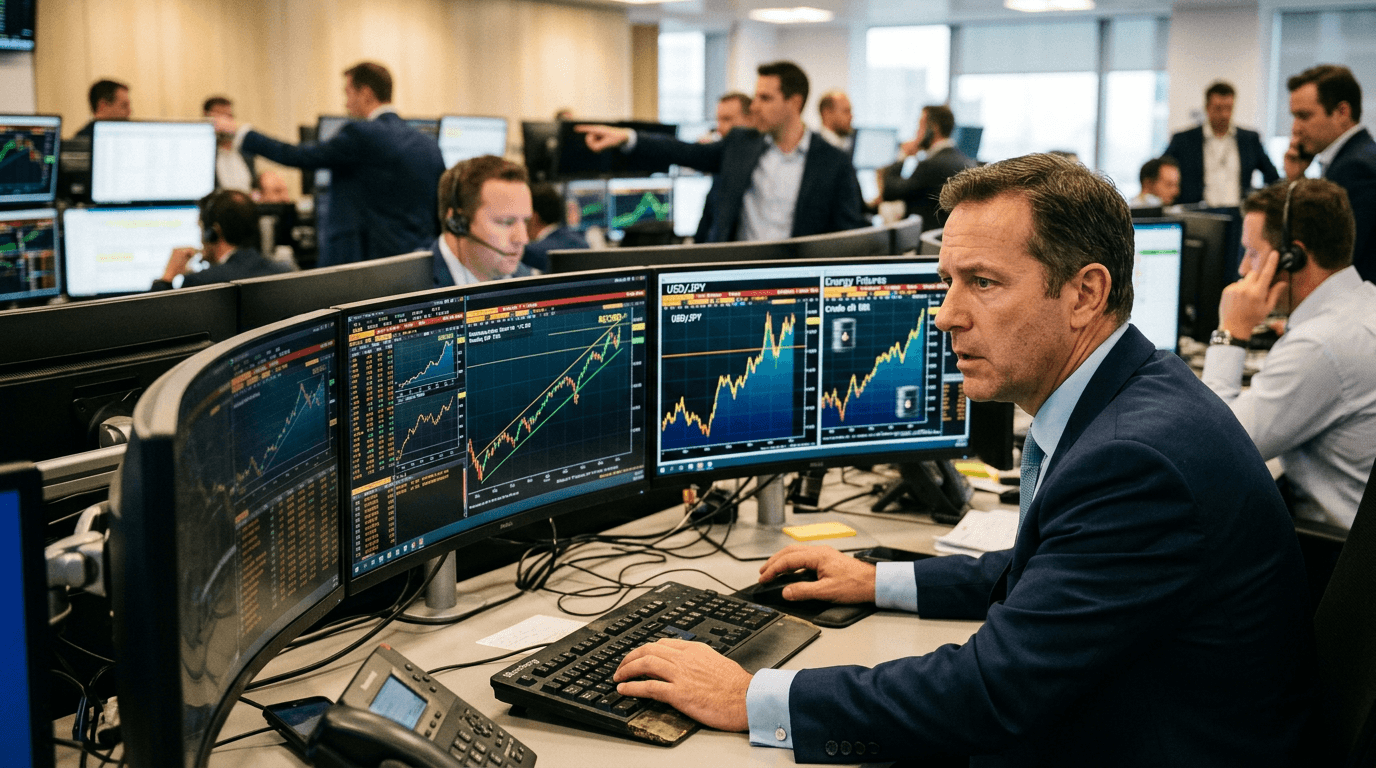
Equity index futures are hovering in rarefied air, with Nasdaq 100 and S&P 500 contracts drifting near record territory even as cross-asset signals turn more challenging. Technology-heavy benchmarks are grappling with lofty valuations, a surging dollar against the yen, and a renewed push higher in crude oil, creating a more nuanced backdrop for both directional traders and hedgers.[1]
Market Snapshot: Futures Near Record Highs
Nasdaq 100 futures have staged a powerful multi-week run, driven by enthusiasm around AI, semiconductors and megacap growth, pushing contracts to within fractions of a percent of all‑time highs.[1] The S&P 500 futures complex has followed suit, supported by resilient earnings and still‑benign credit conditions, even as investors debate how much good news is already priced in.
At these levels, every intraday headline matters more. When markets trade near records, small surprises in economic data, company guidance or macro headlines can trigger outsized moves, because positioning is often skewed long and risk budgets are stretched. This is part of why futures “wobble” intraday even when the broader uptrend remains intact.
To understand today’s setup, it helps to recall what these contracts represent. Nasdaq 100 and S&P 500 futures are standardized agreements to buy or sell the underlying equity index at a predefined date and price, widely used for both speculation and hedging.[2][3] Their near‑24‑hour trading and leveraged nature make them the first place many institutional traders express views on macro news or earnings.[2][4]
In practice, that means the futures market often reacts faster and more violently than the cash index when new information hits. For active traders, monitoring futures order flow and implied volatility can offer early clues about whether a “wobble” is the start of a deeper reversal or just noise inside an ongoing trend.
USD/JPY AT 160: WHY FX MATTERS FOR EQUITIES
The dollar–yen pair testing the 160 level is more than a currency headline; it is a symptom of diverging monetary policy and a potential catalyst for official intervention. A weak yen reflects Japan’s ultra‑loose policy relative to the U.S., where rates remain comparatively high. As USD/JPY pushes toward multi‑decade extremes, speculation grows that Japanese authorities may step in to support the currency.
From a U.S. equity perspective, this has several channels of impact. First, a stronger dollar can weigh on multinational earnings, as overseas revenues translate back into fewer dollars. This is especially relevant for S&P 500 constituents with large foreign sales. Second, abrupt FX moves tend to tighten global financial conditions and can spark risk‑off flows, pressuring equity futures.
Third, a weaker yen has historically been associated with Japanese investors allocating capital abroad, including into U.S. Treasuries and equities. Any sudden reversal in USD/JPY—especially if triggered by intervention—could prompt adjustments in those positions, amplifying volatility in bond yields and stock index futures.
For traders in equity futures, the key takeaway is that extreme FX levels can act as latent catalysts. When USD/JPY trades near a widely watched line in the sand like 160, it effectively embeds “event risk” into markets: no one knows when or how forcefully authorities might respond, but if they do, the reaction can be fast and broad.
Oil On The Rise: Energy And Inflation Ripple Effects
At the same time, Brent crude extending gains for a third straight session introduces another layer of complexity. Rising oil prices feed directly into input costs for transportation, manufacturing, and logistics, and indirectly into inflation expectations. For equity investors, that creates both sector winners and losers.
Energy producers and services firms typically benefit from higher crude, supporting related segments of the S&P 500. But for the broader index, persistent oil strength can pressure margins in consumer, industrial, and some tech hardware names, especially if companies struggle to pass higher costs on to customers without eroding demand.
On the macro side, higher energy prices complicate the disinflation narrative. If oil climbs far and fast enough, it can make central banks more cautious about cutting rates, or in some cases slow the pace of easing. For growth‑oriented indices like the Nasdaq 100, which have benefited from lower long‑term yields and the prospect of policy easing, this can dampen sentiment and valuation support.
For futures traders, the message is that crude is a key input into the equity risk premium. When oil grinds higher alongside already-elevated equity valuations, the margin for error narrows. A surprise in inflation data or central bank rhetoric can then trigger larger adjustments in index futures as investors re‑price both earnings and discount rates.
Two-way Flows And Volatility: What Traders Are Seeing
The combination of record‑high tech valuations, a stretched USD/JPY and rising oil prices is a classic recipe for two‑way flows in index futures, FX, and volatility products. Strong trends are still in place, but more participants are actively hedging or fading short‑term overextensions, creating choppier intraday dynamics.
In index futures, that shows up as sharp rotations between sectors and frequent tests of intraday support and resistance levels. Dip‑buyers remain active, but so do short‑term sellers using futures to tactically reduce exposure without touching underlying portfolios. As a result, realized volatility can rise even if headline indices remain near highs.
In FX, the yen’s weakness encourages carry trades—borrowing in low‑yielding yen to buy higher‑yielding assets—while simultaneously raising the risk that a sudden bout of yen strength could unwind those trades. That uncertainty supports demand for options, increasing implied volatility in both currency and equity markets.
For volatility traders and hedgers, this environment favors more nuanced positioning. Instead of simply buying volatility on fear or selling it on complacency, there is an opportunity to exploit dislocations between realized and implied volatility, between indices and single names, or between equity and FX vol. Simulated environments can be especially useful for practicing how volatility smiles and skews behave during potential intervention or risk‑off episodes.
Practical Takeaways For Traders
For index futures traders, the first priority is to respect the context: trading near record levels with multiple macro cross‑currents increases the odds of abrupt moves. That argues for tighter intraday risk controls, clearer invalidation levels, and careful position sizing, especially around major data releases or policy speeches.
Second, cross‑asset awareness becomes a competitive edge. Watching USD/JPY around 160 and tracking front‑month Brent crude can provide valuable leading clues about sentiment shifts. A sudden drop in USD/JPY or spike in oil during U.S. hours, for example, may foreshadow a change in equity futures flows.
Third, scenario planning matters. Traders can map out “if–then” responses: What is the plan if yen intervention hits and the dollar drops quickly? How will you respond if oil breaks out to new short‑term highs while futures are at records? Predefined playbooks help reduce emotional decision‑making in fast markets.
For newer traders, simulated finance platforms offer a practical way to test these strategies without capital at risk. You can experiment with:
– Hedging a long equity futures position with FX exposure linked to USD/JPY. – Using crude‑linked products to partially offset energy price risk in an equity portfolio. – Structuring simple options strategies around periods of expected policy or intervention risk.
Finally, this environment rewards flexibility. The dominant trend in U.S. equities is still higher, but the drivers are more fragile than they appear at first glance. By integrating equity, FX, and commodity signals into your process—and by rehearsing your response to potential shocks—you can navigate the wobble near record highs with greater confidence and discipline.