
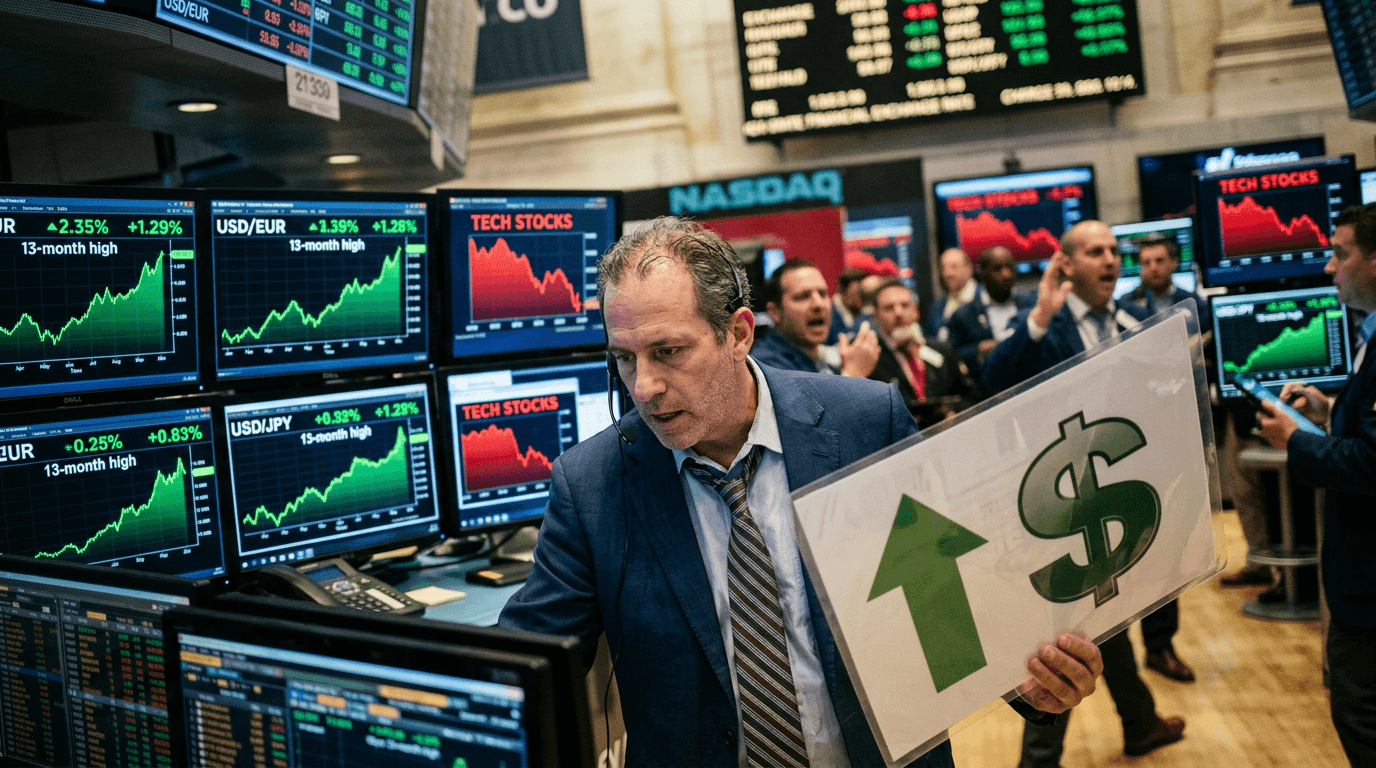
The US dollar is back in the spotlight, breaking to a fresh 13‑month high as investors rush into safe-haven assets amid a sharp selloff in technology and semiconductor stocks. The move is rippling through global markets, pressuring Asian and emerging‑market currencies, and challenging risk sentiment across equities, credit, and commodities.
WHAT IS HAPPENING WITH THE DOLLAR?
The US Dollar Index (DXY), which tracks the dollar against a basket of major currencies including the euro, yen, and pound, has climbed to its highest level in more than a year.[1][3] This push higher has been supported by two powerful forces: renewed expectations of further Federal Reserve rate hikes and a sudden spike in risk aversion following a tech-led equity selloff.[1][6]
In practice, this means the dollar is gaining against most major and emerging‑market currencies. For traders, the price action is not just a headline: it is a signal that global capital is rotating back toward the US and away from risk-sensitive regions and assets.
Why Tech Stocks Matter For The Dollar
The catalyst for the latest leg higher in the dollar has been an aggressive selloff in technology and semiconductor shares. Growth-heavy indices like the Nasdaq have underperformed broader benchmarks, with tech names leading declines as investors reassess stretched valuations against the backdrop of higher-for-longer rates.[2]
When high-beta sectors such as tech and semiconductors come under pressure, broader risk sentiment often deteriorates. Portfolio managers reduce exposure to risky assets and rotate into cash-like instruments and safe havens. The US dollar, alongside US Treasuries, usually benefits from this rotation.
There is also a psychological feedback loop at play
- Falling tech stocks increase volatility and risk aversion.
- Higher risk aversion pushes investors toward safe, liquid assets.
- The US dollar, as the world’s primary reserve currency, absorbs much of this demand.
For traders, the linkage between equity volatility and FX flows is a key macro relationship. A tech rout is not just an equity story—it is a cross‑asset event that can drive large FX moves in a very short time.
Fed Expectations: The Hawkish Undercurrent
The tech selloff is only part of the story. The other driver is the market’s evolving view of the Federal Reserve.
Recent data has reinforced the idea that the Fed may need to keep interest rates elevated for longer to bring inflation sustainably back to target.[1][6] As rate‑cut expectations are pushed out—and the probability of additional hikes or a slower easing path is repriced—US yields tend to rise relative to other major economies.
This rate differential is a core pillar of FX pricing:
- Higher US yields increase the relative return on dollar-denominated assets.
- Global investors rotate into US bonds and cash, increasing demand for dollars.
- The dollar index grinds higher, especially against low‑yielding currencies like the yen and euro.[7]
In other words, the dollar’s strength is not just about fear; it is also about carry and relative monetary policy. Traders who focus solely on risk sentiment and ignore the rates side of the equation risk missing the bigger picture.
PRESSURE ON ASIAN AND EMERGING‑MARKET FX
A stronger dollar almost always creates headwinds for Asian and emerging‑market (EM) currencies, and that pattern is playing out again. As the DXY pushes to new highs, many EM currencies are under pressure as capital flows back toward the US.[1][6]
For EM and Asia FX, a stronger dollar can mean:
- Tighter financial conditions, as local borrowing costs rise or capital leaves.
- Increased stress for countries and companies with dollar‑denominated debt.
- More intervention risk, as central banks step in to support their currencies.
For traders in a SimFi environment, this is an ideal backdrop to explore:
- Relative-value trades: long USD vs. weaker EM currencies (e.g., USD/TRY, USD/ZAR, USD/IDR), while monitoring volatility and liquidity.
- Asia-cross trades: observing how pairs like USD/JPY, USD/SGD, and USD/KRW react differently depending on local central bank policy stances.
- Correlation strategies: tracking how EM FX responds to moves in US yields and global equity indices.
This phase also tends to weigh on global risk assets beyond FX. Equities outside the US, high-yield credit, and some commodities often struggle when the dollar is strong and global liquidity is tightening.
How Traders Can Navigate A Stronger Dollar
For both new and experienced traders, a 13‑month high in the dollar is more than a data point—it is a macro regime signal. Here are practical ways to approach it:
1. Map the macro narrative Clarify the drivers: Fed expectations, tech volatility, and global risk sentiment. Build simple scenarios: • Hawkish Fed + continued tech stress = further USD strength. • Softer data + stabilizing tech = consolidation or partial USD reversal.
2. Watch the key FX pairs Focus on pairs that historically react strongly to dollar trends: • Major FX: EUR/USD, USD/JPY, GBP/USD • Commodity FX: AUD/USD, NZD/USD, USD/CAD • EM FX: USD/MXN, USD/BRL, USD/ZAR, USD/INR
SimFi platforms allow you to test how these pairs behave during different volatility regimes without capital at risk.
3. Incorporate risk management for higher volatility Stronger dollar phases and equity stress often come with wider intraday ranges and sharper moves. • Reduce position size when volatility spikes. • Use stop-losses based on volatility (e.g., ATR-based) rather than fixed pip distances. • Avoid over‑leveraging in highly correlated positions (e.g., multiple USD-long trades).
4. Use Simulated Finance to stress‑test strategies SimFi environments like E8 Markets are well-suited for scenario analysis: • Backtest strategies during past dollar surges (e.g., previous Fed tightening phases). • Simulate how your equity and FX strategies perform when the dollar rallies sharply and equities sell off. • Practice reacting to macro news in real time—NFP, CPI, FOMC minutes—and see how DXY and related pairs respond.
Key Takeaways For Traders
- The US dollar has broken to a fresh 13‑month high as a tech-led risk‑off move and hawkish Fed expectations drive safe‑haven demand.[1][3][6]
- Tech and semiconductor stock volatility is acting as a trigger for broader risk aversion, channeling flows into the dollar and US fixed income.[2]
- Asian and emerging‑market currencies are feeling the pressure, with tighter financial conditions and increased FX volatility likely if the dollar remains strong.[1][6]
- For traders, this environment rewards those who understand macro linkages—equities, rates, and FX—and who apply disciplined risk management.
- SimFi platforms offer a low‑risk way to practice trading dollar strength, test strategies under stress, and build confidence before committing real capital.
As the dollar’s rally extends, the key question is whether this is the early phase of a sustained strong‑dollar cycle or a late‑stage spike driven by crowded positioning and fear. The answer will depend on the trajectory of US inflation, the Fed’s response, and whether the tech selloff stabilizes or deepens. For now, traders should treat the dollar’s 13‑month high as a signal that the macro environment is shifting—and adjust their playbooks accordingly.