
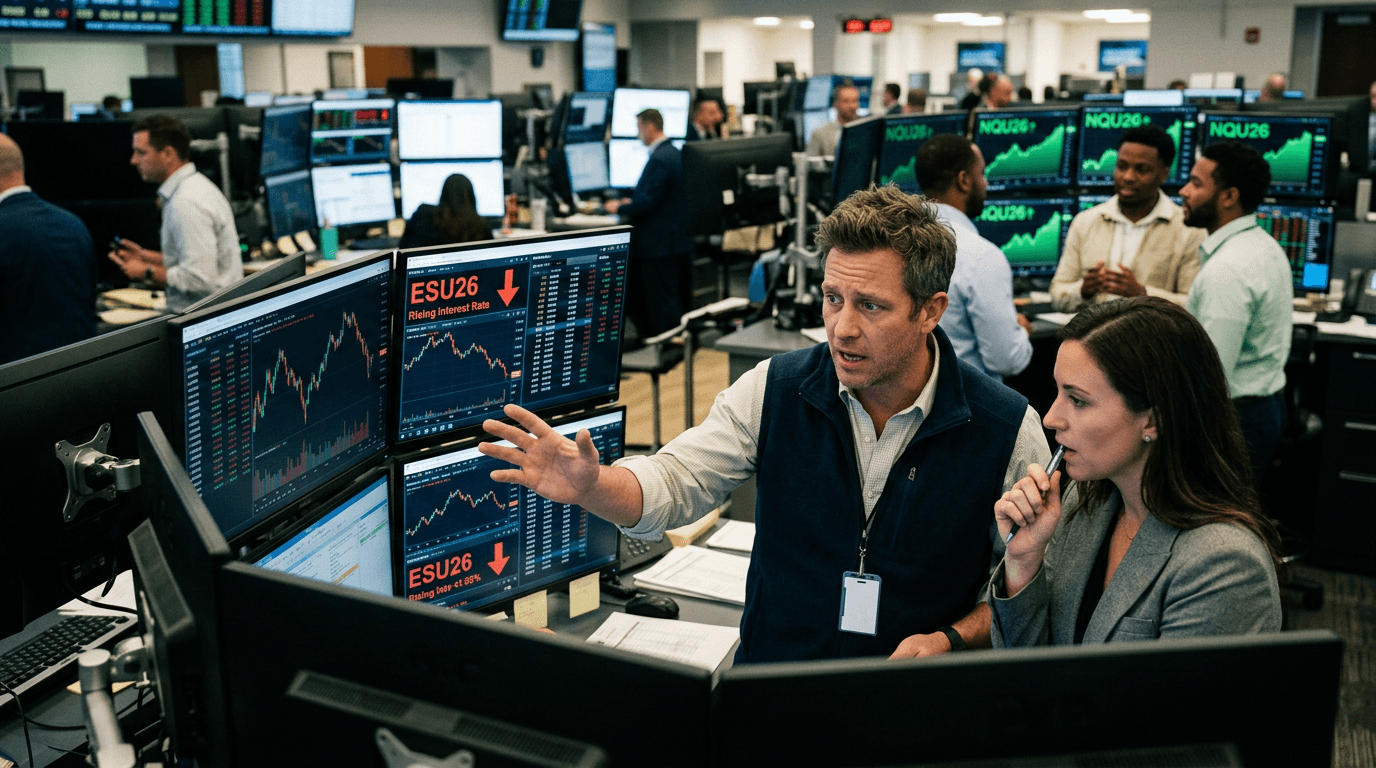
S&P 500 and Nasdaq futures sent a clear message to traders after the latest U.S. nonfarm payrolls report: growth is still strong, but policy risk is back on the table. E‑mini S&P 500 (ESU26) futures slipped around 0.4%, while Nasdaq (NQU26) futures held modest gains as August payrolls surprised to the upside and prior months were revised higher, pushing market-implied odds of a Federal Reserve rate hike at the upcoming FOMC meeting to roughly 60%.[6][11][14][15]
Labor Market Surprise Resets The Macro Backdrop
Nonfarm payrolls remain one of the single most important data releases for U.S. and global markets because they offer a high-frequency read on the health of the labor market and, by extension, the broader economy.[10][11][12] A robust upside surprise—where job creation significantly exceeds consensus forecasts—signals resilient demand, stronger household income, and potential persistence in underlying inflation pressures.[11][12][15] In August, payrolls came in well above expectations and earlier months were revised up, underscoring that hiring momentum has not cooled as quickly as many policymakers and investors had anticipated.[6][11][12]
Markets have seen this playbook before. When nonfarm payrolls beat expectations by a wide margin, rate markets tend to reprice toward a more hawkish Fed stance, pushing Treasury yields higher and weighing on equity valuations.[1][10][13] Recent examples in 2026, including stronger-than-expected March and May reports, have kept the Fed in a cautious “wait-and-see” posture and prompted traders to push out the timing of any potential rate cuts.[5][10][12][13] This latest upside surprise reinforces that narrative: the labor market remains too strong to justify a quick policy pivot toward easier conditions.[6][14][15]
Futures Market Split: S&p 500 Vs Nasdaq
The initial reaction in index futures highlighted an interesting divergence between broad-market and tech-heavy exposures. ESU26 futures trading around 0.4% lower suggest investors are reassessing valuations across the more diversified S&P 500 universe, where financials, industrials, consumer names, and utilities can all be sensitive to higher rates and tighter financial conditions.[1][3][4] In contrast, NQU26 futures were modestly higher, indicating that investors continue to lean into the mega-cap growth and technology complex despite a higher-for-longer rates backdrop.[2][3][9]
Historically, strong payrolls have often pressured both S&P 500 and Nasdaq futures as yields rise and discount rates on future earnings move higher.[1][3][8] However, when the growth narrative is compelling—such as in periods of rapid innovation or strong earnings visibility—Nasdaq futures can prove more resilient, reflecting the perceived durability of secular growth stories even in a less accommodative monetary environment.[2][3][9] The current pattern, with S&P 500 futures underperforming while Nasdaq futures hold up, suggests a market leaning toward “good growth, but tighter money,” where investors are willing to pay for companies less directly exposed to cyclical demand or funding costs.
For traders, this divergence offers an important clue: not all index futures respond to macro data in the same way. Sector composition, earnings sensitivity to rates, and positioning dynamics can create meaningful spread opportunities between ES and NQ contracts around major data releases.[2][7][9]
WHAT A 60% FED HIKE PROBABILITY REALLY SIGNALS
Implied odds of about 60% for a rate hike at the upcoming FOMC meeting place the market in a finely balanced regime: a hike is more likely than not, but far from guaranteed.[6][14][15] Fed expectations are now being driven by a mix of still-solid labor data and an evolving inflation picture, where progress has been uneven and policymakers remain wary of declaring victory too early.[5][10][15] Strong payrolls make it harder for the Fed to justify cutting rates or even standing pat if inflation fails to decelerate convincingly.[10][14]
A jump in Fed hike probabilities typically translates into higher short-term Treasury yields and a steeper repricing across the front end of the curve.[6][10][13][14] That, in turn, feeds directly into equity valuations, particularly for long-duration assets whose cash flows lie further in the future. For index futures traders, the key takeaway is that macro data like payrolls do not just move prices on release; they reshape the entire distribution of expected policy outcomes over the next several meetings, altering risk-reward profiles in ES and NQ beyond the immediate session.[10][12][14]
Practical Takeaways For Index Futures Traders
1. Treat nonfarm payrolls as a high-volatility event: spreads can widen, liquidity can thin, and price discovery can be fast and noisy in the minutes around the release.[1][3][8]
2. Anchor scenarios in both growth and rates: strong jobs data can be bullish for earnings but bearish for valuations if it forces a more hawkish Fed path.[10][11][12]
3. Watch relative performance between ES and NQ: divergences like today’s can reveal sector-level rotation and provide clues about where market participants see sustainable growth versus rate sensitivity.[2][3][9]
4. Use options and defined-risk strategies where possible: structured exposure can help manage gap risk and whipsaws around high-impact macro prints.[1][3]
5. Incorporate Fed expectations into your bias: tools that translate data into implied hike probabilities offer an essential bridge between fundamentals, rates, and index futures.[6][14][15]
Using Simulated Finance To Stress-test Strategies
For traders using a Simulated Finance platform like E8 Markets, days with a surprise in nonfarm payrolls are ideal laboratories for building and refining macro-aware trading strategies. A simulated environment allows traders to experience the rapid repricing in ESU26 and NQU26 contracts without the capital risk that comes with live trading, making it easier to experiment with different pre-release and post-release approaches.
SimFi users can replay market conditions around prior upside payroll surprises to test how various strategies—such as trading calendar spreads between ES and NQ, fading initial moves, or riding momentum aligned with rate-market repricing—would have performed. They can also practice risk management techniques, including scaling in and out of positions, setting dynamic stop levels based on implied volatility, and adjusting exposure as Fed hike probabilities shift. Over time, this kind of disciplined simulation helps traders develop a robust playbook for macro data days, turning what might feel like unpredictable events into structured opportunities.
Conclusion
The latest U.S. nonfarm payrolls report has once again reminded traders that strong growth can coexist with higher policy risk. ESU26 futures trading about 0.4% lower and NQU26 futures modestly higher encapsulate a market that welcomes resilient economic activity but is increasingly conscious of the cost of money and the possibility of another Fed hike, now seen as roughly a 60% probability at the next FOMC meeting.[6][11][14][15] For index futures traders, the challenge is to navigate the intersection of growth, inflation, and policy without overreacting to a single data point.
By treating payrolls releases as structured events, monitoring the evolving balance between the S&P 500 and Nasdaq, and integrating Fed expectations into trade design, traders can move from reactive to proactive in their approach to macro-driven volatility. Simulated finance platforms provide a powerful way to rehearse this process, allowing market participants to refine strategies and risk management before deploying capital in live markets. In an environment where a single data print can shift the path of policy, preparation and practice are as valuable as any trade.