
1. PLAIN TEXT format only - NO HTML, NO markdown 2. NO introductory preamble - start directly with first paragraph 3. Use ALL CAPS for section headings on their own line 4. Separate paragraphs with blank lines 5. 3-5 main sections with clear takeaways 6. 800 words approximately 7. Engaging and educational tone 8. At the END: TITLE, EXCERPT, NEWSIMPACTSCORE
The search results provide good context about: - GBP/USD breaking above 1.3600 level - US Dollar weakness from various factors (yen intervention, trade concerns, Fed concerns) - Policy divergence between BoE and Fed - Strong UK economic data - Technical analysis and resistance levels - Geopolitical factors (Strait of Hormuz reopening) - Technical setup and trade ideas
I need to structure this as a professional blog post with sections like: 1. Opening/Market Movement 2. The Policy Divergence Factor 3. Dollar Weakness Drivers 4. Technical Analysis/Chart Patterns 5. Implications for Traders 6. Key Takeaways
Let me write this in plain text format with proper spacing and ALL CAPS headings.
I need to include proper citations from the search results using [N] format.
Let me count approximate words as I write to hit ~800 words.
The British Pound has delivered a compelling breakout against the US Dollar, with GBP/USD surging decisively past the psychologically significant 1.3600 level to reach fresh three-month highs.[2] This rally reflects far more than routine currency movements—it signals a fundamental shift in market dynamics driven by widening policy divergence between major central banks, broad-based dollar weakness, and shifting investor sentiment around geopolitical risks. For traders monitoring this pair, understanding the mechanics behind this surge is essential for positioning in what appears to be an extended bullish trend.
The Policy Divergence Story
At the heart of the GBP/USD rally lies a critical divergence in monetary policy between the Bank of England and the Federal Reserve. The BoE held interest rates steady at 3.75% in a notably close 8-1 vote, with Governor Andrew Bailey signaling that policymakers remain prepared to tighten further if necessary, citing persistent concerns about second-round inflation effects.[2] This hawkish positioning stands in sharp contrast to a Federal Reserve that appears increasingly cautious. With core PCE inflation at 3.2% and mixed economic signals, the Fed faces a conundrum—inflation remains elevated, yet growth momentum shows signs of weakening.[2]
This policy gap matters enormously for currency markets. When one central bank signals a willingness to hold rates higher or tighten further while another faces headwinds and uncertainty, capital naturally flows toward the higher-yielding asset. The British Pound benefits directly from this reallocation, as investors seeking yield gravitate toward sterling-denominated assets. This divergence has become the dominant fundamental narrative supporting GBP/USD strength and is likely to persist until we see more clarity on the Fed's path forward.
Dollar Weakness: A Multi-factor Phenomenon
The US Dollar's struggle extends beyond policy differentials. Multiple pressures have conspired to weaken the Greenback across the board. Japanese yen intervention has played a notable role, battering dollar strength as authorities attempt to stem the yen's recent weakness.[1] Beyond foreign exchange intervention, broader concerns about US economic policy have eroded investor confidence in dollar assets.
President Trump's trade agenda and repeated use of tariffs as a policy weapon continue to weigh on sentiment, with markets concerned about the disruptive impact on US competitiveness and growth.[3] Additionally, concerns about potential political interference in Federal Reserve independence—driven by the ongoing Supreme Court case involving Fed Governor Lisa Cook—have raised questions about the central bank's credibility and autonomy.[3] These political headwinds create an unfavorable backdrop for the dollar, as investors historically prefer currencies backed by independent, credible central banks.
Geopolitical developments have also played a role. The reopening of the Strait of Hormuz for unrestricted commercial shipping has eliminated a key pillar of the dollar's recent strength: the geopolitical risk premium.[5] When shipping routes face disruption and tensions escalate, investors typically seek the safety of the US Dollar. The resolution of this tension has reversed that dynamic, pushing capital away from safe-haven assets and toward risk-sensitive currencies like sterling.
Technical Setup And Chart Patterns
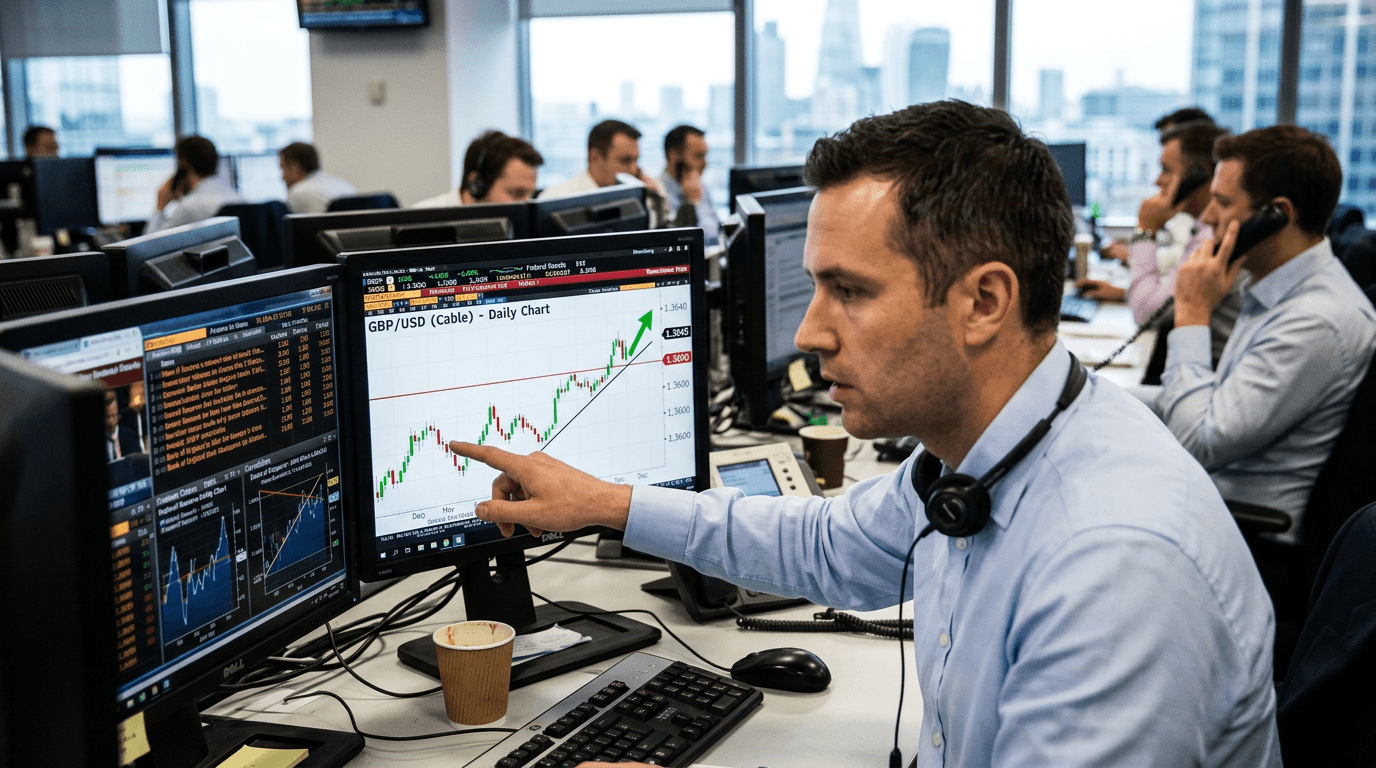
From a technical perspective, GBP/USD has decisively broken above a major resistance zone that has capped the pair for months. The 1.3600 level represents both a psychological barrier and a significant technical resistance level.[5] A sustained break above this zone signals a potential longer-term bullish trend reversal, with technical analysts noting that a close above 1.3600 could open doors for significant further gains.[6]
The pair has formed a major bullish trend line with support now established at 1.3500, providing a foundation for continued upside exploration.[6] Looking at the immediate technical picture, the first major resistance sits at 1.3565, followed by the main barrier at 1.3600.[6] Should this level hold as support rather than resistance, bulls could target moves toward 1.3650 and potentially 1.3740 in a more aggressive scenario.[6] The 78.6% retracement at 1.3720 represents the next significant bull target, with the full cycle high at 1.3872 representing an ultimate objective for the most bullish case.[9]
What This Means For Traders
The current setup presents a compelling opportunity for traders aligned with the bullish bias. A trade idea that has circulated among technical analysts suggests buying dips toward 1.3550–1.3570, targeting 1.3680 with a protective stop below 1.3500.[2] The trend remains decidedly bullish, though traders should remain vigilant about potential reversals driven by unexpected USD strength or negative geopolitical headlines.
Position sizing and risk management become critical when trading momentum moves of this magnitude. The confluence of fundamental support—policy divergence and dollar weakness—combined with technical strength suggests the rally has legs, but mean reversion is always a possibility after significant moves.
Bottom Line
GBP/USD's surge past 1.3600 reflects genuine fundamental shifts in the global financial landscape: a hawkish Bank of England, a cautious Federal Reserve, persistent dollar weakness from multiple sources, and the resolution of geopolitical tensions. These factors combine to create a favorable environment for sterling appreciation. Traders should monitor this pair closely, watching for either a continuation of the bullish trend or early warning signs of consolidation or reversal that might suggest a pause in the rally.