
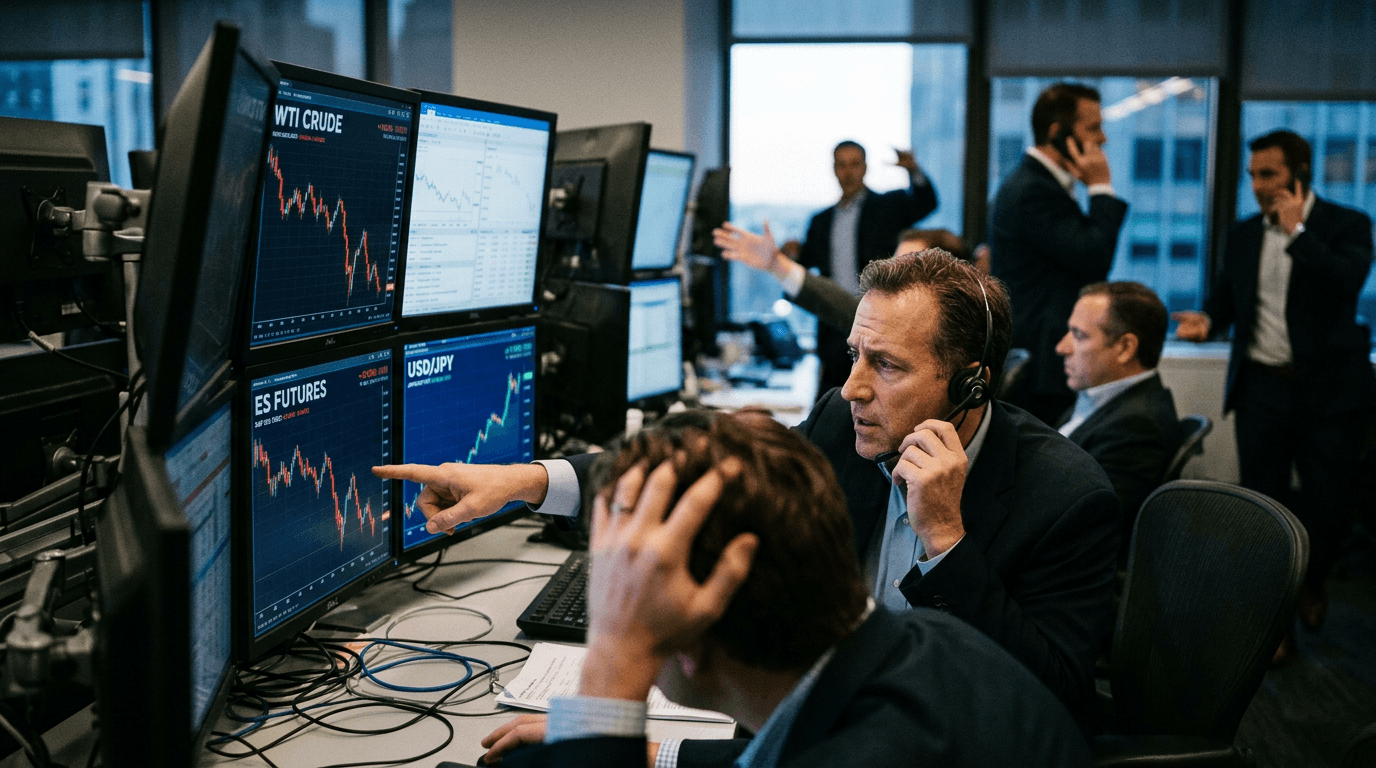
Oil and equity futures are once again trading under a geopolitical cloud as tensions between the U.S. and Iran flare up, keeping volatility elevated across crude, stock indices, and key currency pairs. Renewed conflict risk in the Middle East is reviving concerns about supply disruptions, higher inflation, and weaker global growth—all of which are being rapidly priced into futures markets.
WHY THE U.S.-IRAN CONFLICT MATTERS FOR MARKETS
At the heart of the current market stress is the Strait of Hormuz, the narrow chokepoint through which roughly 20% of global seaborne crude oil passes.[2] Any threat to shipping in this corridor instantly raises questions about how much oil can actually reach global buyers, and at what price.
We have already seen how sensitive prices are to this risk. In one earlier escalation, when shipping in Hormuz was effectively shut for several days and fears of broader regional conflict intensified, U.S. crude oil futures jumped more than 12% in a single session, with West Texas Intermediate (WTI) settling near $90.90 a barrel and Brent above $92.[1] Those kinds of one-day moves are normally associated with major macro shocks, not routine trading.
More recently, crude has been whipsawing violently as traders react to every twist in the conflict narrative. During one highly volatile week, June WTI futures swung between a high of about $107.46 and a low near $88.66 before stabilizing around $97, underscoring how quickly sentiment can flip from panic to cautious relief.[2] The same dynamic has played out on fresh U.S. strikes against Iranian targets, which pushed WTI toward the low $90s and Brent into the mid-$90s as markets rushed to reprice the geopolitical risk premium, while equity markets across Asia and beyond sold off in response.[4]
The bottom line: the U.S.-Iran conflict is not just a regional story. It directly affects a critical artery of global energy trade, and futures markets are responding in real time.
Oil Futures: Pricing Supply Shocks And Risk Premium
Crude futures are the most immediate barometer of how traders perceive the conflict. When markets sense heightened risk of sustained supply outages—whether from missile strikes near export hubs, drone attacks, or naval disruptions—near-dated oil contracts tend to surge as buyers scramble for guaranteed barrels.[2]
Analysts tracking the recent moves note that the escalating U.S.-Iran tensions have repeatedly pushed WTI and Brent toward the psychologically important $100 threshold, with some sessions seeing intraday rallies into the high $90s as headlines point to intensified strikes or prolonged closure risks in Hormuz.[3] Each sign of military escalation tends to bring that $100 level back into focus.
At the same time, the tape has been defined by abrupt reversals. When there are reports of diplomatic overtures or potential frameworks to gradually reopen the Strait of Hormuz, crude can give back a large chunk of its gains as traders price in the possibility that the crisis may cool before it inflicts lasting damage on physical supply.[5][2] That push-pull between war premium and de-escalation hope is exactly what produces the wide daily ranges and “whipsaw” conditions that many traders are experiencing.
For active participants in oil futures, this environment means:
- Higher realized volatility and larger intraday swings.
- Greater gap risk around unexpected headlines or weekend developments.
- More sensitivity to technical levels, as markets oscillate between risk-on and risk-off narratives.
In such conditions, risk management often matters more than conviction about any single geopolitical outcome.
Equity Futures And Safe-haven Flows
The stress does not stop at the energy complex. Equity futures have also come under pressure as higher oil prices feed into concerns about inflation, corporate margins, and consumer demand.
Rising crude tends to act like a tax on the global economy: it raises input costs for companies and energy bills for households. When futures markets start to price a scenario where oil stays elevated due to conflict risk, index futures often reflect expectations of slower growth and potentially tighter monetary policy if inflation proves sticky.
That is why we see
- Broad equity index futures trading lower, even as some energy and defense-related names find support.
- Increased dispersion within indices, with energy and some commodity-linked sectors outperforming while consumer, transport, and rate-sensitive growth names lag.
On the currency side, the renewed Middle East escalation has also triggered classic “risk-off” behavior. Commentary from FX-focused outlets has highlighted that safe-haven currencies such as the U.S. dollar and Japanese yen tend to benefit when traders seek safety from equity and emerging-market volatility, especially when oil spikes and inflation fears rise.[4] In practice, that often means:
- USD and JPY strengthening against higher-yielding or commodity-linked currencies in periods of intense geopolitical anxiety.
- Short-term dislocations in usual correlations, as macro traders rebalance portfolios quickly in response to new headlines.
For equity and FX traders alike, understanding how these cross-asset relationships evolve during geopolitical shocks is crucial.
Trading Implications: Risk Management First
In a headline-driven market, the key challenge is not predicting each twist in the U.S.-Iran story but surviving the path between them. For futures traders, several practical principles stand out:
- Scale position sizes to volatility. When WTI is moving $5–10 in a day instead of $1–2, the same contract size carries much higher risk.
- Consider volatility-adjusted stops, using tools like Average True Range (ATR) to set wider but more realistic risk limits.
- Be aware of event risk around weekends, official statements, or known diplomatic milestones, when surprise headlines are more likely.
- Avoid over-reliance on historical correlations. In intense risk-off phases, oil and equities can sometimes fall together (growth fears overshadowing energy profits), while in others, energy may decouple from the broader market.
Scenario planning can help traders avoid emotional decisions. Thinking through “if-then” frameworks—such as “if credible de-escalation emerges, then I expect oil to retrace and equities to bounce” versus “if attacks intensify near key infrastructure, then I expect further upside in crude and deeper equity selling”—can create a more disciplined response to breaking news.
Using Simulated Trading To Navigate Geopolitical Volatility
Geopolitical markets are challenging even for experienced professionals, which is why simulated trading environments have become increasingly valuable as training grounds. In a Simulated Finance (SimFi) setup, traders can practice:
- Trading crude oil and equity index futures under high-volatility conditions without risking real capital.
- Testing hedging approaches, such as using energy exposure to partially offset equity risk when conflict pushes oil higher and stocks lower.
- Exploring FX strategies that lean into safe-haven dynamics in USD and JPY during risk-off episodes, then reposition for potential relief rallies on de-escalation headlines.
- Building and stress-testing rule-based systems that define when to stand aside (for example, avoiding fresh entries immediately before key geopolitical briefings).
By replaying historical episodes of U.S.-Iran tensions and experimenting with different responses, traders can refine execution, position sizing, and psychological discipline before applying those lessons to live markets.
Conclusion: Stay Data-driven, Not Headline-driven
The renewed U.S.-Iran conflict has reintroduced a sizable geopolitical risk premium into oil, weighed on equity futures, and supported safe-haven currencies—all while keeping volatility elevated across asset classes.[1][2][4] For traders, this mix offers opportunity but also substantial danger.
Those who approach the environment with a clear framework, robust risk management, and an understanding of how supply shocks ripple through inflation, growth, and cross-asset flows will be better positioned than those who simply chase the latest headline. In markets where a single news alert can move crude $5 and invert sentiment in minutes, discipline, preparation, and practice are the real safe havens.