
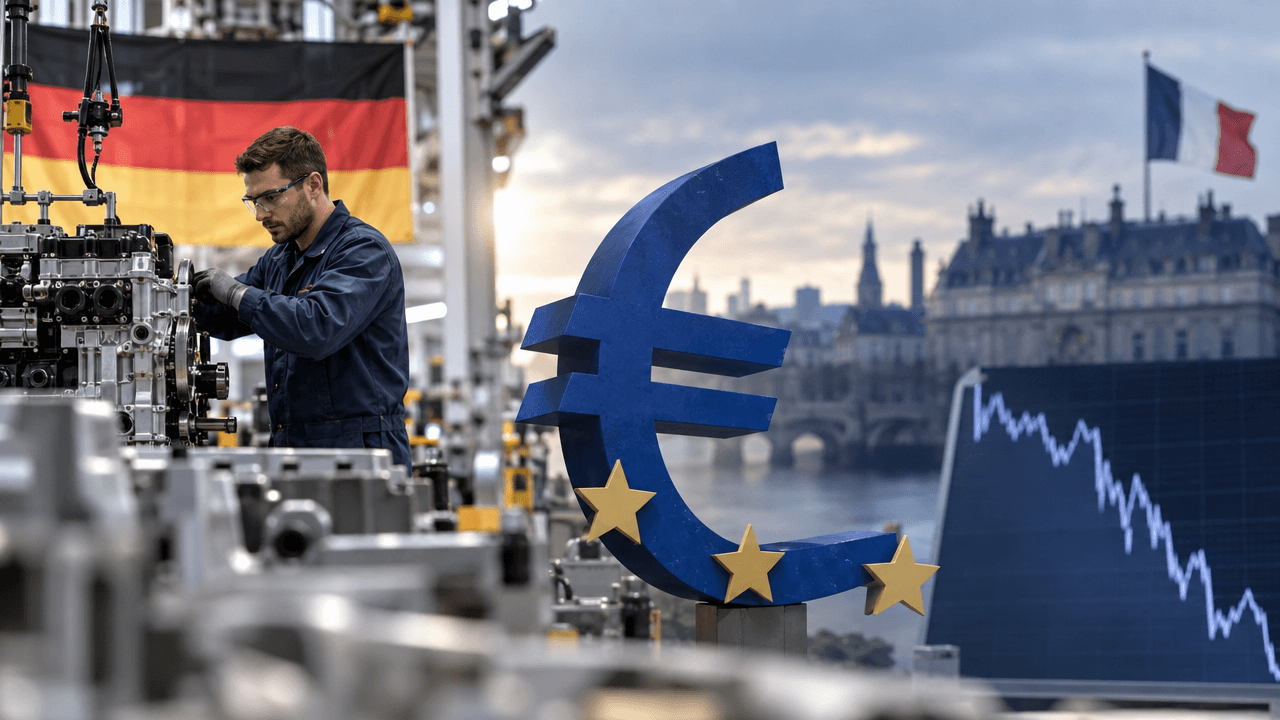
Germany’s latest industrial production figures offered a rare bright spot for euro-area data, with output jumping 2.0% month on month in August, sharply reversing July’s 1.2% decline and beating the 0.5% consensus forecast.[1][3][12][13][15] On an annual basis, industrial production rose around 2.3%, underscoring that this is more than just a one-off rebound.[1][3][4][13][15] For traders, the print sends an important signal: Europe’s largest economy still has cyclical momentum left, even as sentiment around the euro remains fragile.[2][7][9][14]
German Industry Shows Signs Of Life
Industrial production is a key high-frequency indicator for Germany, where manufacturing and construction play an outsized role in the growth mix and export performance.[6][8] The August 2.0% month-on-month rise marks the strongest increase since early 2025, highlighting a meaningful inflection after several weaker months.[1][3][12][13] Markets had been braced for a modest 0.5% gain, so the upside surprise reinforces the idea that the industrial slowdown may be bottoming out.[1][4][12]
The year-on-year increase of roughly 2.3% is equally important, because it suggests the pick-up is visible even after smoothing monthly volatility.[1][3][4][13][15] For macro-focused traders, this type of beat versus expectations can shift growth narratives, influence earnings assumptions for cyclicals, and tweak probabilities in models that drive rates and FX positioning. In short, these are the data points that feed directly into both discretionary and systematic trading strategies.
WHAT’S BEHIND THE AUGUST SURGE
Drilling into the details, the rebound was not evenly spread across sectors. Construction output surged by about 9.3% in August, making it a major driver of the headline increase.[1][3] This tells a story of delayed projects being executed and a possible easing of previous bottlenecks in labour and materials.[8] At the same time, energy production edged lower, and the automotive sector actually contracted by around 5.4%, reminding traders that Germany’s signature industry remains under pressure from structural shifts and global demand dynamics.[1][3]
Manufacturing output, excluding energy and construction, rose more modestly, reinforcing the view that the headline beat is partly a catch-up in construction rather than an across-the-board boom.[15] For equities, this composition matters: it supports a constructive view on construction, industrials, and some capital goods names, while encouraging caution on autos until demand and margin pressures clearly turn.[1][3][15] In a simulated trading environment, this kind of sector-level nuance can be used to design relative-value strategies—going long construction-related proxies while hedging with auto exposure, for example.
Implications For Euro Area Growth
Germany’s rebound slots into a broader story of slowly improving euro-area momentum. Recent forecasts have nudged euro-area growth expectations for 2026–2027 up to just above 1%, compared with roughly 0.6% projected only months ago, as stronger exports and industrial activity helped lift GDP by 0.3% quarter-on-quarter in Q2.[5] Domestic research houses see German GDP growth around 1.5% for 2026 and close to 1.8% for 2027, building on earlier signs of rising manufacturing output.[6][8] The latest industrial data provides another data point supporting these upgraded trajectories.[1][3][12]
For traders, the key takeaway is that the euro area’s growth profile is shifting from “near-stagnation” toward “modest expansion,” even if headline sentiment has yet to fully adjust.[5][6] That matters for everything from earnings expectations for European cyclicals to term-premium in bond markets and medium-term FX fair value estimates. In SimFi environments, traders can model scenarios where industrial strength gradually feeds into corporate earnings, credit spreads, and equity indices, testing how portfolios would respond if Europe’s growth surprise continues.
Market Reaction: Strong Data, Weak Euro
Despite the upbeat German release, the euro has been under sustained pressure, recently sliding to a 17-month low against the US dollar.[2][7][9][14] The driver is not German data but rising concern around France’s fiscal position and political backdrop, which has pushed French government bond yields to multi-decade highs and widened the spread over safe-haven German bunds to levels reminiscent of past sovereign stress episodes.[2][7][9][10][11][14] France’s public debt has climbed to around 119% of GDP, with 10-year yields flirting with 5% and the premium over German debt stretching well above 120 basis points.[10][11]
This divergence—strong German data but a weak euro—illustrates a crucial market lesson. FX markets often trade more on relative risk and policy expectations than on single data points, especially when cross-country fiscal concerns dominate the narrative.[2][7][9][10][14] For traders, that means positive surprises such as Germany’s industrial rebound may cushion downside rather than trigger a full reversal in the euro’s trend, unless accompanied by credible improvements in French fiscal dynamics or a shift in global risk appetite. In a simulated setting, this is an ideal case study: run parallel strategies where you fade euro weakness on better data versus those where you respect the broader risk narrative and stay defensive on the currency.
What Traders Should Watch Next
The August release elevates the importance of upcoming German and euro-area data for both discretionary and systematic approaches. Industrial orders, business surveys, and PMI readings will help confirm whether the rebound has legs or is primarily a one-off construction-driven spike.[1][3][8][15] Corporate guidance from German exporters—particularly outside autos—can signal how global demand and currency moves are interacting with this domestic production upswing.[6][8]
On the macro side, interest will focus on whether improved activity leads to any reassessment of monetary policy paths, even as the European Central Bank remains constrained by uneven growth and pockets of fiscal stress.[5][11][14] In FX, traders will watch whether safe-haven flows into German debt intensify as French yields climb, potentially supporting the euro on a relative basis even if absolute sentiment remains cautious.[2][7][9][10][11] SimFi platforms allow traders to experiment with these linkages—testing how bundles of data surprises, bond spread moves, and risk sentiment shifts would have affected euro crosses, European indices, and sector baskets historically.
Conclusion
Germany’s industrial output rebound is more than just a comforting headline; it signals that one of the euro area’s key growth engines is still capable of delivering upside surprises, even in a challenging macro environment.[1][3][12][13][15] The composition of the data—strong construction but lingering weakness in autos—highlights where cyclical opportunities and structural risks lie for sector-focused traders.[1][3][15] At the same time, the euro’s slide under the weight of French debt concerns demonstrates how country-level fiscal narratives can overpower single-country data beats in driving currency markets.[2][7][9][10][11][14]
For traders operating in both live and simulated environments, the actionable takeaway is clear: treat Germany’s data as a signal of underlying resilience, but map it carefully onto sector exposure, cross-country spreads, and FX risk rather than assuming a straightforward bullish story. Combining data-driven analysis with scenario testing can help build strategies that are robust to Europe’s evolving mix of industrial recovery and fiscal strain.