
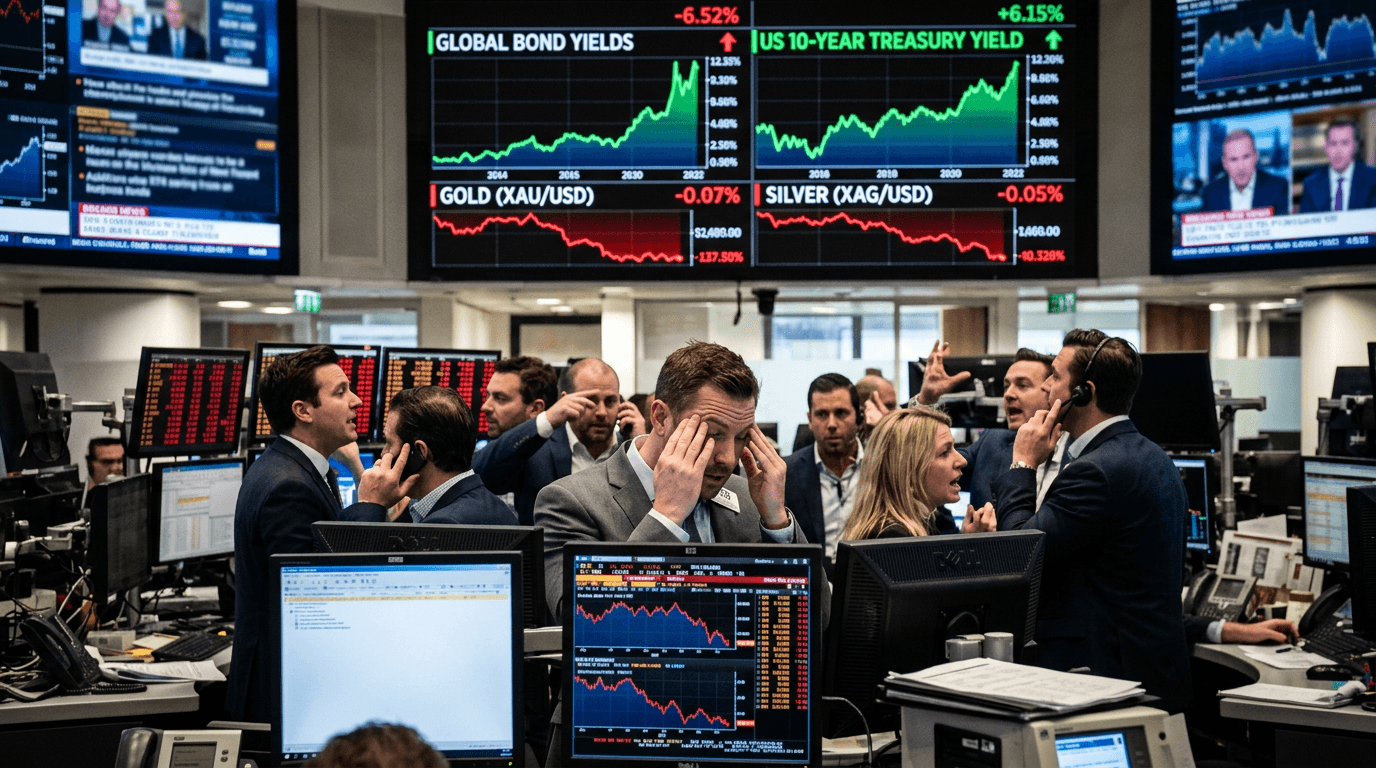
A sharp, sudden jump in global bond yields has sent a shockwave through precious metals markets, knocking gold lower by around 2% in just a few hours and dragging silver and other metals with it. Firmer U.S. economic data and a hawkish repricing of Federal Reserve expectations have pushed nominal and real yields higher, raising the opportunity cost of holding non-yielding safe-haven assets and triggering a wave of selling in gold-linked products.
What Just Happened In Bonds And Gold
Bond markets have been repricing aggressively as traders digest stronger-than-expected U.S. data and scale back bets on near-term rate cuts. Benchmark 10-year U.S. Treasury yields have pushed higher, while inflation expectations have been relatively stable, meaning real yields (nominal yields minus inflation expectations) have also moved up decisively.
This matters because real yields are a key driver of gold. In late March 2026, for example, the U.S. 10-year yield traded around 4.45% with real yields near 2%, and gold was under sustained pressure near $4,430 per ounce, with silver hovering around $68. The latest move is a similar pattern condensed into a shorter time frame: a rapid yield spike and a near-immediate drop in precious metals.
The speed of the move is as important as its size. When yields jump quickly, risk models, margin requirements, and hedging strategies all adjust at once. That can force systematic funds, leveraged ETFs, and options dealers to rebalance, amplifying short-term price swings in gold and silver beyond what fundamentals alone would suggest.
Why Higher Bond Yields Hit Precious Metals
The textbook explanation for why rising yields pressure gold is straightforward: opportunity cost. Gold and silver do not pay interest or dividends. When risk-free yields on government bonds are low, that forgone income is minimal; when yields climb toward 4–5% in major economies, the cost of holding metals instead of bonds becomes much more significant.
Real yields are particularly important. Historically, periods of rising or high real yields tend to coincide with weaker gold prices because investors can earn a positive, inflation-adjusted return in bonds. In recent trading, higher real yields have acted like a gravitational pull away from non-yielding assets and into fixed income, especially for large institutions with strict return and risk targets.
A stronger U.S. dollar often travels with rising U.S. yields, adding a second headwind. Precious metals are priced in dollars globally. When the dollar firms, gold and silver become more expensive in local currencies outside the U.S., dampening demand from key buying regions like emerging markets and parts of Asia.
Positioning also plays a role. After a long period of rising gold prices and recurrent geopolitical tensions, speculative and hedging flows into gold-related instruments have been elevated. When the macro backdrop abruptly shifts toward “higher for longer” interest rates, it can trigger profit-taking, liquidation of leveraged positions, and mechanical selling from products tied to volatility or trend signals.
When The Relationship Breaks: Safe-haven Exceptions
The bond-yield–gold relationship is strong but not absolute. There are notable episodes when both yields and gold prices rise together. That typically happens when the bond selloff is being driven not by strong growth and hawkish central banks, but by fears over fiscal sustainability, inflation credibility, or financial-system stress.
In those scenarios, investors may sell bonds because they are worried about future inflation or sovereign risk, and simultaneously buy gold as a hedge against currency debasement or systemic turmoil. We saw such behavior during several episodes of global bond market stress in recent years when gold briefly “decoupled” from yields and acted as the primary safe haven.
The current episode looks different: the driver is firmer economic data and a more hawkish interpretation of central bank policy, not a sudden loss of confidence in government solvency or the monetary system. That tilts the balance toward the classic pattern: yields up, dollar firmer, gold and silver lower.
For traders, the key is to diagnose which regime the market is in. If yields are rising on growth optimism and credible central bank tightening, precious metals are more likely to face headwinds. If yields are rising on fiscal or inflation fears, the safe-haven bid for gold can reassert itself, even in the face of higher nominal yields.
What Traders And Investors Should Watch Next
In the near term, volatility is likely to remain elevated across both bonds and precious metals. A few indicators deserve close attention:
1. Real yields and breakevens: Track not just the headline 10-year yield, but also inflation expectations and real yields. A continued grind higher in real yields is a clear warning sign for gold bulls.
2. Fed and central bank communication: Any shift in tone from “data-dependent” to clearly hawkish can extend the pressure on metals. Conversely, signs that policymakers are worried about overtightening can ease yield pressures and support a rebound.
3. Bond market volatility indices: Elevated bond volatility tends to spill over into commodities. When volatility spikes, forced rebalancing from hedge funds and ETFs can lead to outsized intraday moves, like the recent 2% gold drop in a matter of hours.
4. Positioning and flows: CFTC futures data, ETF inflows/outflows, and options skew help gauge whether the market is crowded in one direction. In past episodes, large outflows from major gold and silver ETFs have coincided with accelerated price declines but have also sometimes marked medium-term capitulation points.
Practical Takeaways For Precious Metals Traders
For active traders and SimFi participants, this environment offers both risk and opportunity.
First, respect the macro driver. When yields and central bank expectations are the dominant forces, technical levels in gold and silver can break more easily. Breakouts or breakdowns that occur alongside a major yield move are more likely to sustain than those occurring in isolation.
Second, adjust risk sizing to volatility. A 2% intraday move in gold and larger swings in silver can quickly overwhelm tight risk limits. Using smaller position sizes, wider but well-defined stops, and clear maximum daily loss limits can help navigate sudden repricings without being forced out at the worst levels.
Third, consider relative trades. Some traders may look at gold versus silver, or gold versus miners, rather than outright long or short positions. When macro pressure hits the entire complex, relative value opportunities can emerge based on differing fundamentals, cost structures, or balance sheets.
Finally, keep a multi-horizon view. In the short term, higher real yields are a genuine headwind. But structurally, many of the longer-term supports for gold—persistent global debt, fiscal deficits, geopolitical frictions, and ongoing central bank buying—remain in place. That means sharp yield-driven selloffs can, for longer-horizon investors, become potential accumulation opportunities rather than signs of a broken thesis.
Conclusion
The latest surge in global bond yields has delivered a textbook reminder of how tightly precious metals are linked to the interest-rate backdrop. A rapid repricing of Fed expectations and higher real yields have pulled capital away from non-yielding safe-haven assets, sending gold down around 2% and pressuring silver and other metals.
For traders, understanding the yield–gold relationship, distinguishing between different bond market “regimes,” and actively managing risk around macro data and central bank events is essential. While the immediate direction of travel for metals may hinge on the next inflation print or policy speech, the deeper story is about how investors balance income, safety, and long-term hedging in a world where the era of ultra-low yields appears firmly behind us.