
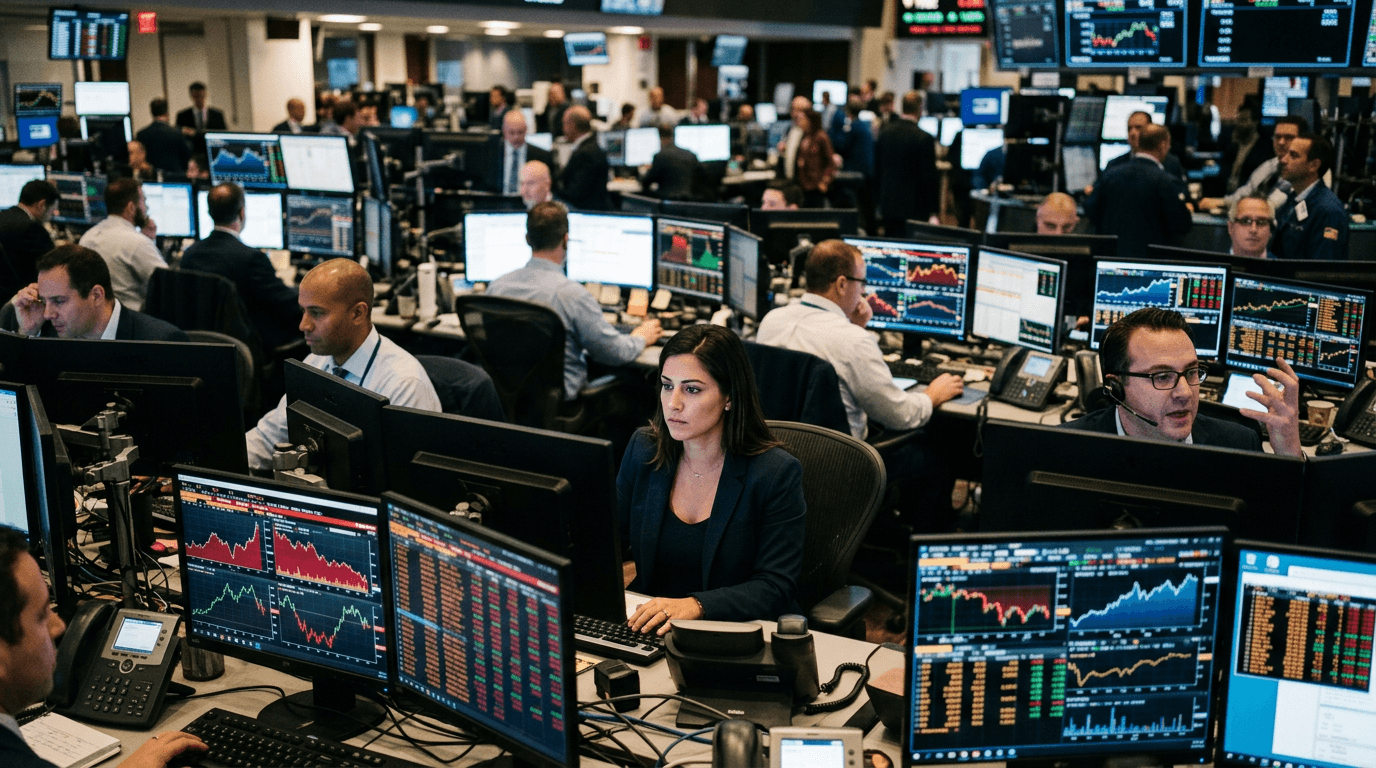
Equity and energy futures are drifting lower as global risk sentiment cools, signaling a cautious tone rather than outright panic in markets[10][14]. Major index contracts such as the E‑mini S&P 500 and Nasdaq futures have slipped modestly, while key crude benchmarks like WTI and Brent have edged off recent highs, reinforcing a mild risk‑off bias[3][10][14]. This softer backdrop is supporting the US dollar on dips and pressuring higher‑beta currencies and selected commodities as traders reassess policy and geopolitical risks[8][9][14].
GLOBAL FUTURES SIGNAL A MILD RISK‑OFF MOOD
Recent price action in equity futures suggests investors are moving from aggressive risk‑taking to a more defensive stance without exiting markets entirely[3][10]. E‑mini S&P 500 and Nasdaq 100 futures have been trading fractionally lower after a stretch near record levels, highlighting a phase of consolidation rather than a sharp reversal[3][5]. The tone is echoed across global indices, where futures markets show smaller day‑to‑day moves but a gradual loss of momentum as participants weigh earnings, policy decisions, and geopolitical headlines[3][10].
Energy futures are telling a similar story. After periods of strong gains driven by Middle East tensions and concerns over the Strait of Hormuz, WTI and Brent have seen more muted trading, with rallies increasingly met by profit‑taking[10][12][15]. Softer energy prices remove some inflation pressure but can also be interpreted as a sign that growth expectations are stabilizing rather than accelerating[5][12]. For traders, the key takeaway is that both equity and energy futures are transitioning from trend‑driven markets to range‑bound conditions, where intraday sentiment shifts matter more and momentum strategies may deliver less consistent results[3][5].
Drivers Behind Cooling Risk Sentiment
Several overlapping factors are behind the cooler tone in risk assets. Monetary policy uncertainty remains central, with markets still debating the timing and pace of the next Federal Reserve rate move[1][2][11]. Futures pricing has oscillated as investors respond to inflation data and central bank commentary, with expectations for at least one hike this year supporting the dollar while simultaneously tempering enthusiasm for risk assets[1][2][11]. When policy paths are unclear, traders typically demand a higher risk premium for equities and commodities, which shows up as softer futures pricing and more frequent pullbacks[3][10].
Geopolitical risks continue to act as a wildcard. Episodes of tension in the Middle East, including concerns around energy infrastructure and shipping routes, have periodically pushed oil higher, only for prices to ease once immediate fears subside[10][12][15]. Each swing in energy markets feeds directly into broader risk sentiment, influencing inflation expectations, corporate margins, and the perceived resilience of global growth[5][12]. At the same time, shifting tariff policies and trade rhetoric, particularly from the United States, have added another layer of uncertainty that channels demand into safe‑haven assets[9][13][14]. In combination, these drivers encourage investors to reduce leverage, tighten stops, and favor quality over cyclicality, reinforcing the current mild risk‑off environment[3][10][14].
Currency And Commodity Reactions
The foreign‑exchange market has responded by rewarding defensive positioning. The US dollar index has held firm, supported by both expectations of higher relative interest rates and its traditional role as a safe‑haven in times of elevated uncertainty[1][2][9][11]. Periods of risk aversion tied to geopolitical developments and energy price swings have led to renewed capital flows into dollar assets, helping the currency recover quickly on any pullbacks[9][13][14]. That resilience tends to weigh on higher‑beta currencies such as the New Zealand dollar and the euro, which have softened when Fed expectations turn more hawkish and risk appetite fades[2][8][11].
Commodities outside the energy complex have also felt the impact. Industrial metals and some agricultural products are sensitive to global growth expectations and to the strength of the dollar, which often moves inversely to commodity prices[9][13]. When futures pricing implies slower momentum in equities and energy, and the dollar trades stronger, demand for speculative long positions in cyclical commodities typically diminishes[2][8][11]. For portfolio builders, the practical implication is that cross‑asset correlations can tighten in a risk‑off phase: weaker equities, softer energy, and stronger dollar often arrive together, amplifying portfolio volatility if positions are not diversified[3][9][13].
How Traders Can Navigate A Softer Futures Landscape
For traders on simulated or live platforms, a cooling in risk sentiment offers an opportunity to refine playbooks for range‑bound and risk‑off regimes. One useful step is to map out the typical sequence of moves: equity futures soften, energy contracts trade off highs, the dollar firms, and high‑beta FX and cyclicals underperform[3][8][10][14]. Building scenarios around these patterns helps traders anticipate where stress might appear next, rather than reacting only after a move has occurred.
Risk management becomes more important when markets shift from trending to choppy conditions. With futures contracts showing smaller but more frequent reversals, traders may need to shorten holding periods, rely more on intraday levels, and reduce position sizes to account for false breakouts[3][5]. Volatility indicators, order‑book dynamics, and spread behavior between related contracts (for example, S&P vs. Nasdaq, or WTI vs. Brent) can provide early signals that sentiment is shifting within the day[3][5][12]. Practically, traders can experiment with strategies such as relative‑value trades between indices, calendar spreads in energy, or FX pairs aligned with dollar strength, always within well‑defined risk parameters[2][8][11].
SIMULATED FINANCE: PRACTICING RISK‑OFF STRATEGIES
Simulated finance environments are particularly well suited to learning how to trade through mild risk‑off periods without the pressure of real capital at stake. By replicating current conditions—softer equity and energy futures, a firm dollar, and uneven commodity performance—traders can test how different strategies behave under stress, including hedging with equity index futures or balancing energy exposure with FX positions[3][8][10][14]. Scenario‑based exercises allow participants to explore how a surprise policy announcement or an escalation in geopolitical tension might ripple through futures curves, spreads, and correlations[1][2][12][15].
For developing traders, the main takeaway is that risk‑off does not mean “no opportunity”; it means opportunity with a different playbook. Practicing disciplined entry and exit rules, diversifying across asset classes, and tracking how macro drivers like policy expectations and geopolitical headlines translate into futures pricing are all skills that can be honed in a SimFi setting[3][9][13][14]. When real markets cool, those prepared with tested frameworks are better positioned to identify mispricings, avoid emotional decisions, and deploy capital selectively across equity, energy, FX, and commodity contracts[2][8][11].
Conclusion
The current phase of softer equity and energy futures reflects a cooling of global risk sentiment rather than outright stress, characterized by modest pullbacks, a firm US dollar, and more selective risk‑taking[3][8][10][14]. For traders and investors, this environment rewards disciplined positioning, cross‑asset awareness, and preparedness for policy and geopolitical surprises. By using simulated finance platforms to rehearse strategies for risk‑off regimes, market participants can transform today’s cautious tone into a valuable training ground for more confident decision‑making when conditions eventually shift again[3][9][13][14].