
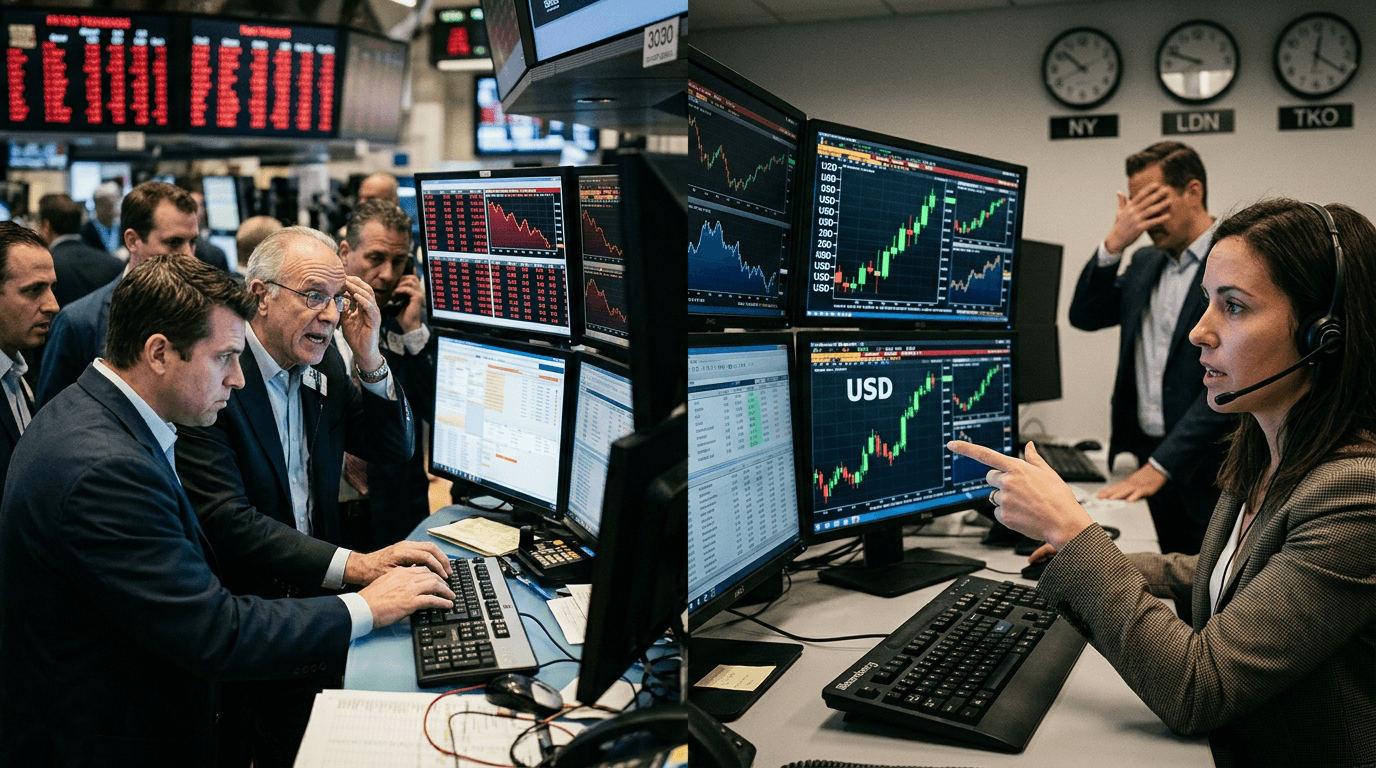
Investors ended the week facing a familiar pattern: falling US equities, rising yields, and a stronger dollar as rate expectations crept higher again. The Dow, S&P 500, and Nasdaq all finished the week in the red, with tech and other long-duration growth names under particular pressure as higher borrowing costs were repriced into valuations.[13][15] What looked like another routine bout of profit-taking quickly evolved into a broader risk-off move as traders reassessed how much more work the Federal Reserve may have to do.
Global Risk Sentiment Shifts
US equity benchmarks had already shown signs of fatigue after a strong run, but the latest pullback was notable because it was driven less by earnings and more by macro.[13] The S&P 500 and Nasdaq registered clear weekly losses, breaking recent winning streaks and signaling that the bar for good news has risen as markets trade near cycle highs.[13][15] Elevated Treasury yields added another layer of pressure, tightening financial conditions and undermining the appeal of risk assets relative to cash and short-duration bonds.[2][14] In this environment, even modest negative headlines can trigger outsized reactions as positioning and sentiment lean toward optimism.
For traders, the key takeaway is that risk-off episodes like this rarely occur in isolation. When equities sell off due to macro drivers, the repercussions are quickly expressed across FX, rates, and commodities. A week that begins with equity rotation and sector-level adjustments can end with broad de-risking, tighter liquidity, and more mechanical selling from systematic strategies. Recognizing when a routine dip is morphing into a cross-asset repricing is a critical skill.
Higher Rate Expectations Back In Focus
The catalyst this time was a renewed focus on the Fed’s reaction function, sparked by commentary suggesting that policymakers may still need to lean harder against inflation. Warsh’s remarks, interpreted as hawkish, nudged futures-implied probabilities toward the possibility of further tightening and a more prolonged period of restrictive policy. That shift matters because it comes after markets had begun to price a smoother glide path toward eventual cuts.
Higher-for-longer rate expectations raise the discount rate applied to future cash flows, which disproportionately affects growth and tech stocks where valuations are built on earnings further out in time.[15] As yields move up, defensive sectors and value names typically become more attractive, and that rotation was visible in recent trading as investors sought out more resilient cash-flow profiles.[1][7] At the same time, the cost of capital rises for corporates, and risk premia in credit and equities adjust, often with a lag.
For macro-focused traders, this is a reminder that central bank rhetoric can move markets even in the absence of a formal policy decision. The interplay between inflation data, labor markets, and Fed commentary remains central to directional calls in both equities and FX. Short-term rate expectations, as expressed in futures and swaps, are key instruments to watch when assessing how far a narrative shift may run.
How Fx Markets React To Equity Weakness
When US equities slide on the back of higher yields and rate concerns, global FX typically responds through three main channels. First, the US dollar tends to benefit from safe-haven demand and relatively attractive short-term yields, particularly against low-yielding currencies. Second, traditional havens like the Japanese yen and Swiss franc can see inflows as carry trades are pared back and investors seek to reduce risk. Third, high-beta and pro-cyclical currencies such as the Australian dollar, New Zealand dollar, and emerging market FX often underperform as global growth expectations are repriced.
The recent equity pullback fits that pattern: risk-off flows favored the US dollar and selected safe-haven currencies, while more vulnerable FX complexes faced selling pressure. Short-term moves in major pairs such as EUR/USD, USD/JPY, and GBP/USD reflected this rotation, with intraday volatility picking up around key US data releases and Fed-related headlines. In parallel, equity index futures in regions like Europe and Asia moved lower, reinforcing the sense of a global, not purely US-centric, risk adjustment.
For traders, the lesson is that FX does not move independently of equities and rates. A selloff in US tech driven by repricing the Fed can easily become a broader dollar story, affecting export-sensitive economies, commodity-linked currencies, and cross-currency funding markets. Monitoring correlations and understanding when they are tightening or loosening can help refine trade selection and risk management.
Implications For Short-term Traders
Short-term traders operating in this type of environment face both opportunities and risks. Elevated intraday volatility in FX and indices can create attractive setups for mean-reversion and breakout strategies, but it also increases tail risk and the likelihood of sharp moves driven by headlines. Liquidity can deteriorate around key levels as dealers widen spreads and reduce risk appetite, especially into the close of the week.
A few practical takeaways
- Treat rate-sensitive headlines, especially those involving Fed officials, as potential catalysts for cross-asset moves.
- Watch front-end yields and rate futures as leading indicators for equity and FX sentiment.
- Use clearly defined levels in major FX pairs and equity indices to structure trades, with pre-planned exit rules.
- Size positions conservatively when volatility regimes shift higher, even if the directional thesis feels compelling.
- Consider diversification across instruments and timeframes to avoid concentration risk around a single narrative.
In addition, traders should differentiate between tactical and structural shifts. A brief risk-off episode driven by commentary may reverse quickly if data or subsequent speeches soften the tone, while a sustained series of upside inflation surprises can underpin a longer-lasting dollar and yield story. Time horizon discipline—separating intraday trades from swing and positional views—is crucial.
Building And Testing Strategies In Simulated Environments
Episodes like this highlight the value of simulated finance environments for both new and experienced traders. A week that combines rising rate expectations, equity weakness, and FX volatility offers a rich test bed for strategies that span multiple asset classes. In a risk-free simulation, traders can explore how different approaches—trend-following in FX, mean reversion in indices, relative value in rates—perform when macro conditions shift suddenly.
Simulated trading allows for systematic tracking of performance under specific scenarios: hawkish surprises, yield spikes, tech-led equity selloffs, and broad risk-off flows. By tagging trades with environmental labels (for example, “hawkish Fed narrative” or “equity correction with rising yields”), traders can build a playbook of what tends to work when. That playbook becomes invaluable when similar patterns reappear in live markets.
Equally important, simulated environments help refine execution and risk management. Slippage around data releases, fill quality in fast-moving FX markets, and the behavior of spreads in index futures can all be observed and incorporated into more realistic assumptions. Over time, this improves the robustness of strategies and reduces reliance on idealized backtests that may understate operational risk.
Conclusion
The latest week of market action serves as a clear reminder that US equities, global FX, and rate expectations are tightly intertwined. A modest but broad-based decline in the Dow, S&P 500, and Nasdaq, driven by rising yields and renewed Fed tightening fears, was enough to tilt sentiment toward safety and strengthen the dollar.[13][14][15] For traders, the real story is less about the magnitude of the move and more about the mechanism: higher-for-longer narratives, risk-off rotations, and cross-asset feedback loops.
Understanding how these elements interact—and practicing responses in simulated environments—can help turn volatile weeks from sources of stress into opportunities for disciplined, informed trading. As central bank communication and data continue to evolve, maintaining a flexible, cross-asset perspective will be essential for navigating the next phase of the macro cycle.