
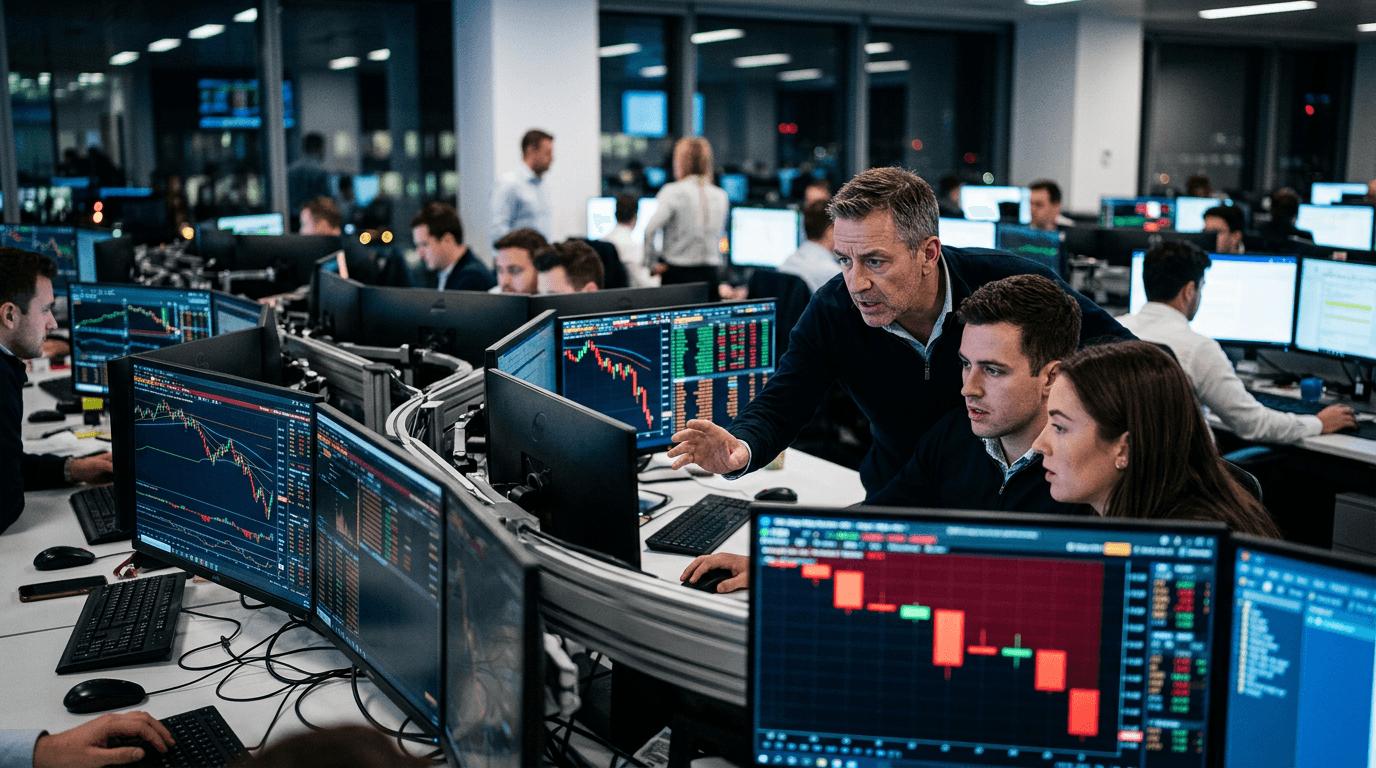
A wave of selling in global technology stocks is rippling through futures markets and stock-linked risk assets, turning what had been a narrow tech story into a broader test of risk appetite. Sharp declines in heavyweight chipmakers and AI leaders are pulling equity index futures lower and injecting a fresh dose of intraday volatility into an already nervous market backdrop.[1][2][4][7][11]
WHAT IS HAPPENING IN GLOBAL TECH?
Tech and chipmaker shares have swung from market darlings to primary sources of downside pressure, with recent sessions seeing outsized losses in AI-exposed names after an extended rally.[1][2][5][7][8][11] Nasdaq 100 futures have dropped several percent at times, while S&P 500 contracts have seen meaningful declines, signaling an adjustment in investors’ growth expectations.[1][2][4][7][11]
The weakness is not confined to U.S. names. Global technology stocks, including major semiconductor producers and data-center plays in Asia and Europe, have come under heavy selling pressure, translating into synchronized declines across regional indices and their related futures.[1][2][7][10][11] As leadership falters in such a concentrated sector, broad benchmarks tied to tech weightings become more vulnerable to sharp swings.[5][7][8][11]
Importantly, this drawdown is occurring after a period in which AI and chipmakers contributed disproportionately to index gains, leaving positioning crowded and valuations elevated in many marquee names.[1][5][7][8][11] When those leaders stumble, passive flows and derivatives-linked rebalancing can accelerate the move, amplifying the impact on index futures and ETFs linked to technology-heavy benchmarks.[2][5][7][14]
Why Ai Spending And Higher Rates Are Spooking Markets
At the heart of the selloff are concerns that the massive capital expenditures required to build AI data centers, specialized chips, and energy-hungry infrastructure may weigh on margins and free cash flow in the near term.[1][2][3][6][15] Analysts increasingly highlight that AI-related investment needs are large, persistent, and often debt-financed, which raises execution and balance-sheet risks if revenue growth disappoints.[3][6][15]
Higher interest rates and tighter financial conditions intensify this concern. Elevated borrowing costs increase the hurdle rate for long-dated AI projects and reduce the present value of expected profits for growth companies whose cash flows are far in the future.[3][11][12] As real yields stay firm, long-duration tech and AI plays are particularly sensitive to even small changes in rate expectations.[3][11]
Investors are also questioning whether the pace of AI-driven revenue growth can match the surge in market valuations and capital spending. While AI has clear potential to boost productivity and economic growth, the timing and distribution of those gains remain highly uncertain.[3][9][12][15] When expectations become overly optimistic, any hint of slower adoption, pricing pressure, or regulatory scrutiny can trigger abrupt re-pricing in equity and futures markets.[1][2][4][7]
Impact On Futures And Stock-linked Risk Assets
Equity index futures, which trade virtually around the clock, are acting as the primary channel through which this tech shock is being priced.[2][4][7][11][14] Overnight moves in Nasdaq 100 and S&P 500 futures now often set the tone for the cash session, with gap openings, wider ranges, and more frequent retests of key intraday levels.[2][4][7][14]
Because many structured products, options books, and volatility-linked strategies reference index levels, sharp moves in futures can trigger mechanical hedging flows. Dealers dynamically hedge their options exposure by buying or selling futures as markets move, which can amplify underlying trends when positioning is one-sided.[2][5][7][14] That feedback loop is especially powerful when tech giants dominate index weightings, as is currently the case.[5][7][11]
The ripple effects reach beyond pure equity indices. Stock-linked risk assets such as equity sector futures, high-beta ETFs, thematic AI funds, and even some credit and volatility products can experience outsized moves as investors de-risk.[2][5][7][8] When tech is viewed as the “risk-on” bellwether, weakness there can sap confidence across growth-sensitive assets and raise cross-asset correlations.[5][7][11]
Takeaway: In a tech-led selloff, futures markets become the central transmission mechanism for sentiment, and moves can extend well beyond the tech complex itself.
Practical Playbook For Traders In A Tech-led Selloff
For both live and simulated traders, the current environment demands a sharper focus on volatility regimes. Tech-driven futures swings can turn a previously calm session into a fast market, where slippage, gaps, and false breakouts are more common. Adjusting position size, leverage, and intraday profit targets to reflect higher realized volatility becomes critical.
Intraday, monitoring how futures trade relative to the cash index can provide valuable clues. Persistent discounts or premiums in Nasdaq or S&P 500 futures may signal forced hedging, margin-driven liquidations, or aggressive speculative positioning.[2][4][7][11][14] Observing order flow around the open, close, and key economic releases helps traders identify when liquidity is thin and when large participants are active.
Levels matter more when volatility spikes. Previous swing highs and lows, volume-weighted average prices, and areas where futures repeatedly traded during prior tech selloffs can become focal points for stop orders and algorithmic activity. Building a playbook of historical reaction zones for the main equity index futures allows traders to respond with a plan instead of reacting emotionally.
Risk management should be front and center. Testing strategies under stress scenarios—such as a sudden 3–5% intraday swing in Nasdaq futures or correlated moves across tech-heavy indices—can reveal where a trading approach is fragile. Using simulated environments to rehearse these scenarios is a low-cost way to understand how a strategy behaves in real-time turbulence.
Takeaway: Treat a tech-led selloff as a volatility drill—tighten execution, refine levels, and stress-test your approach before risking more capital.
What This Means For Simulated Traders And Skill Building
For SimFi participants, episodes like the current tech rout are a chance to practice handling real-world market stress without the emotional burden of large capital swings. The combination of headline risk, rapid futures repricing, and shifting correlations offers an ideal training ground for building discipline and process.
Simulated traders can focus on three core skills. First, developing a structured pre-session routine that incorporates overnight futures moves, key tech earnings or guidance, and rate headlines linked to AI financing costs.[1][2][3][4][7][11][15] Second, executing a clearly defined intraday plan that sets limits on loss, leverage, and number of trades. Third, performing honest post-trade reviews that distinguish between bad outcomes and bad decisions.
Because tech-led selloffs can reverse quickly or morph into broader risk-off phases, simulated environments are also useful for testing different time horizons—scalping around levels, holding swing positions in index futures, or hedging portfolios with options. Experiencing these dynamics repeatedly in simulation helps traders internalize how futures, cash markets, and stock-linked products interact during stress.[2][4][7][11][14]
Takeaway: Use simulated trading to turn a chaotic tape into a structured learning laboratory, so that when similar conditions return, your responses are deliberate rather than emotional.
Conclusion
The global tech selloff is more than a sector-specific setback; it is a real-time stress test of how markets are pricing AI, interest rates, and growth expectations. As tech and chipmakers stumble, equity index futures and stock-linked risk assets are absorbing the shock and translating it into heightened intraday volatility.[1][2][4][7][11]
For traders, this environment blends risk and opportunity. Those who respect volatility, understand how futures transmit shocks, and operate with clear rules are better positioned to navigate the swings. Simulated trading platforms provide an especially powerful arena to refine these skills, turning today’s tech turbulence into tomorrow’s trading edge.