
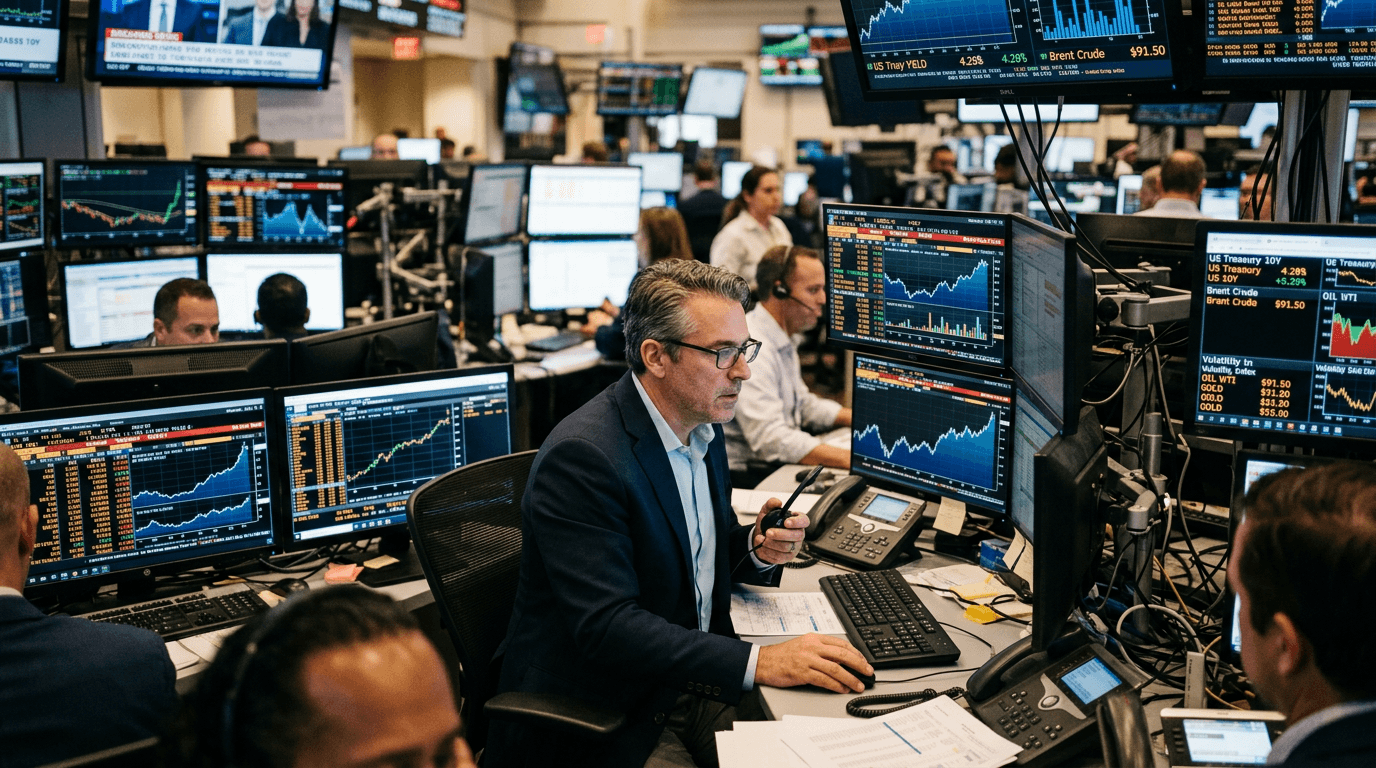
Escalating tensions between the United States and Iran have pushed global bond yields toward multi-week highs, reshaping the landscape for rates, currencies, and commodities all at once.[1][3] Investors are grappling with a complex mix of safe-haven demand, oil-driven inflation risks, and shifting central bank expectations—conditions that reward those who understand how these forces connect.[1][3][11] For traders in both real and simulated markets, this is a live case study in how geopolitics ripples across asset classes.
Global Yields At Multi-week Highs
In major bond markets, yields on benchmark government debt are holding near recent peaks as investors reprice risk rather than simply rushing into safety.[1][3] The 10-year U.S. Treasury yield has been trading around the mid-4% range, straddling levels last seen several weeks ago and, at moments, touching highs not seen since late spring.[1][11] Shorter-dated U.S. yields near 4.2% underscore that markets are adjusting both long-term inflation views and nearer-term policy expectations.[1]
The move is not limited to the United States. German 10-year Bund yields around 3.05%–3.06% are close to their highest readings in roughly a month, reversing a period of steady fixed-income gains in the eurozone.[1][2] In the UK, 10-year gilt yields have climbed above 4.10%, keeping borrowing costs elevated and adding pressure on rate-sensitive sectors.[3] Taken together, these levels signal that global bond markets are pricing in a world where geopolitical risk can keep inflation sticky, forcing central banks to stay cautious for longer.[4][7]
For traders, the key takeaway is that “higher for longer” is not just a central-bank soundbite—it is being actively reflected in the yield curve. Elevated yields translate into tighter financial conditions, higher discount rates for equities, and changing relative value trades across regions.
Geopolitics, Oil And Inflation Expectations
The immediate trigger for this latest leg higher in yields is the escalation in U.S.-Iran tensions, particularly around energy supply routes and the risk of disruption in the Strait of Hormuz.[2][3] These concerns have helped lift oil prices, in some cases by double digits in a matter of weeks, reviving fears of a renewed energy-driven inflation wave.[4][5] When crude jumps, markets quickly reassess the path of headline inflation and the potential knock-on effect on core prices.
Higher oil prices feed into inflation expectations in two ways. First, they directly raise input costs for transportation, manufacturing, and agriculture. Second, they can shift consumer and business inflation psychology, making it harder for price pressures to dissipate.[4][7] Bond investors, sensitive to both realized and expected inflation, demand higher yields to compensate for this risk, especially on longer maturities.[4][7]
This is why we see the seemingly paradoxical combination of safe-haven flows and rising yields. Some investors seek the security of sovereign bonds during geopolitical stress, but if that stress is inflationary—via oil—other investors demand greater compensation to hold those same bonds.[3][4] The result is elevated, sticky yield levels rather than the sharp yield declines typical of “flight to safety” episodes.
The practical lesson: geopolitical risk that impacts commodities is not just about short-term volatility; it can meaningfully alter the inflation regime priced into bonds.
Currencies And Commodities: How Flows Are Shifting
These moves in yields are spilling over into foreign exchange markets, where rate differentials remain a central driver of currency performance.[1][3] Higher U.S. and UK yields relative to peers tend to support their currencies, particularly against lower-yield jurisdictions, as carry trades become more attractive.[3][9] At the same time, the euro’s rate profile has firmed with Bund yields near multi-week highs, limiting downside for the single currency.[2]
Commodity-linked currencies—such as those tied to oil-exporting economies—can benefit from rising crude prices, but the picture is nuanced. If geopolitical risk is perceived as destabilizing or likely to prompt sanctions, investors may become more selective in their exposure, favoring more liquid G10 currencies over emerging markets despite similar commodity themes.[4]
In energy markets, oil’s rise on Middle East tensions illustrates how supply concerns can trump demand worries, at least in the short run.[4][5] Higher oil reinforces the inflation narrative and therefore supports elevated real and nominal yields. For traders, this environment tends to favor strategies that monitor correlations closely: when oil, yields, and FX move together, relative-value and cross-asset trades can become more compelling.
Key takeaway: rate moves are no longer siloed. They interact continuously with currencies and commodities, and understanding those linkages is crucial to building robust macro and cross-asset strategies.
What This Means For Traders And Investors
For discretionary and systematic traders alike, elevated yields and geopolitical tension translate into higher volatility in rate-sensitive assets. Bond futures, swaps, and rate options see increased activity as participants hedge exposure or express views on the direction of yields.[6][10] Equity markets often respond with sector rotation—pressure on growth and highly leveraged names, relative support for value, financials, and energy.[4][10]
Portfolio managers face a tricky trade-off. On the one hand, higher yields improve prospective returns for fixed income over the medium term. On the other, mark-to-market losses can be significant when yields reprice up sharply, especially on longer-duration holdings.[7][9] Risk management becomes paramount: position sizing, scenario analysis, and hedging with futures or options need to reflect the possibility of further geopolitical flare-ups.
For participants in simulated finance environments, such as SimFi platforms, this episode is an ideal laboratory. Users can test how different portfolios react to:
- A sustained rise in long-term yields
- Oil spikes driven by supply risk
- Shifts in FX as rate differentials widen
Running “what if” scenarios—such as an extended Hormuz disruption or surprise central-bank response—helps traders build intuition about cross-asset dynamics without real-world capital at risk.
How To Navigate Heightened Rate Volatility
Navigating an environment where global yields hover near multi-week highs starts with a clear view of the drivers: geopolitics, inflation expectations, and central bank reaction functions.[1][3][11] Traders should track not just headline yield levels but also curve shape. Steepening or flattening can reveal how markets balance near-term policy risk against long-term inflation concerns.
A few practical guidelines
- Focus on real yields and breakeven inflation: These metrics show whether moves are driven more by growth/inflation expectations or changes in term premiums.
- Monitor energy markets closely: Rapid changes in oil prices can be early warning signals of upcoming repricing in bonds.[4][5]
- Use scenario analysis: Stress test portfolios for both “risk-off” shocks (yields down, oil off) and “stagflation-lite” scenarios (yields up, oil up).
Finally, keep an eye on central-bank communication. If policymakers signal tolerance for temporarily higher inflation due to geopolitics, yields may remain elevated but more stable. If they hint at renewed tightening, rate volatility could rise further, magnifying moves across FX and commodities.
In short, U.S.-Iran tensions have turned global bond markets into a real-time classroom on how geopolitics, inflation, and rates interact. Traders who engage with that complexity—rather than simply reacting to headlines—will be better positioned to manage risk and uncover opportunity in both live and simulated markets.