
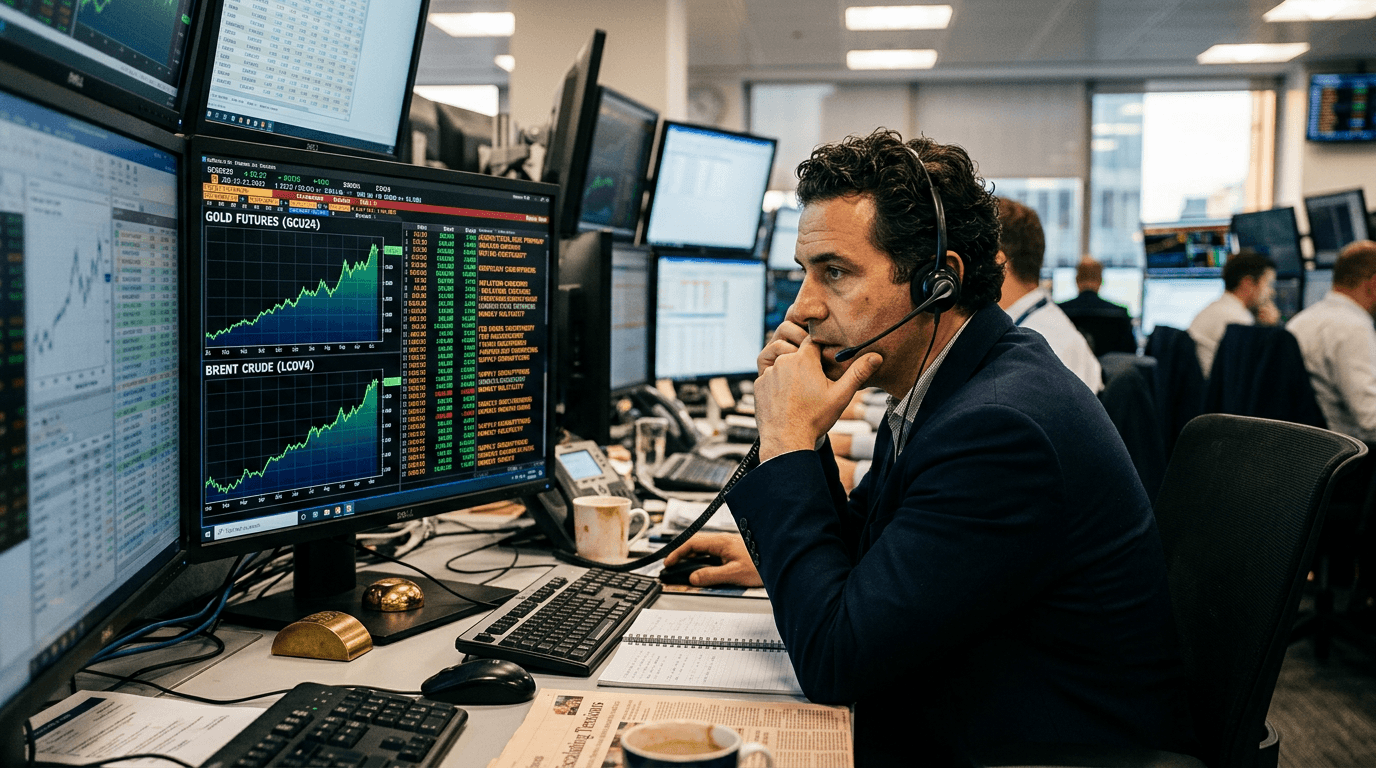
Gold and Brent crude holding firm at elevated levels tell a clear story: markets are still pricing in meaningful geopolitical risk and persistent inflation, even as investors debate the next moves from central banks.[13][15] For traders, these futures benchmarks act as real-time barometers of global stress, shaping expectations for currencies, rates and equity sectors long before official data catch up.[7][10]
Geopolitics Keep A Floor Under Gold And Oil
Recent conflict episodes in the Middle East, including disruptions around the Strait of Hormuz, have repeatedly jolted energy markets and reinforced the premium investors are willing to pay for secure oil supply.[2][11][15] Brent crude has held above key levels, with analysts highlighting that low inventories and ongoing geopolitical uncertainty are likely to keep prices supported through 2026.[15]
Under baseline projections, Brent is now forecast to average around the mid‑$80s per barrel in 2026, a sharp increase from the high‑$60s seen in 2025, reflecting the impact of war‑related supply concerns.[13] Strategists at major banks warn that if disruptions intensify, Brent could push into a $120–$130 range, with worst‑case scenarios stretching toward $150 a barrel.[7] Such paths would represent not just high prices, but sustained stress that cascades into inflation expectations and growth forecasts worldwide.[7][13]
For traders, the takeaway is that geopolitical headlines are no longer just noise; they are key drivers of term structure and volatility in both oil and gold futures. Elevated and sticky energy prices can keep implied inflation higher, making any ceasefire, new sanctions regime or shipping disruption a tradable event with cross‑asset implications.[10][12]
GOLD AS DEFENSE AGAINST UNCERTAINTY – BUT RATES MATTER
Gold has also been trading near historically high levels, with prices around $4,300–$4,700 per ounce in recent months and roughly 20–30% higher than a year ago.[4][8][14] This reflects strong demand for defensive assets as investors hedge against war risk, policy uncertainty and the possibility that inflation remains above central bank targets for longer.[5][9]
However, the same inflation pressures that support gold can also cap its upside when they force interest rates higher. As real bond yields and the U.S. dollar have strengthened, gold has experienced sharp corrections, including double‑digit percentage drops over short periods.[8][14] Studies of recent trading show gold moving in a tight negative correlation with both real yields and the dollar index, underscoring its sensitivity to monetary conditions.[14]
The result is a two‑sided dynamic: geopolitical shocks and inflation fears drive safe‑haven demand, while tighter policy and higher yields reduce the appeal of non‑yielding bullion.[3][5] For traders, this means gold should be viewed not only as a hedge against uncertainty, but also as a live expression of the market’s view on real rates and currency strength. Positioning needs to account for both forces rather than assuming gold will simply rise whenever risk sentiment deteriorates.[3][9][14]
Oil, Inflation Expectations And Central Bank Dilemmas
Oil remains a central transmission channel from geopolitics to inflation. Estimates of supply‑driven price shocks suggest that a sustained 10% rise in crude can add roughly 35 basis points to headline CPI over a few months before fading.[10] With Brent already elevated and at risk of further spikes, this mechanical pass‑through keeps inflation expectations on edge.[10][13][15]
Major institutions now model scenarios where U.S. headline inflation is pushed back toward 4% or higher if Brent trades in the $120–$150 range for any length of time.[7] In more severe cases, if high energy prices persist through the summer, headline CPI could move above 5%, keeping inflation above central bank targets well into next year.[7] That prospect reinforces “higher for longer” rate expectations and limits room for policy easing.
This backdrop creates a dilemma for monetary authorities and a rich environment for futures traders. Higher oil pushes inflation up, but aggressive rate hikes to counter that shock risk slowing growth and amplifying downside in cyclical assets.[7][13][15] Scenario analysis across gold, oil, breakeven inflation and rate futures can help traders map how different paths for Brent and CPI might translate into central bank decisions and cross‑asset performance.
RIPPLE EFFECTS ON FX AND RATE‑SENSITIVE SECTORS
The combination of firm gold and elevated Brent has visible spillovers across currencies and rate‑sensitive sectors. Rising energy prices tend to support commodity‑linked currencies and can weigh on import‑dependent economies, while the prospect of higher U.S. inflation often keeps the dollar strong.[9][10][15] That in turn pressures gold, which has shown a strong inverse relationship with the dollar index in recent months.[9][14]
In equity markets, elevated crude tends to hurt fuel‑intensive industries like airlines and some transportation firms, while supporting energy producers and parts of the commodity complex.[10][15] If inflation expectations re‑accelerate, rate‑sensitive sectors such as utilities, REITs and long‑duration growth stocks can come under renewed pressure as real yields grind higher.[7][14][15]
For traders, this environment favors a more holistic view of positioning. Watching how gold responds to moves in the dollar and real yields, and how oil re‑prices inflation breakevens and sector indices, can reveal whether markets are leaning toward stagflation, soft‑landing or renewed disinflation narratives.[10][13][15] Cross‑asset relative value trades – for example, pairing energy exposure with hedges in vulnerable sectors – become particularly important as correlations shift.
How Simulated Finance Traders Can Navigate These Themes
On a SimFi platform, traders can treat the current gold‑oil backdrop as a live laboratory for stress‑testing strategies before deploying capital in the real world. By building scenarios where Brent ranges from the baseline mid‑$80s toward the higher‑risk $120–$150 band, users can observe how inflation proxies, FX pairs and rate‑sensitive equities respond across different regimes.[7][10][13]
Similarly, running gold strategies that explicitly link positioning to assumptions about real yields and dollar strength can help refine hedging frameworks. For instance, traders might test whether combining long‑gold futures with short positions in rate‑sensitive sectors offers better downside protection than gold alone when policy tightening resumes. Simulated environments make it easier to capture the non‑linear behavior observed recently: gold may rally on geopolitical shocks yet still underperform when monetary headwinds intensify.
Practical takeaways include building playbooks for major geopolitical headlines, defining clear rules for adjusting positions when oil breaches certain thresholds, and tracking a simple dashboard of gold, Brent, real yields and FX to keep risk aligned with market narratives. Doing this in a simulated context allows for experimentation with leverage, time horizons and diversification without exposure to actual drawdowns.
Conclusion And Key Takeaways
Gold and Brent holding firm at elevated levels are not isolated facts; they are signals that markets continue to price in significant geopolitical risk and sticky inflation.[13][15] Futures curves in both commodities feed directly into expectations for CPI, interest rates, currency trends and sector rotation, making them critical reference points for any macro‑aware trading strategy.[7][10]
The key takeaway for traders is to treat gold and oil as interconnected parts of a broader macro mosaic rather than standalone assets. Combining geopolitical analysis with inflation modeling, central bank scenarios and cross‑asset correlations offers a more robust framework than simple directional calls on any one market.[7][10][14] In a SimFi environment, this approach can be refined and pressure‑tested, turning today’s elevated gold and Brent prices into an opportunity to build stronger, more resilient strategies for when conditions change.