
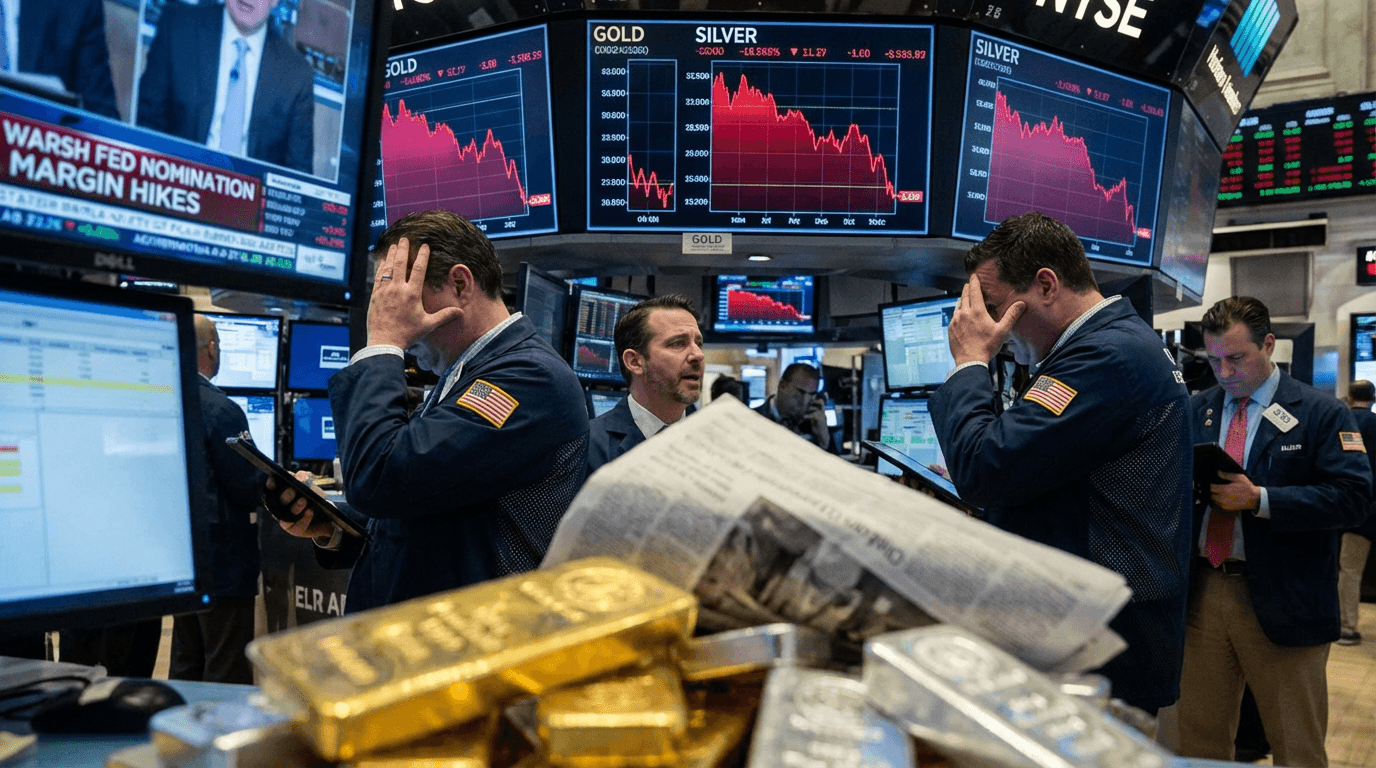
Gold and silver prices have extended their sharp sell-off into a second consecutive day of losses, marking one of the most dramatic reversals in precious metals trading in recent memory. What began as a stunning correction on Friday has morphed into a broader liquidation event, with both metals erasing weeks of gains in just 48 hours. This collapse has left investors scrambling to understand whether this represents a temporary shock or a fundamental shift in market dynamics heading into 2026.[1][2]
The sell-off has been nothing short of historic in its magnitude. Silver experienced a particularly brutal crash, plunging 33.5 percent or approximately Rs 1.35 lakh in just two days after hitting an all-time high above Rs 4 lakh earlier in the week.[1] Gold mirrored this weakness by sliding 18 percent or over Rs 31,000 during the same period, following its record peak of Rs 1.93 lakh last month.[1] In a single day on Friday, silver delivered its worst crash ever recorded on the MCX, plunging as much as 27 percent in just one session, dragging prices back below the Rs 3 lakh mark from their record highs.[1]
What Triggered The Collapse
Multiple factors converged to create a perfect storm for precious metals. The most immediate trigger came from Kevin Warsh's nomination as the next Federal Reserve Chair by President Donald Trump. Warsh, a former Fed governor who has publicly criticized prolonged accommodative policy and warned of inflation risks, immediately strengthened expectations for a less dovish Fed.[1][2] This nomination shifted market sentiment dramatically, with the U.S. dollar surging above the 97 mark as concerns over central bank independence eased.[1]
A stronger U.S. dollar creates immediate headwinds for gold and silver, which are globally priced in dollars. When the dollar strengthens, the metals become more expensive for foreign buyers, dampening demand precisely when it matters most.[1] This currency dynamic was compounded by rising interest rate expectations, which reduce the appeal of non-yielding assets like precious metals that offer no return on capital.
Beyond the Fed leadership story, CME margin requirement hikes triggered forced liquidation across the commodities complex. Higher margin requirements meant that traders holding long positions in precious metals futures faced immediate calls to deposit additional capital or risk having their positions automatically liquidated.[3] This created a vicious cycle where margin calls forced selling, which pushed prices lower, triggering additional margin calls and further forced selling.
The Scale Of The Bloodbath
The wealth destruction has been staggering. According to Mirae Asset ShareKhan data, gold's market capitalization alone fell by almost $3.5 trillion, while silver shed approximately $1.5 trillion, combining for a $5 trillion decline.[2] Despite this recent plunge, it is important to note that gold has still gained $3 trillion and silver $2 trillion since the start of 2026.[2]
Putting the longer-term context in perspective helps. Over the past two years, international gold prices have risen 150 percent, while silver has climbed 326 percent.[2] This means that even after the recent crash, both metals remain substantially elevated compared to historical levels. The brutal correction reflects profit-taking after an extended bull run rather than a complete invalidation of the structural case for precious metals.
Understanding The Technical Picture
Despite the sharp losses, technical analysts suggest that key support levels remain in place. Gold is now trading close to its 20-day exponential moving average, with key support placed at Rs 1,40,000 to Rs 1,45,000, reinforced by the firm dollar backdrop.[1] As long as prices hold above Rs 1,40,000, the medium-term bias remains constructive according to market technicians.[1] A sustained move above Rs 1,55,000 could revive momentum toward Rs 1,65,000 to Rs 1,80,000 or higher in coming months, supported by domestic tailwinds and structural demand.[1]
Silver witnessed an even steeper correction, sliding from peaks near Rs 4,20,048 per kilogram to around Rs 2,91,000 to Rs 2,91,925. Volatility remains elevated, though immediate structural support is visible near Rs 2,91,000, with stronger confluence at Rs 2,51,000 to Rs 2,52,000 around the 50-day exponential moving average.[1]
How Investors Should Navigate
Market experts diverge on the appropriate response. Kaynat Chainwala, AVP Commodity Research at Kotak Securities, cautions that selling pressure will likely intensify as traders approach the Union Budget carefully, wary of potential changes to import duties on precious metals.[1]
However, Akshat Garg, Head of Research and Product at Choice Wealth, offers perspective for long-term investors. He argues that today's sharp fall in gold and silver ETFs looks scary on the screen, but it represents more of a sentiment shock than a story-breaker.[1] Precious metals had run up sharply over the last year, and what we are seeing is a mix of profit-booking, global volatility, and reaction to macro cues. Crucially, he emphasizes that gold and silver are portfolio hedges, not trading bets.[1]
For investors, Garg recommends staying put if your allocation is sensible. Staggered buying during corrections works better than chasing rallies, and volatility hurts emotions more than long-term plans.[1] This approach acknowledges both the genuine short-term risks and the longer-term structural case for precious metals as portfolio diversifiers.
The coming weeks will prove critical for determining whether this collapse marks a temporary reset or a more lasting change in market structure. For now, investors should monitor the technical support levels closely while remembering that severe corrections are not uncommon in commodity markets, especially when margin dynamics and macro policy shifts align.